

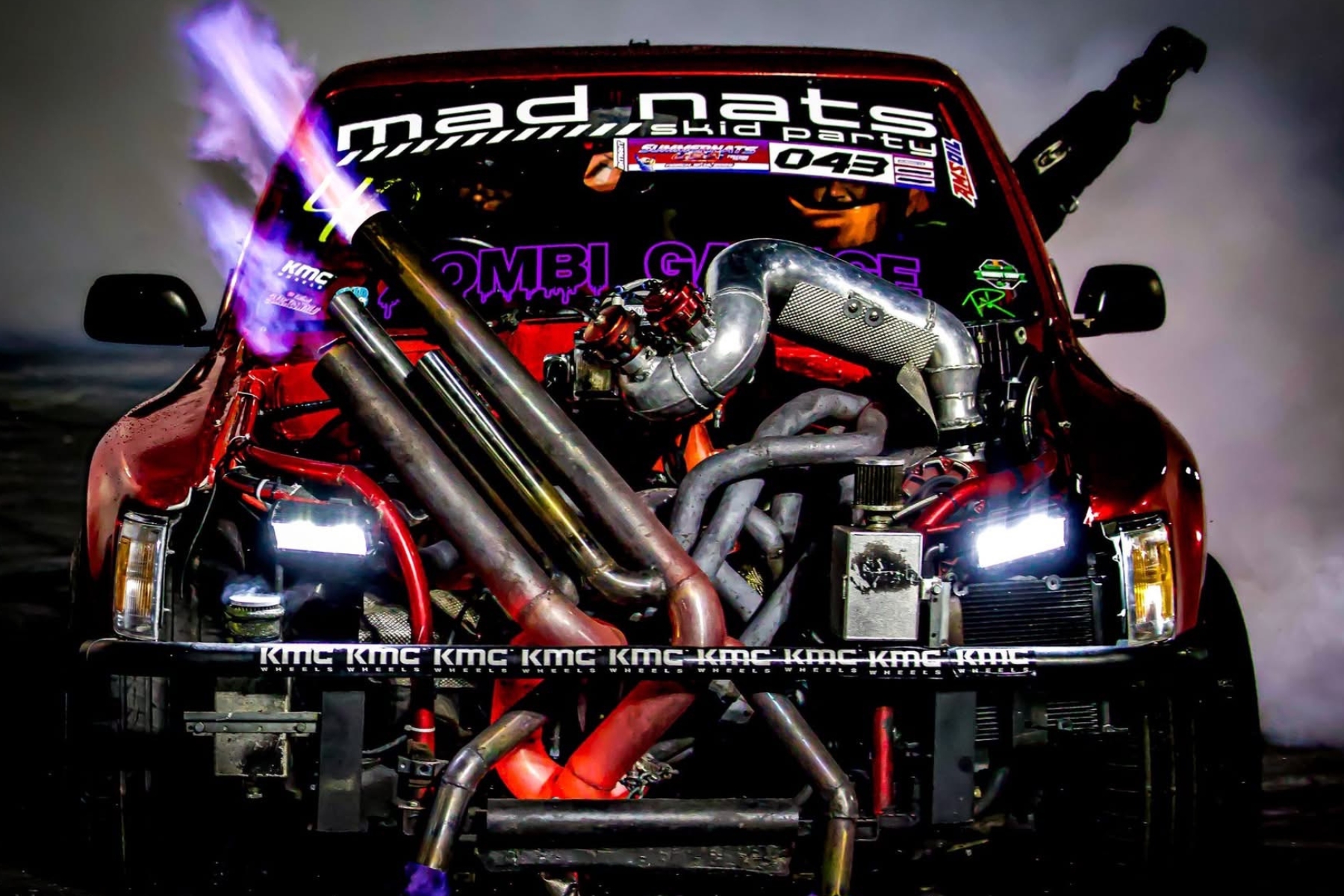
Choosing the right LS cams for drift versus burnout builds may seem straightforward, but the two applications have more differences than most builders expect. Jonathan Nerren is a sponsored driver on the Michigan Motorsports Drift Team and one of the people who shapes how those LS cams get developed and refined for competition use. Both disciplines see sustained high RPM, both live on the rev limiter, and both demand a valvetrain that will not quit under punishment. The differences are significant enough that running the wrong setup in either discipline will cost you. Michigan Motorsports has established itself as an industry authority on LS camshaft development, engineering specific profiles for both drift and burnout applications based on direct competition feedback from the drivers running them. We went straight to those drivers to find out what separates each build when the season kicks off.
The Shared Valvetrain Foundation
Both disciplines start from the same place on valvetrain integrity. Jonathan Nerren, a member of the Michigan Motorsports Drift Team, explains what goes into the kit. “Your standard cam package comes with hardened pushrods and springs paired to the cam,” Nerren says. “We take it a step further with a trunnion upgrade to the rockers as well as a shaft mount design. We have seen some wear on the valve stem tips over time on stock rockers, which supports running a roller tip aftermarket piece. A quality lifter is also a critical piece of the puzzle. We’ll run Johnson Lifters, with preference to the short travel link bar in the higher-end builds, or Cadillac race lifters in our standard drift build. We tie everything together with ARP head studs with mains, rods, and damper bolts at a minimum.”
The rev limiter abuse both disciplines dish out means none of this is optional equipment. Valvetrain stability is the starting point for any build meant to survive competition. Skipping any part of it is how engines end up on the teardown table before the season is over.
Oiling Strategy: Drift Cars Demand More
Nerren explains that priority oiling to the mains is always preferred when possible, such as in an aftermarket block. Michigan Motorsports-supported drift driver Nerren runs a Dailey Engineering dry sump system on his stock block application. The sustained g-forces and side-to-side movement in a drift car create conditions that a standard wet sump struggles to manage. Bearings stay happier for longer with a dry sump keeping oil where it needs to be. For non-competition drift cars, a stock-style pump with higher volume output and trap doors in the oil pan around the pickup provides solid protection without the cost of a full dry sump conversion.
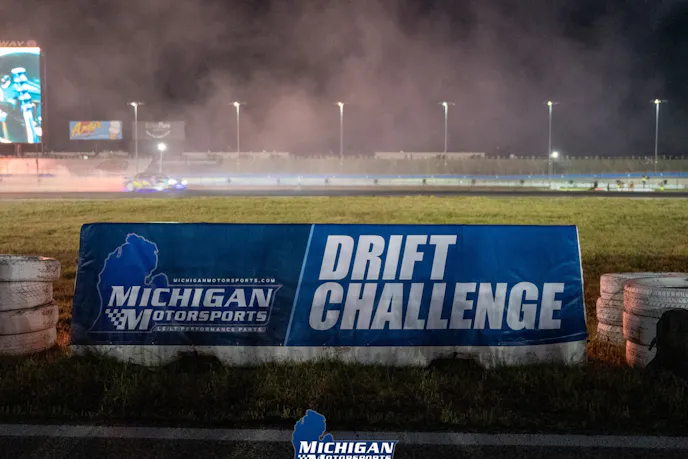
Nerren does not consider the same level of oil control necessary in a burnout build. The prolonged lateral loads a drift car experiences are not part of a burnout car’s environment in the same way. Trap doors and added volume are still never a bad idea in any build. Larger oil volume helps with temperature management and reduces the likelihood of starving the engine during a long run.
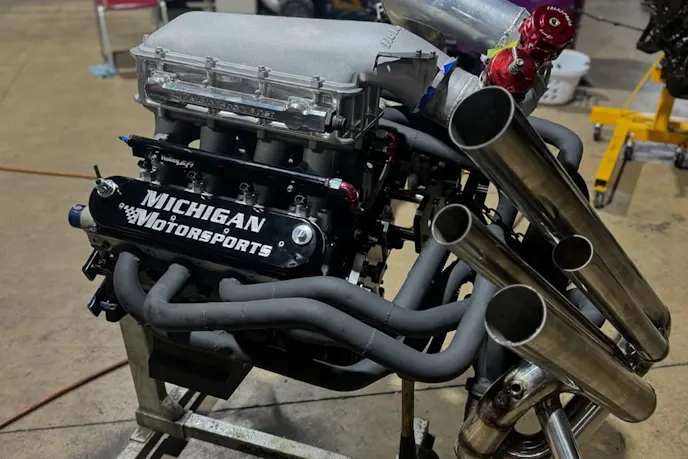
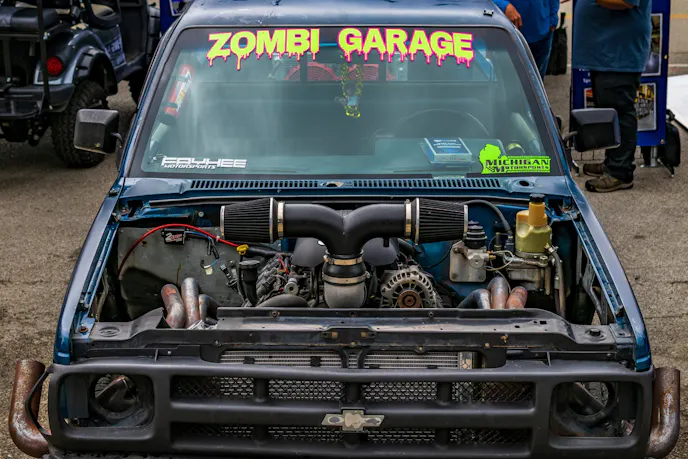
Jack Harrison of Zombi Garage competes on the Michigan Motorsports burnout team and approaches oiling with burnout-specific priorities. He considers high oil pressure essential and cites the Melling 10296 with the high-pressure spring as his go-to choice. A large capacity sump, a big oil cooler, and an extra capacity cooling system round out his setup. Running E85 also helps with temperature management, as it runs cooler than pump gas and gives the engine a better chance of surviving what burnout competition puts it through.
LS Drift Cams And Power Band
Power band is where LS cams for drift versus burnout diverge most clearly, and the specs bear that out. Michigan Motorsports engineers distinct cam profiles for each discipline, and comparing the two lineups shows exactly why one cam cannot do both jobs well. That’s why the company developed a Stage 2-5 cam specifically for the drift competition.
Their Stage 2 cam is exactly what you’d imagine: an aggressive-sounding unit that’s ideal for daily-driven street vehicles. Stepping up to Stage 3 delivers more lope and power, which is perfect for weekend warriors. Stage 4 provides maximum sound and performance while retaining stock short block compatibility. Finally, Stage 5 features an ultra-aggressive grind that’s designed for aftermarket pistons with valve reliefs, providing extra clearance needed.
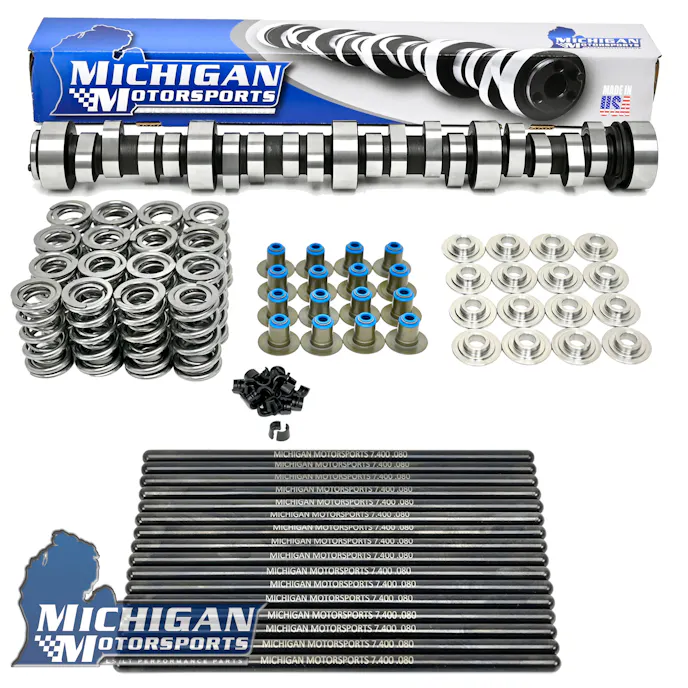
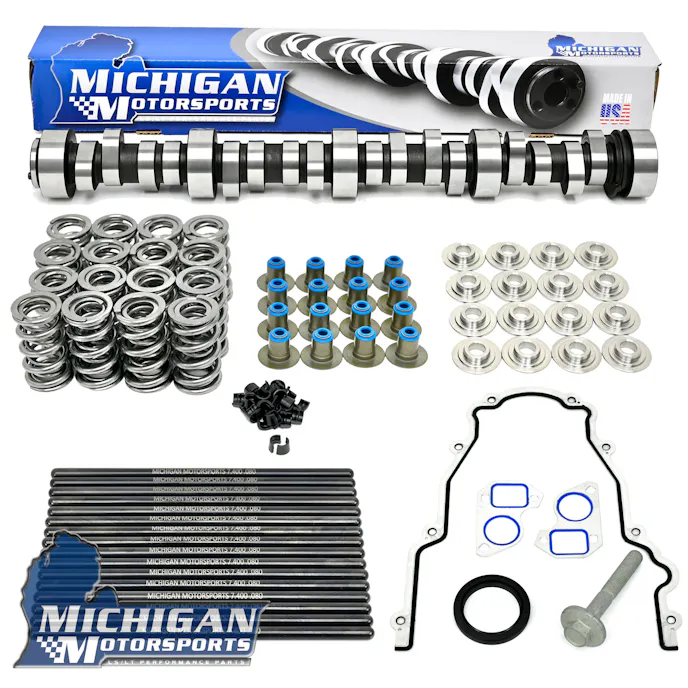
The drift cams also carry more duration and run tighter LSA values as the stages climb. The Stage 2 cathedral port drift cam runs a 225/229 duration with a .629″/.600″ lift on a 111 LSA. By the Stage 5 cathedral port, that grows to 243/250 duration with .629″/.615″ lift on a 109 LSA, with 28 degrees of overlap even in engines more than 400 cubic inches. The rectangle port drift cams follow a similar path, with the Stage 5 LS3 rectangle port reaching a 244/256 duration and 32 degrees of overlap. That tighter LSA and longer duration support the broad, responsive power curve a drift car needs to pull hard across the RPM range and respond instantly when the driver gets back on the throttle.
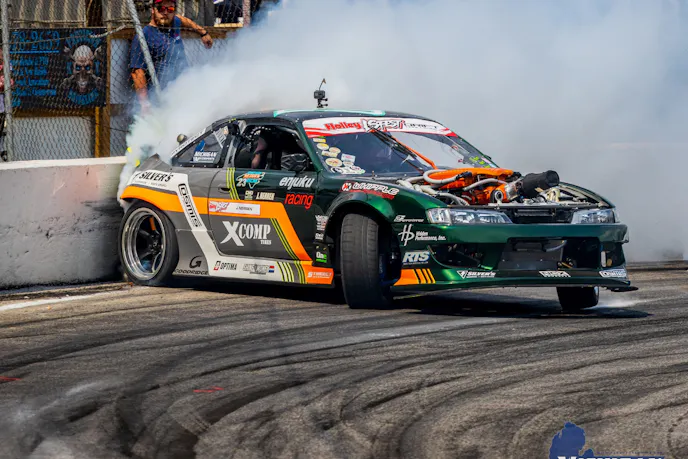
Nerren explains that a broader power curve is essential in a drift car. The driver needs the ability to light the tires at any given moment with throttle input alone. Drift involves deceleration, lifting the throttle while chasing an opponent, and transitioning to slower arcs that require quick speed changes. That larger curve under the peak keeps the car predictable through all of those transitions.
Burnout Cams
The burnout cams tell a different story. Across all four stages, every burnout cam in the Michigan Motorsports lineup runs a consistent .600″/.600″ lift. That moderate lift is deliberate. It reduces valvetrain stress during extended high-RPM and rev limiter action, which is exactly what a burnout build sees lap after lap. The Stage 1 burnout cam runs 216/224 duration on a 111 LSA. The Stage 4 burnout cam stretches to 234/248 duration on a 112 LSA with 17 degrees of overlap. Duration climbs with each stage, but the LSA stays wider and lift stays controlled, keeping the powerband focused in the upper RPM range without overloading the valvetrain. Harrison, whose Stage 3 burnout cam runs 230/245 duration on a 112 LSA, specifically recommends low lift cams for burnout use. Low lift keeps piston-to-valve clearance manageable as the engine heats up and components expand during a long stationary run, and it keeps the engine from hammering the limiter unnecessarily.
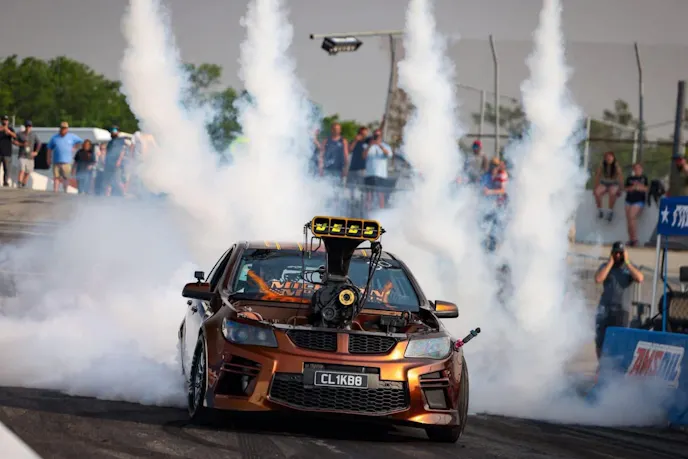
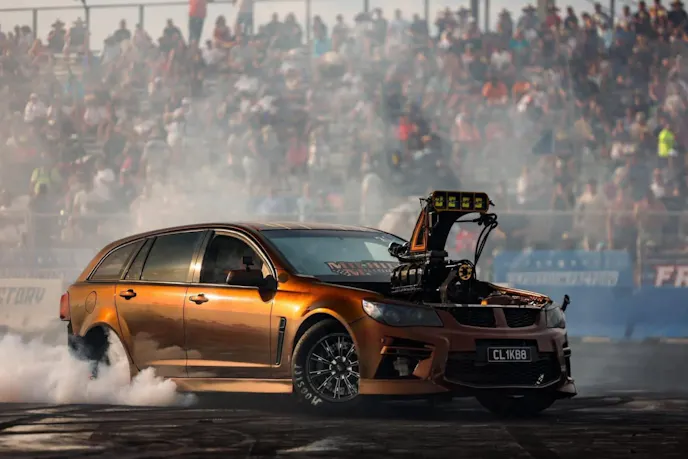
A burnout build almost strictly stays at high RPM from start to finish. Peak power is the priority. The drift cam is built to deliver power across a wider range. The burnout cam is built to survive delivering that power repeatedly without killing the valvetrain.
Culture And Character In The Burnout World
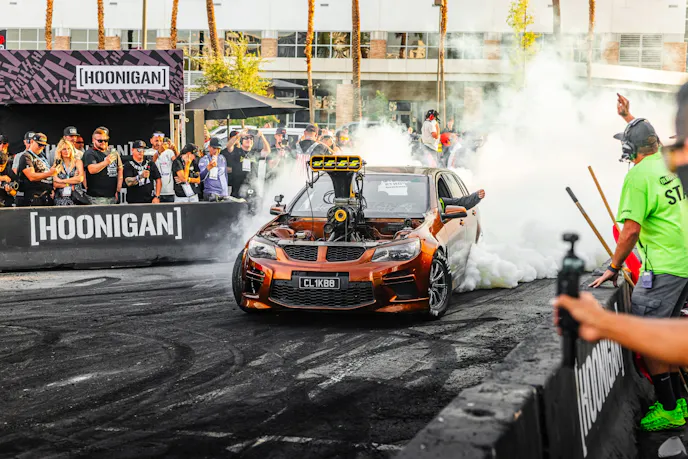
The builds differ in philosophy, too, and the burnout world carries a culture that directly shapes how cars are put together. Mick Hinchy of Zombi Garage makes it clear that burnout competition is as much about spectacle as performance. Noise, wheel speed, and torque are the priorities. Cars run four-links and Ford 9-inch rears, big wheels, and all paint with no vinyl or livery anywhere on the body. No stickers on the body panels either, only on the glass. Hinchy favors roots blowers because height and visual presence are part of the package. As the saying goes in Australia, if you want to make a name for yourself, you need a big blower combo. Smoke consistency and thickness are a major part of the score sheet. That is why Powerglides and Turbo 400 transmissions are the standard choice. Competitors have tried to run manuals, but they have not been able to hang in that environment.

How Burnout Cars Are Evolving
Seth Ritter, also from Zombi Garage, describes how the burnout side of things is changing as builders push further. Cooling, oil flow, and heat tolerance are always the priorities, sometimes at the expense of some precision. Large external water tanks, block-style intercoolers, and water/methanol injection setups are all tools competitors use to manage temperature through extended runs. Ritter also notes that some newer burnout cars are now essentially drift-capable. Cars like Jack Harrison’s Lux have the suspension geometry, steering angle, and overall setup of a drift vehicle, but are built to handle far more abuse and tire destruction than a dedicated drift car would ever see.
Throttle Response And The Drift-Specific Mindset
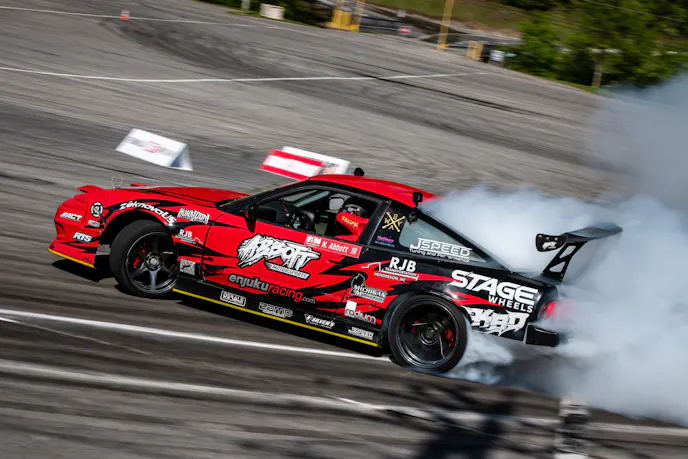
Nicholas Abbott is a Michigan Motorsports drift team member running the Michigan Motorsports drift camshaft. He identifies throttle response as the number one priority for a drift-specific build. Quick adjustments and handbrake entries demand an engine that will not bog when the driver gets back on the throttle after a lift. A super-responsive engine makes those transitions clean and predictable, which directly determines how the car behaves through a competitive run.
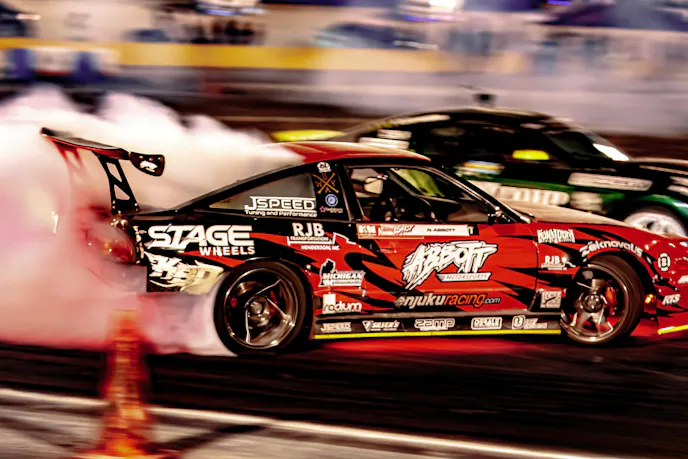
That focus on responsiveness is the defining characteristic that separates a purpose-built drift motor from a burnout motor. A burnout engine is optimized to sustain punishment while sitting stationary or moving slowly. A drift engine has to react instantly to driver inputs, lap after lap. Selecting the right LS cams for each application is not guesswork. Michigan Motorsports has built specific cam profiles for both disciplines, informed by the drivers running them in competition. The right camshaft, paired with the correct oiling strategy and valvetrain package, is what keeps these builds alive when it counts most.
You might also like
L8S V8 Could Replace The Silverado HD's L8T For 2027
Chevrolet's next heavy-duty gas engine is on the way. The L8S V8 could bring more power and torque to the ’27 Silverado HD.