

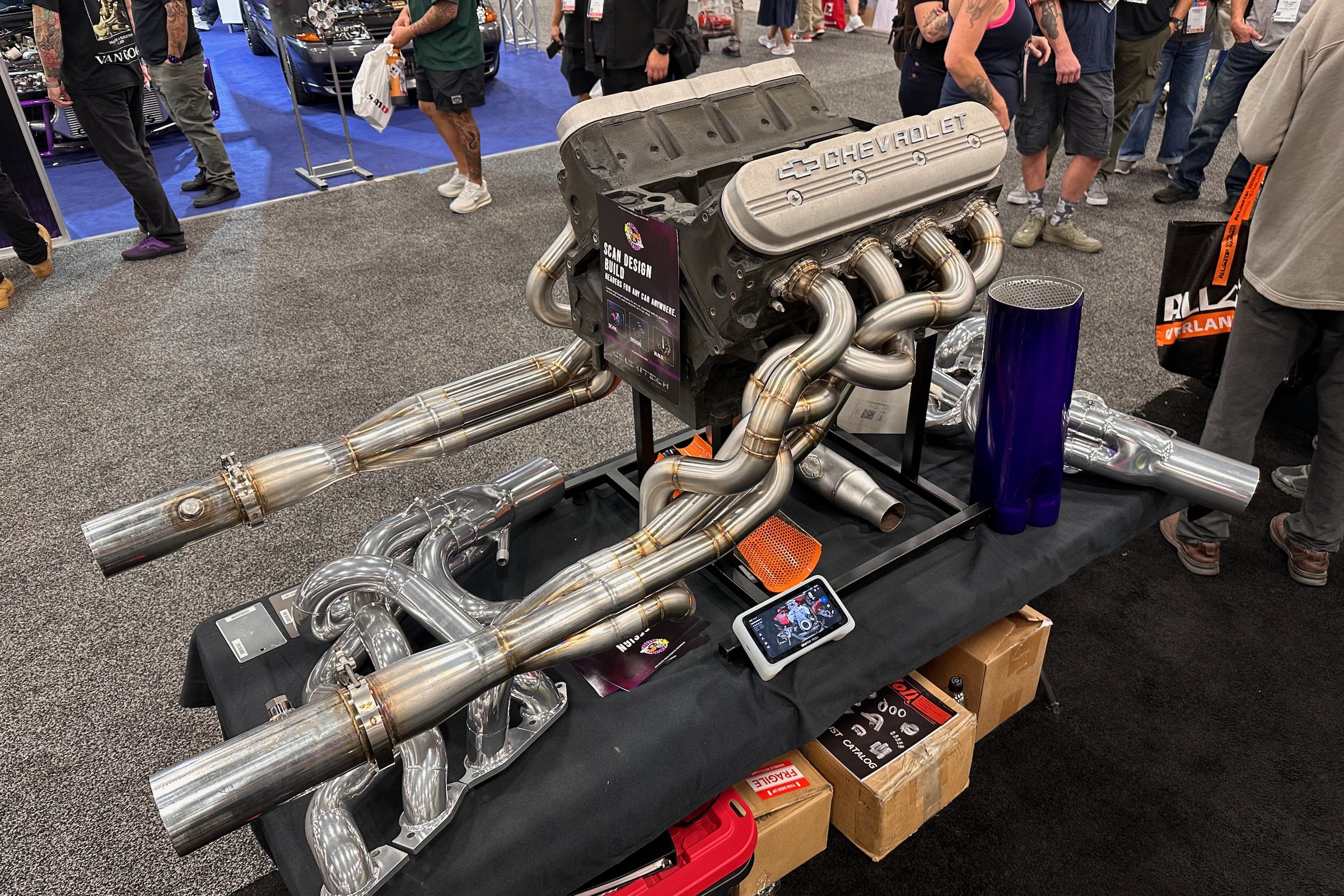
Some of the most exciting news to come out of SEMA 2026 was an announcement by the exhaust virtuosos at Lemons Headers. If you know Lemons, you know the company does a fantastic job at creating custom tubes for big-block Chevys. But in reality, Lemons is so much more, with applications spanning big-blocks, small-blocks, LS engines, and now, pretty much any build you can imagine.
That’s right, with their new Scan•Design•Build process, Lemons will 3D scan the engine bay of your project, design and build a set of headers that is unique to your application, and ship them to you ready to bolt up. And, what, nooo waaay! It just so happens that one of the pilot programs for Lemons’ new Scan•Design•Build process is none other than Frank, the burnout truck built by Shaun Umschied.
Scan It, Design It, Build It
According to Chuck MacDougall, Lemons Headers General Manager, the company began developing its Scan•Design•Build technology earlier this year. The idea is relatively straightforward: scan the vehicle’s engine bay, identify the available space, and use that information to engineer a set of headers that fits the application. In our opinion, it’s pretty much the ultimate in universal and custom header construction. But, of course, there’s a little more to it than simply pointing a scanner at an engine.

The process begins with a detailed 3D scan of your vehicle’s full engine bay. Rather than focusing exclusively on the engine itself, the team pays particular attention to the negative space around it, which allows them to capture critical obstacles such as the steering column, frame rails, firewall, and other components that could interfere with the exhaust. This also allows the team to visualize potential routing paths under and behind the engine.
Once the scanning process is complete, the information is sent to an engineer who develops a header design specifically for your ride. That design can then be reviewed and adjusted before the headers are even manufactured. In other words, instead of being stuck with an off-the-shelf solution or modifying a common header layout for your project, Lemons Scan•Design•Build gives you the ability to create bespoke headers from the very beginning.
Frank Gets The Custom Treatment
One of the pilot applications for Lemons’ Scan•Design•Build process is Frank, the burnout truck belonging to Shaun Umschied, better known as the No Way Guy. We caught up with Shaun at the Lemons Headers booth, where he and Chuck were showing off the custom headers developed for his truck.

According to Shaun, one of the biggest challenges of building Frank was finding an off-the-shelf header that worked with the truck’s unique configuration. While commercially available headers provided a starting point, their dimensions and routing made building the rest of the exhaust system more difficult than it needed to be, and that’s where Lemons stepped in.
Chuck visited Shaun’s home and performed a detailed scan of Frank’s engine compartment. With that information, the team developed a custom header design intended to clear the truck’s crossmember, transmission, and frame. But even with all that technology, the process still required some creativity.

When Shaun reviewed the initial design, the headers extended farther outward than he wanted. Rather than settle for the original layout, the team revised the design, bringing the tubes inward and incorporating an elaborate corkscrew-style arrangement to make everything fit. That’s where this technology really starts to shine. Instead of cutting, welding, and hoping everything clears, Lemons can work through potential fitment issues before a single piece of tubing hits the fabrication table.

Frank’s finished headers are certainly impressive to look at, but the real advantage is that they were designed around the truck’s existing components rather than forcing Shaun to modify the vehicle around the exhaust. And with 408 cubic inches of rowdy LS cranking out around 700 horsepower, having a properly fitted exhaust system is particularly important.
Anything, Anywhere
While Frank is a pretty wild example of what Lemons can accomplish with this technology, the possibilities could go well beyond a 700-horsepower burnout truck. The company has built much of its reputation around big-block Chevrolet engines, and Chuck acknowledged the group hasn’t traditionally produced many LS headers. However, the Scan•Design•Build process could change that.

Since the process starts with a 3D scan of the actual vehicle, Lemons isn’t necessarily tied to a particular chassis or engine combination. That opens the door to custom headers for applications that might otherwise require extensive fabrication. Chuck even suggested that Scan•Design•Build could allow the company to create headers for vehicles virtually anywhere in the world. That’s a pretty interesting proposition, especially for enthusiasts working with unusual LS swaps, heavily modified engine bays, or one-off fabrication projects.

Anyone who’s ever tried stuffing a set of headers into an engine bay that wasn’t designed for them knows just how frustrating the process can be. If Lemons can eliminate some of that headache, we’re all for it. Frank is proof that the concept has some serious potential, and we’re looking forward to seeing what other applications the company tackles next. After all, anything that makes it easier to cram an LS into something it was never intended to power is something we can certainly get behind!

You might also like
Kindig-It's 780hp '68 Pontiac Bonneville Redefines The Mild Kustom
Kindig-It's 1968 Pontiac Bonneville blends mild custom styling, stunning metalwork, and 780 horsepower of supercharged LT4 power at SEMA 2026.