

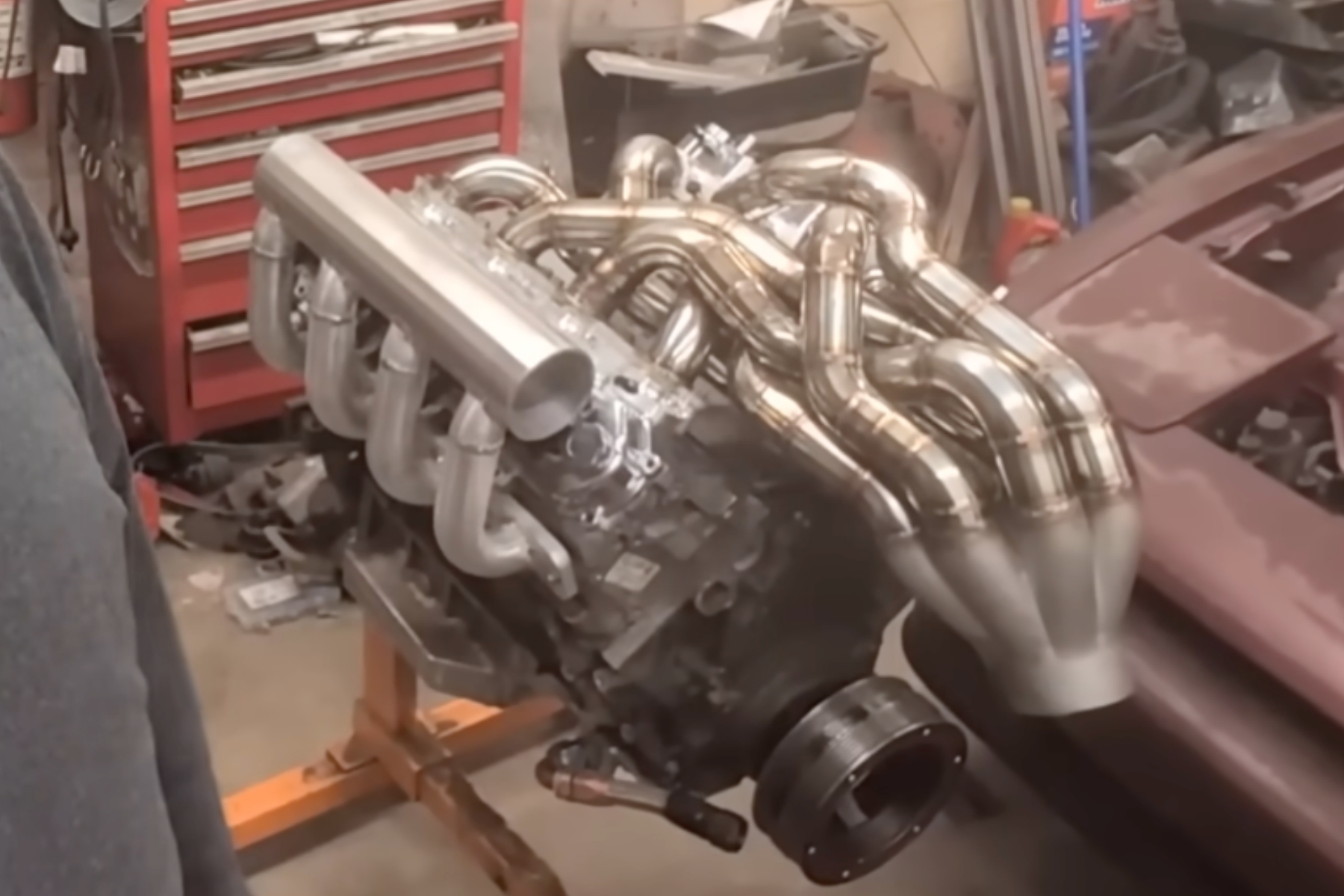
The Nivlac57 YouTube channel is chasing the perfect eight-into-one exhaust note, and their backwards LS hot V build might be the wildest approach to that goal we have ever seen on the platform. Everyone has seen a cammed LS, a boosted LS, an LS swap, and even LS-powered builds with V10, V12, and V16 configurations. Wild things have been tried on the old small-block 350 for decades, but a true hot V on an LS using GM production parts is a new one entirely.
On a conventional LS, the intake manifold sits in the center, and exhaust exits out the sides through headers or exhaust manifolds. A hot V flips that entirely. Exhaust exits from the center of the engine, and the intake ports move to the outside.
Why Build A Backwards LS Hot V?
The design shows up on turbocharged diesel and gasoline engines because it keeps heat energy centralized to spool a turbo more efficiently. Mercedes, BMW, and even Cadillac have used hot V configurations in production engines. The only naturally aspirated gasoline hot V the builder is aware of is the engine in the Porsche 918 Spider, which used the layout to route exhaust heat away from the hybrid battery pack.
For this build, the goal is turbocharging, but the bigger motivation is packaging an eight-into-one collector correctly. On a conventional LS with an eight-into-one header, getting primary pipes to the correct length is nearly impossible. The builder says he needs primaries in the range of 25 to 30 inches for his target RPM range, and a conventional layout will not get there. Achieving a sequentially timed pulse arrangement into the collector is also far easier when all the exhaust ports are clustered together in the center of the engine.
How Gen 5 LT Heads Make It Happen
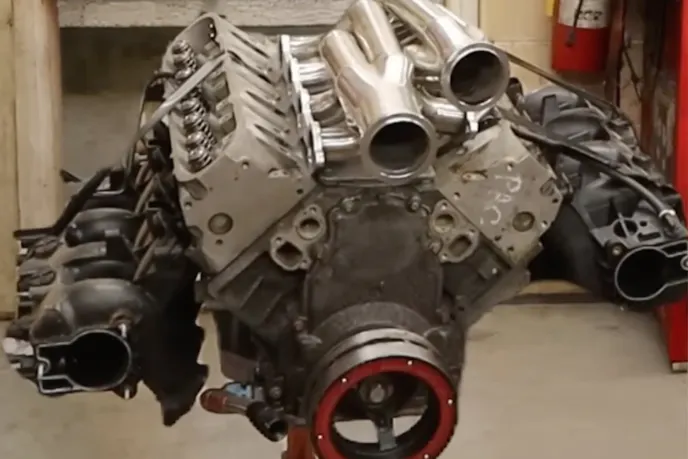
The execution relies on a key difference between Gen 4 LS cylinder heads and Gen 5 LT cylinder heads. When GM developed the LT architecture, they needed to make room for the mechanical fuel pump that drives the direct injection system. To do that, they switched the valve order in the head. An LS head starts with an exhaust valve, then intake, then exhaust, then intake down the cylinder. The LT head reverses that pattern, starting with an intake valve followed by exhaust.
The coolant passages and head bolt locations remain largely the same between the two generations. The builder places an LT cylinder head on an LS block and retains the original LS camshaft. Because the valve order reverses, what was the intake port becomes the exhaust port, and what was the exhaust port becomes the intake. The engine still rotates clockwise and uses the same camshaft, and the LT head does the work of redirecting the airflow entirely.
The Honest Challenges
The builder is not pretending this is a clean engineering solution. The intake valve in a conventional head is larger than the exhaust valve for good reason. This configuration puts the smaller valve on intake duty and the larger valve on exhaust duty. The plan is to compensate with boost.
There is also a materials issue. Exhaust valves are typically made from Inconel because they must survive high exhaust gas temperatures. Intake valves are generally titanium or stainless steel. Running intake-spec valves on the exhaust side, with a turbo adding heat, is a real concern. The cylinder head cooling also centers around the conventional exhaust ports, so the cooling priorities no longer match the thermal demands once the layout reverses.
The build plan for the first phase is to run it as-is and see what happens. If cooling becomes a problem, space remains in the LT head where the direct injection hardware was removed, and the builder could potentially reroute coolant flow through that area. He has also mentioned the possibility of physically swapping the valve positions in the head, something that has been done on small-block Chevys before, and is reaching out to cylinder head shops willing to take on the challenge.
We have watched wild experiments on small-blocks for years, but never quite like this on an LS. We will be following Nivlac57 closely to see if the exhaust note makes it all worth it.
You might also like
Cadillac Celebrates 125 Years With A $239,000 Escalade-V Collector Series
Cadillac unveils the 2027 Escalade-V 125th Anniversary Collector Series, a $239,000 supercharged V8 SUV limited to just 252 examples.