

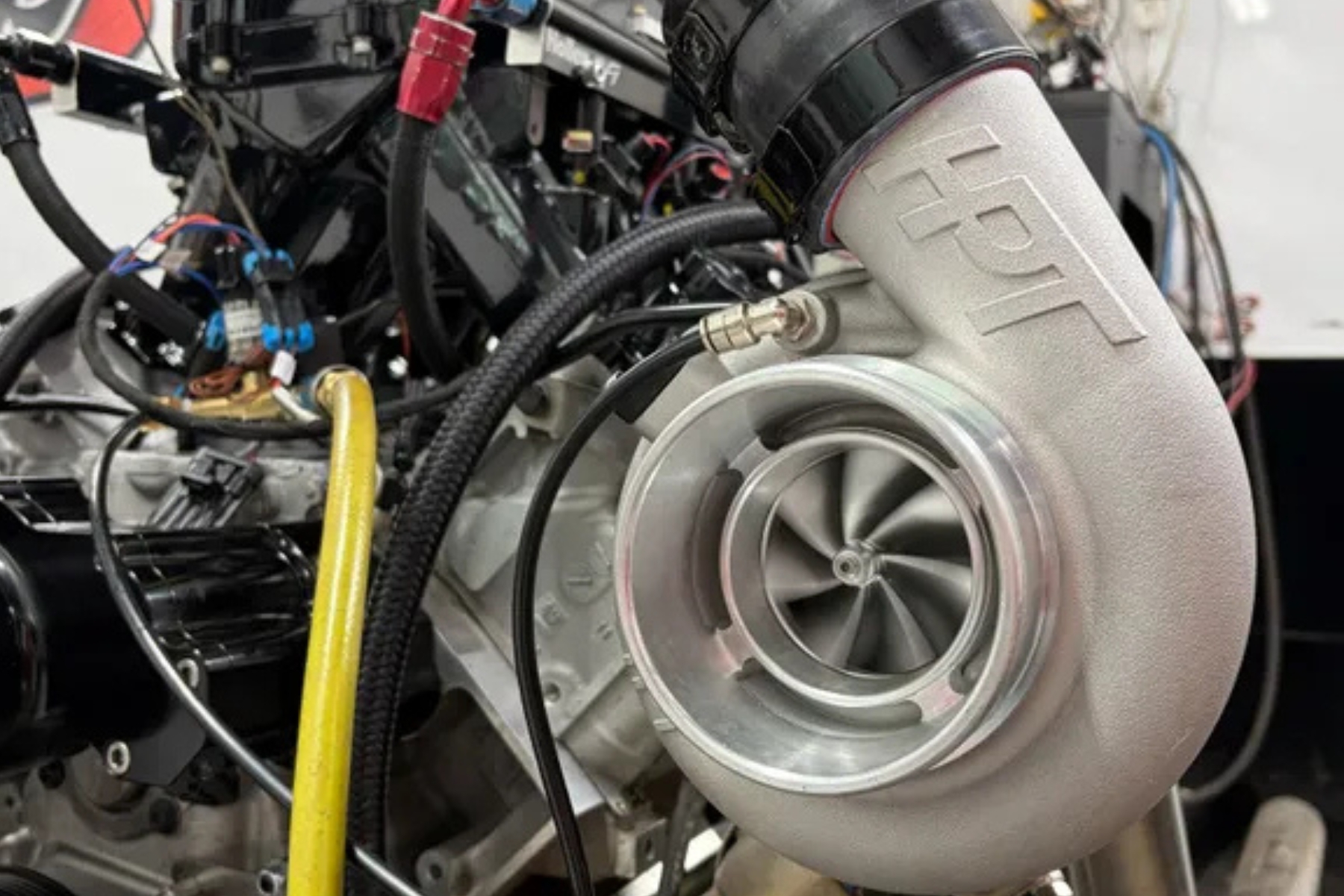
Scoggin Dickey Parts Center built its reputation by pushing the Gen V small-block platform hard. A few years ago, the Texas-based shop made more than 2,000 horsepower with a twin-turbocharged L8T. That program positioned SDPC as a serious player in LT development. This time, however, the team chose a different direction. Instead of adding displacement, they cut two cylinders and focused on the 4.3-liter LV3 V6.
They nicknamed the project Danny LVito, a nod to the shared DNA between the LV and LT engine families. The LV-series engines use the same 4.400-inch bore spacing and core architecture as the V8 LT engines. In other words, the smaller V6 shares the same structural blueprint as its larger sibling. That similarity led Kurt Urban, SDPC’s engine development lead, to ask a simple question. If the same piston and rod strategy survives in 2,000-plus-horsepower V8 builds, could it survive in a high-boost V6?
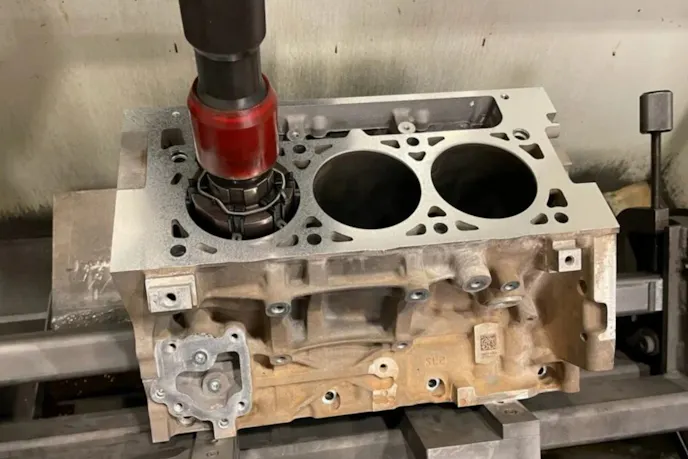
To find out, the team pulled an LV3 from a junkyard and put it on a stand. The block still shows stains from its previous life, and even the hot tank could not remove all of them. Rather than chase a perfect core, SDPC wanted a realistic starting point. Urban set a goal of 1,200 horsepower. He based that number on customer feedback, since several builders already push similar combinations near 1,000 rear-wheel horsepower.
Short On Displacement, Not Weakness
First, the team cleaned and inspected the factory aluminum block. Then Urban added a slight overbore, increasing the cylinder size to 3.925 inches. Combined with the stock 3.62-inch stroke, displacement now measures 263 cubic inches. Next, he installed Wiseco forged pistons with a fuel bowl design and GFX rings. SDPC uses this same piston strategy in many boosted LT builds, only scaled for a smaller bore.
Molnar 6.125-inch connecting rods link the pistons to the stock steel crankshaft. Urban liked the crank’s steel construction, although he questioned the split-pin design at first. However, repeated dyno pulls erased that concern. The crank handled four-digit power without complaint.
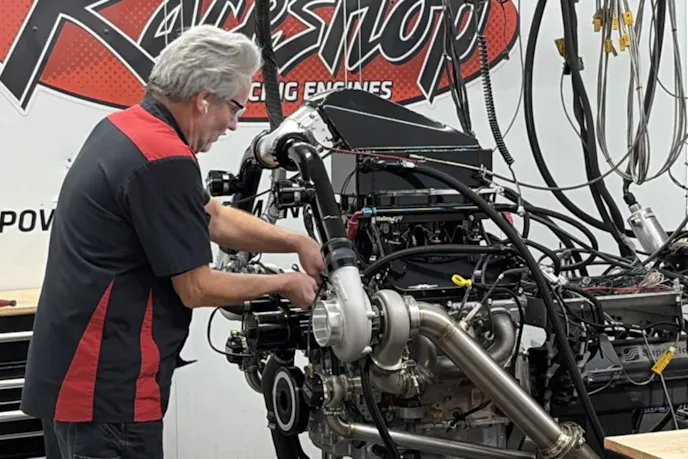
Meanwhile, the valve train received targeted upgrades. SDPC worked with Cam Motion to regrind a camshaft for improved RPM capability. The cam covers 212 degrees of intake duration and 218 degrees of exhaust duration. Valve lift measures 0.564 inch on the intake and 0.558 inch on the exhaust, all on a 113-degree lobe separation angle. An LS3 timing gear pairs with a C5.R chain and an LME tensioner to synchronize the cam and crank. In addition, Johnson 2110R lifters occupy the lifter bores.
Urban retained the factory LV3 cylinder heads. He refreshed them with brand-new stock valves and a multi-angle valve job. He also added PSI beehive springs and a CHE trunnion upgrade. Then he removed the direct-injection system, installed the provisions, and converted the engine to port injection. That change simplified the fuel system for a big boost.
Twin Turbos And Smart Fabrication
Next, Urban modified a Holley High-Ram intake manifold to fit the six-cylinder layout. He removed two runners and reshaped the plenum to better match the 4.3-liter’s airflow demands. A Bell air-to-water intercooler now sits between the intake plenum and a custom sheet metal lid. Early dyno pulls split the original lid under boost, so the team reinforced the design. For fuel, FID 1,300 cc injectors deliver VP Racing Fuels MS109 unleaded race fuel.
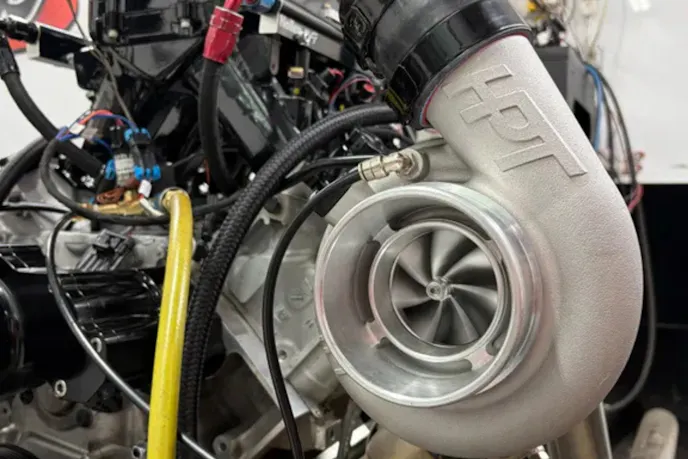
For forced induction, SDPC selected a pair of HP Turbos 6262 dual ball-bearing turbochargers with mirror-image housings. Each turbo carries an 800-horsepower rating, so together they offer airflow for roughly 1,600 horsepower in the right setup. On the hot side, Urban started with factory L8T exhaust manifolds. He sectioned them to match the three-port layout of the 4.3-liter LV3 heads. Then he routed exhaust through custom stainless-steel tubing into each turbine. Go Fast Bits EX38 wastegates control boost, while large dump tubes evacuate spent gases.
On the cold side, charge air flows through a Motion Raceworks billet Y-merge and a matching 102 mm throttle body. In addition, Go Fast Bits SV52 blowoff valves release excess pressure when the throttle closes. As a result, the compressors stay protected during deceleration.
Turn Up The Boost
With the hardware complete, Urban approached the dyno session methodically. First, he ran the engine on wastegate spring pressure alone. At just 8 psi, the LV3 produced 664 horsepower and 584 lb-ft of torque. Those numbers confirmed that the foundation remained stable.
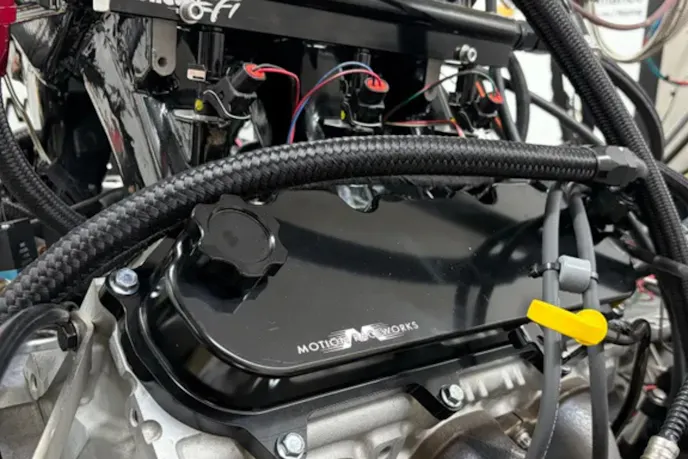
Next, Urban added dome pressure through the Holley Dominator EFI system. At 23 psi, the engine jumped to 1,071 horsepower and 850 lb-ft of torque. He checked the Brisk spark plugs and confirmed the tune remained clean. Therefore, he decided to push harder.
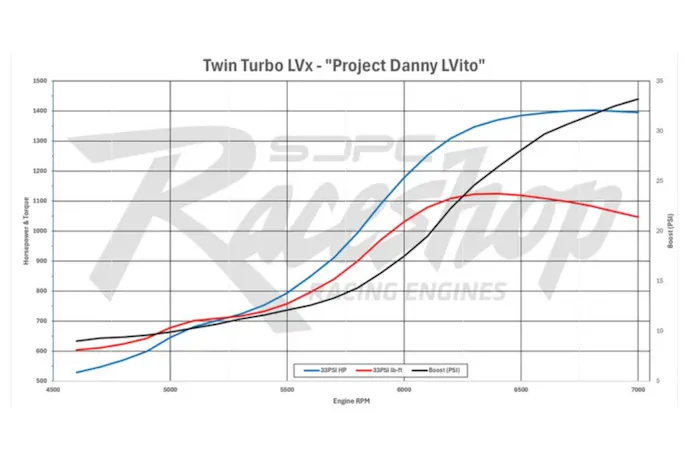
At 31 psi, the LV3 surpassed its original goal. The dyno registered 1,305 horsepower and 1,048 lb-ft of torque. Data logs showed stability, and the plugs still looked safe. Finally, Urban increased the boost to 33 psi and refined the calibration. That final pull produced 1,403 horsepower and 1,125 lb-ft of torque.
In the end, the junkyard-sourced 4.3-liter LV3 delivered more than anyone initially demanded. More importantly, it validated SDPC’s piston and rod strategy in a smaller package. The Gen V architecture once again proved its strength. Even with only 4.3 liters and six cylinders, this platform can support serious power when the right parts and tuning come together.
You might also like
Go-Fast Fasteners: Why ARP Hardware Matters
One often overlooked but critically important LS upgrade is the fasteners. Luckily, the folks at ARP have just the components to help out.