

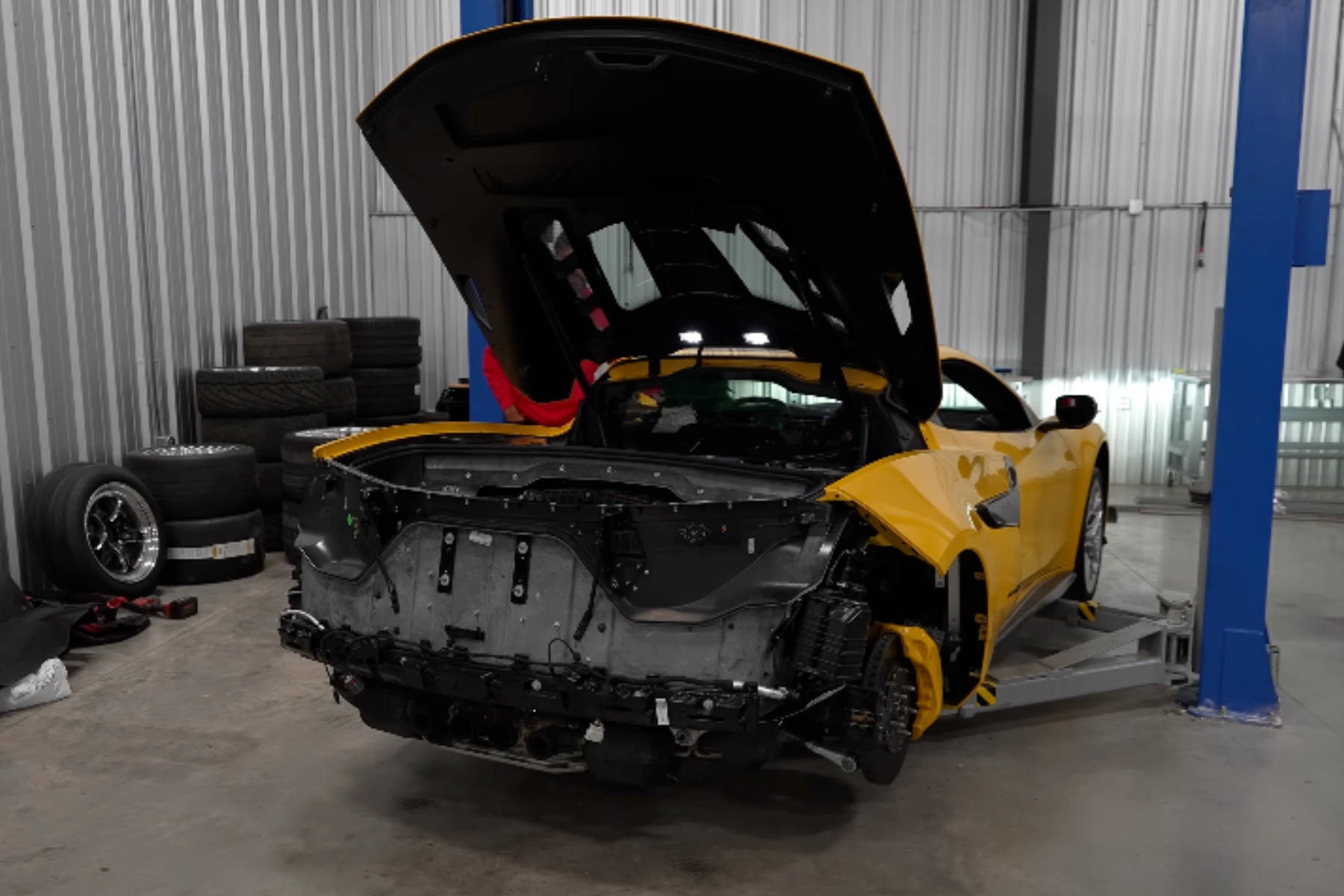
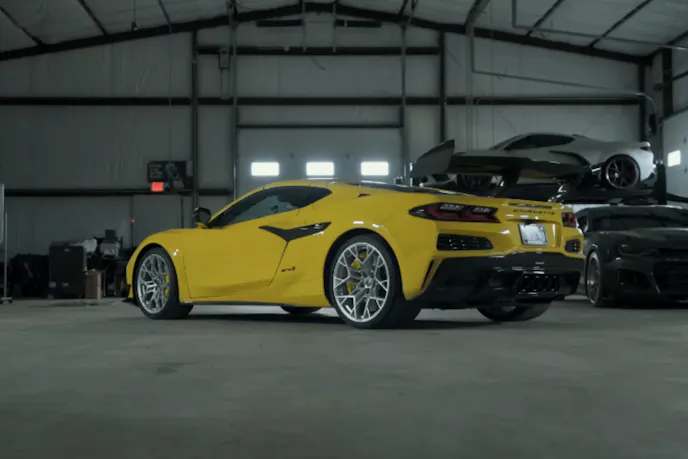
The new C8 ZR1 already entered the conversation as a monster, rated at 1,064 horsepower from the factory. But as Boost District set out to prove, there is still measurable performance hiding inside the platform, especially when it comes to optimizing the ZR1 exhaust system.
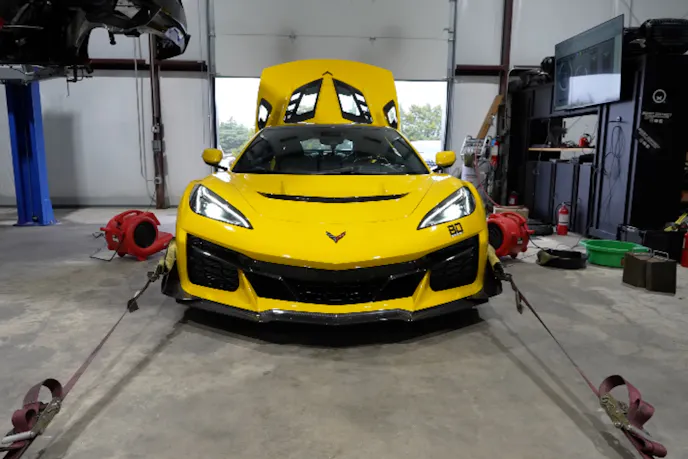
Before touching a single bolt, the team strapped the twin-turbo Corvette to the dyno to establish a true baseline. Rather than chasing a flashy number, they focused on data logging ignition timing, throttle position, boost pressure, intake manifold pressure, and intake air temperature. The goal was simple: understand what the car is doing in stock form before adding parts.
Baseline Data And Heat Management
On the first cold pull, the ZR1 laid down 966 wheel horsepower. However, as the runs stacked up, heat became a major factor. By the third consecutive pull, output had dropped to 822 horsepower, a 140-horsepower swing. After a proper cooldown, the car rebounded to 946 wheel horsepower.
That fluctuation confirmed what many boosted applications experience: heat soak significantly impacts consistency. For Boost District, that presented an opportunity. If cooling and flow can be improved, repeatable power follows.
High Flow Cats And ZR1 Exhaust Upgrades
Stage 1 centers around 49-state-legal high-flow catalytic converters fabricated in-house. The design retains OEM-style flanges, factory gasket compatibility, and factory sensor placement. No check engine lights, no cutting corners.
Cold-to-cold testing showed the stock configuration previously produced 952 horsepower and 790 lb-ft of torque. With the high-flow cats installed, the ZR1 recorded 1,041 horsepower and 818 lb-ft. That represents roughly an 80-horsepower gain at peak, though Boost District openly acknowledged variables such as coolant bleed and temperature differences could account for 15 to 20 horsepower. Even conservatively adjusted, gains of approximately 60 wheel horsepower remain realistic.
More telling than peak power was the torque curve. Data revealed a significant increase in low RPM boost response. The freer-flowing ZR1 exhaust components allowed the turbos to spool quicker, creating a noticeable surge earlier in the pull.
Boost District plans to follow up with intake and cat-back testing, but Stage 1 already proves the C8 ZR1 responds well to carefully engineered bolt-ons. With transparent data and emissions-compliant hardware, the foundation for more serious performance upgrades is clearly there.
You might also like
Need A 1000hp Chevy Tahoe Or Suburban? SVE Has You Covered!
Specialty Vehicle Engineering's 2026 Yenko/SC Chevy Tahoe and Suburban offer up to 1,000 horsepower.