

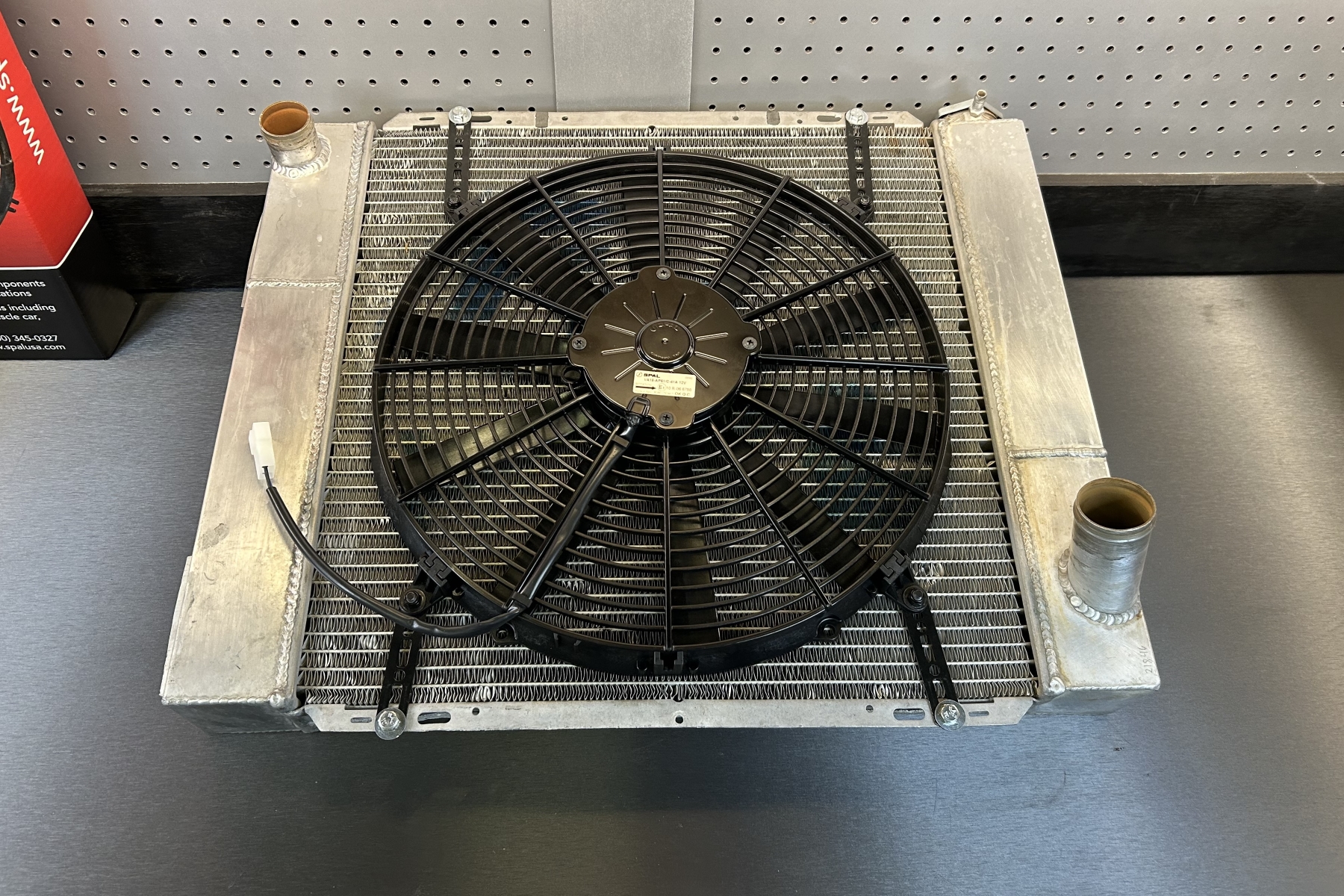
Although temperatures dropped for the winter, progress on our projects didn’t slow down, and next on the list is how to keep one of our swaps cool in the hot months of summer. Whether it’s the local dragstrip, autocross, or empty backroads, our LS-swapped project RX7 will be driven hard, and we need a cooling system that can keep up. The cooling fan in our Mazda is an old, low-buck unit that’s on its last leg, so we turned to SPAL for a new electric cooling fan that flows well and will last as long as our rebuilt engine.
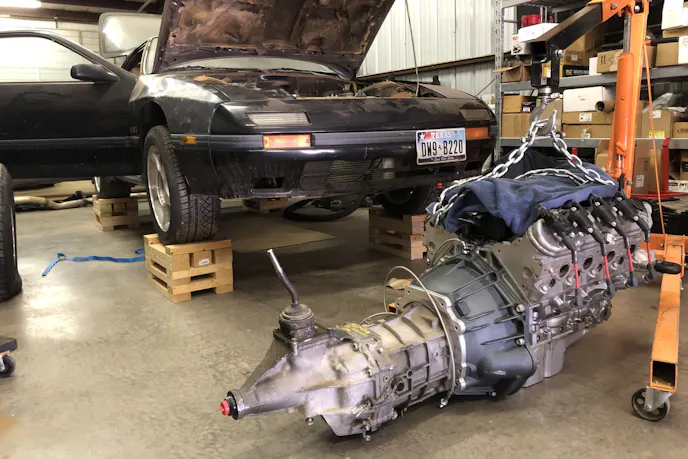
Our 1988 Mazda RX7 is an abandoned project that was born with a 1.3-liter turbo rotary, swapped to an LS2 and T56 by the previous owner, and then sold as a swap-ready roller to us for a price we couldn’t pass up. These little Japanese sports cars are known as superb handling featherweights, but the factory rotary isn’t known for the best reliability.
This means you can grab one for a budget LS-swap project. Since ours started life as a Turbo model, we get great brakes, 5-lug hubs, and a stronger diff with a clutch-type LSD that can handle the LS’s torque. Specifically, our car has a rebuilt LS6 from a C5 Z06 that’s backed by an AR5 5-speed from a Colorado.
Picking The Fan
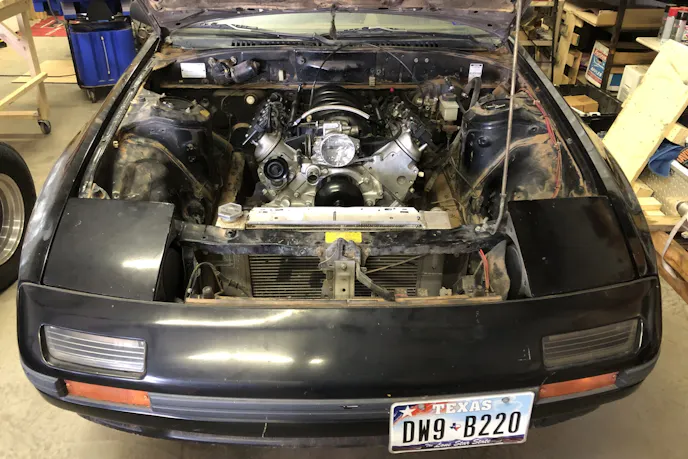
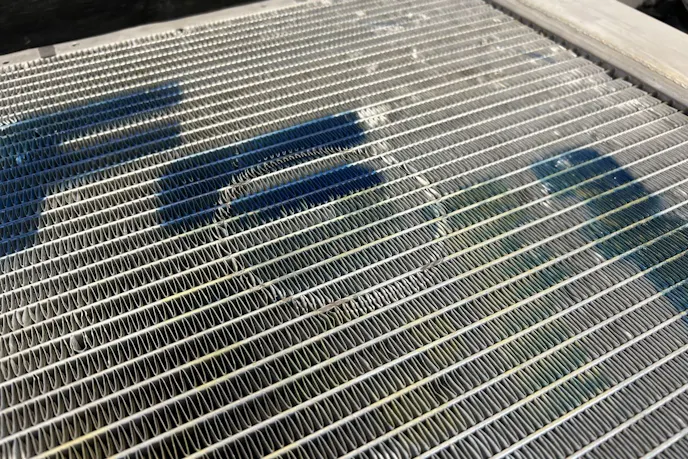
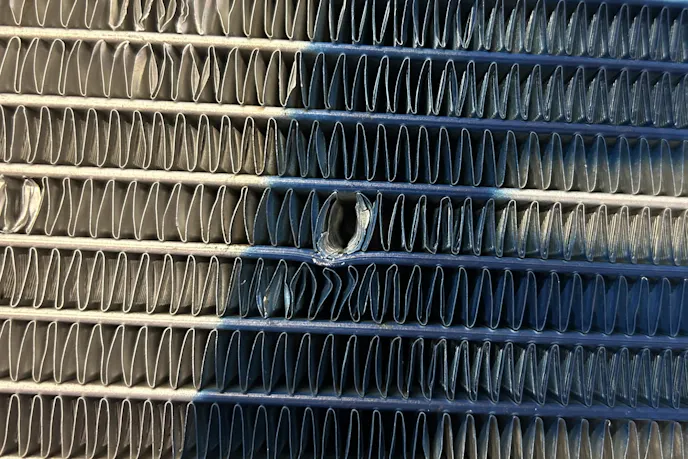
We lucked out with our project already being an LS-swapped car in a previous life, which meant the seller happily handed over plenty of parts to complete our swap, like mounts, exhaust, and the cooling system. The radiator in the car is an FSR dirt track radiator that a local radiator shop cut down to fit the compact sports car’s radiator support. To the naked eye, it’s rough around the edges, but it functions just fine. The noisy cooling fan, on the other hand, is from an unknown brand and was poorly mounted to the radiator.
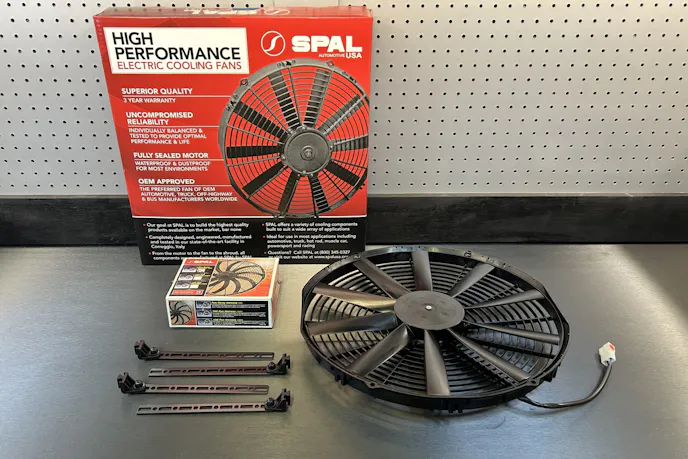
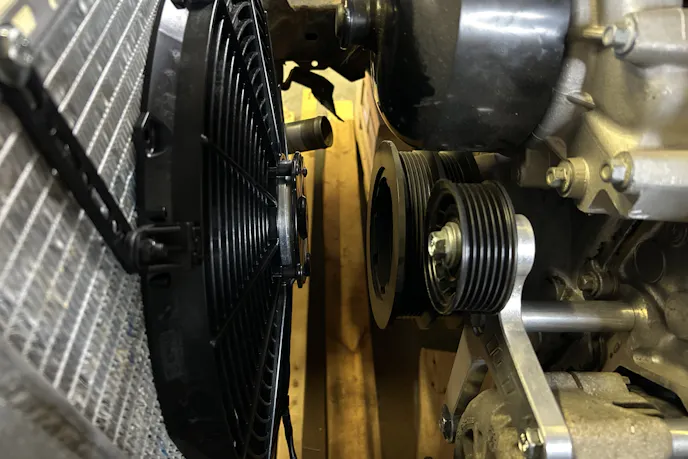
We reached out to SPAL for a replacement electric cooling fan that will fit in the tight engine bay. We needed to maximize the size to fit as much of the radiator core as possible to maximize airflow while remaining thin enough to clear the accessory drive on the front of the engine. SPAL recommended a 16-inch medium-profile straight-blade fan. This fan is less than 2.5 inches thick overall to fit in the engine bay, but still flows over 1,600 cfm. The brushed motor design is robust enough to last a long time under high heat while fitting our budget.
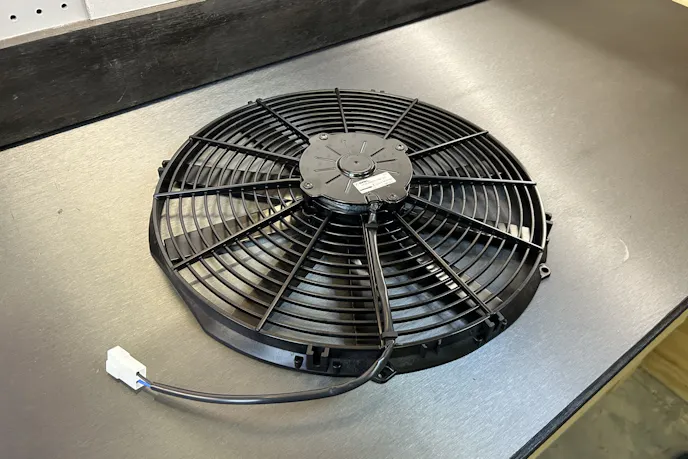
With more than five decades of engineering expertise, SPAL has built a reputation for delivering high-quality, dependable products to customers worldwide. As a leading manufacturer of electric cooling fans for OEM applications, SPAL controls every stage of engineering and production in-house. This end-to-end approach allows the company to maintain strict quality standards while consistently delivering performance, durability, and reliability that manufacturers and enthusiasts alike can trust.
Don’t sweat cfm ratings. People get told they need 2,000 or 3,000 cfm from people who don’t know what they’re talking about. CFM ratings are often obtained in free air conditions, which are not the same conditions people expect to use the fans mounted on a radiator. – Brent Chuck, SPAL Automotive USA
Fan Blade Designs
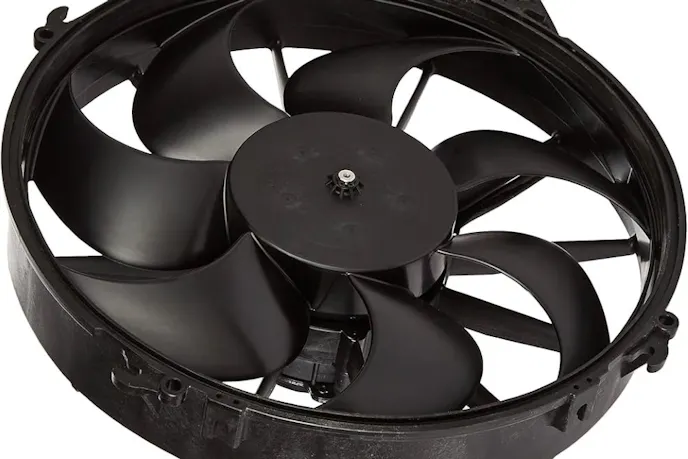
SPAL offers a few different electric cooling fan blade designs, including curved paddle, curved blade, and straight blade, each tailored to different performance and packaging needs. The curved paddle design features a thicker fan assembly with a more aggressive blade profile, allowing it to move a high volume of air at lower RPM. This results in strong cooling performance with reduced noise compared to other styles. The trade-off is that these fans are bulkier, heavier, and require more electrical current to operate, which can be a concern in tight engine bays or power-limited applications.
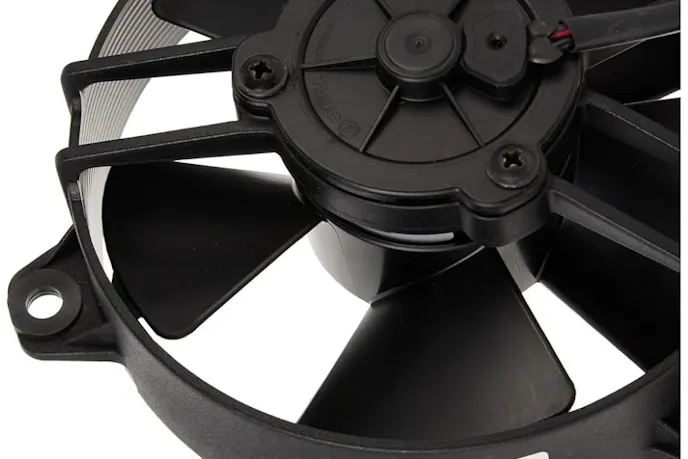
The curved-blade fan is a solid middle-ground option for builders who need a thinner fan while still maintaining good airflow. Its lightweight, narrow blade profile spins at higher RPM to achieve its performance goals, which introduces a noticeable whining sound compared to the curved paddle design. While this style can work well in many setups, the higher-RPM motor is still relatively thick, which makes it less than ideal for applications where clearance around components like the water pump is limited.
For this particular build, the straight-blade fan proved to be the best solution. Although it produces more noise than the other two designs, noise was not a concern for our LS-swapped RX7 project, which will be overpowering our eardrums with straight-through dual exhaust. In return, the straight-blade fan delivers strong airflow, fits easily into tight spaces, and draws less current than the other two designs. This means that it comes with the thinnest electric motor, maximizing clearance.
Basically, we always recommend paddle blades if you can fit them. They offer the best noise/performance. The other two designs are simply made to be thin, so they make a less desirable noise. – Brent Chuck, SPAL Automotive USA
The Install Parts
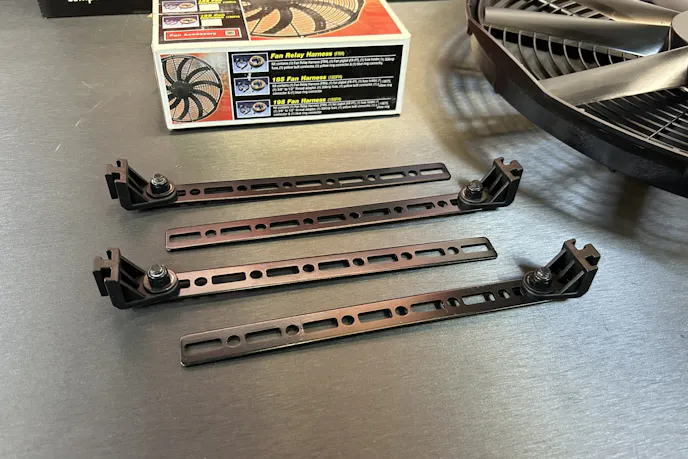
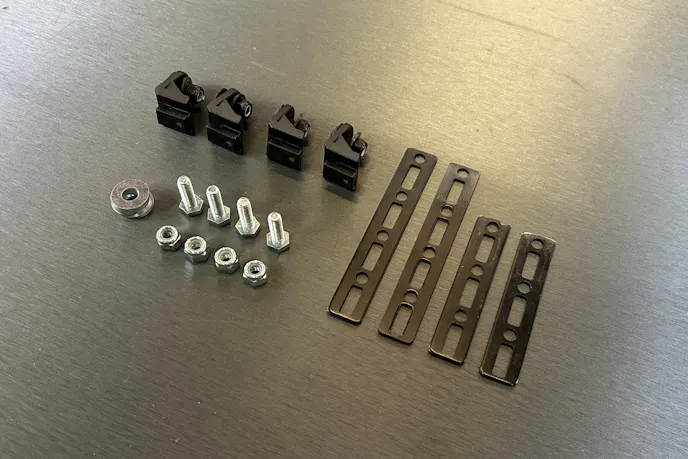
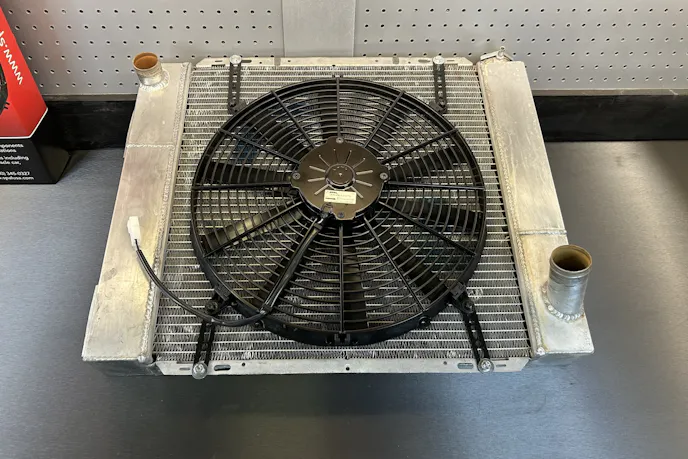
To complete our install, we also choose SPAL’s universal fan brackets and fan wiring kit to help complete our install. The fan brackets mount directly onto the fan housing and allow us to trim the metal legs as needed to attach to our custom-made radiator. The previous fan was attached via a universal plastic pull-tie mounting kit that clamps the fan through the radiator core. Over time, these can rub through the radiator and cause a leak; it looks like ours would’ve done the same if we had used it for much longer.
The fan wiring kit gave us everything we needed to give our electric cooling fan the current it needed to run at peak RPM without struggling. The straight-blade fan uses a lower amount of current compared to other designs, but an electric fan still draws high amperage and needs thick, high-quality wiring, relays, and fuses. The kit includes a weather-proof 40-amp relay and fuse holder, spare fuses, heat-shrink crimps, and enough thick-gauge copper wire to reach the back of the car, if needed.
Electric Cooling Fan Mounting
The installation of the electric cooling fan for our project, and most projects, is very straight forward. Our 16-inch SPAL fan is a puller style fan, which means it mounts on the backside of the radiator that faces the engine and pulls air through the radiator. SPAL does make pusher fans, which mount on the front of the radiator to help with applications that have little space in the engine bay and more room in the front, but they do not flow as well.
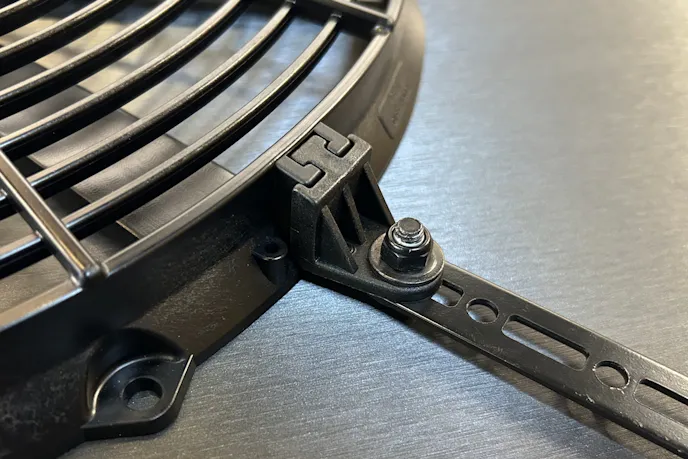
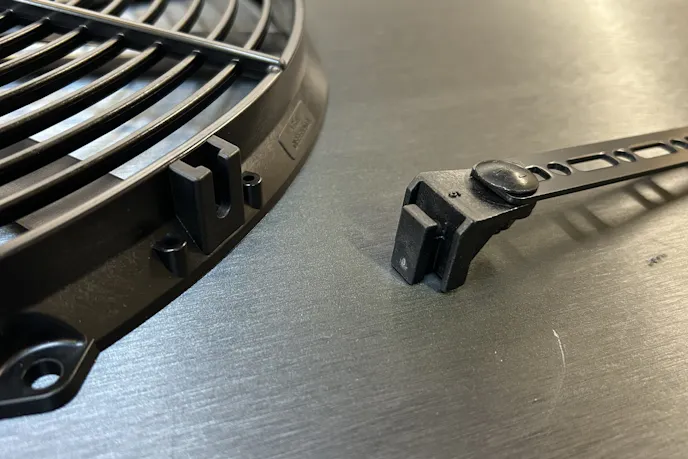
As luck would have it, the holes in the SPAL universal mounting brackets line up perfectly with pre-drilled holes that came on the upper and lower rails on the radiator. So after double checking exactly where each bracket arm is going to bolt down, a quick scribe with a pocket knife to mark where we need to cut to remove the excess.
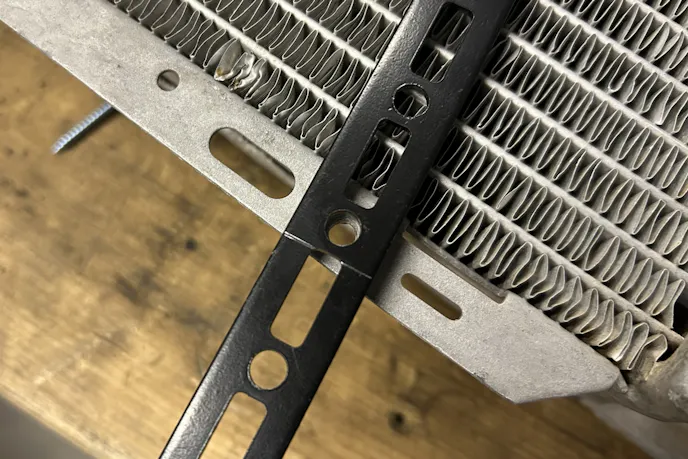
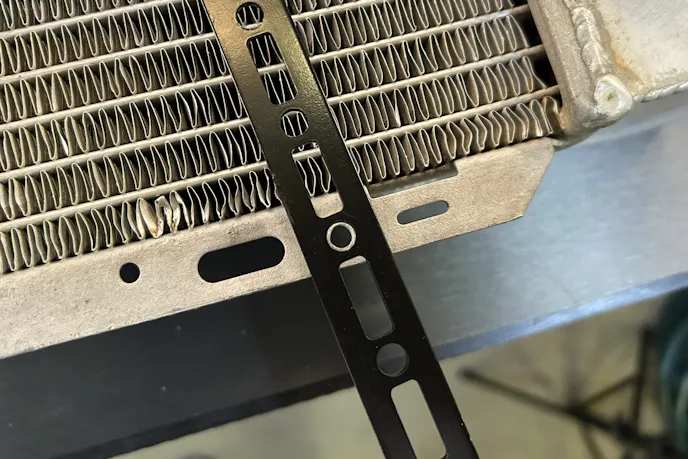
Since each metal arm needed to be cut in the same spot past the mounting hole, we carefully placed all four arms in a bench vice and used a cutoff wheel to cut all four in one big cut. After a quick cleanup with a wire wheel and some black paint, our SPAL electric cooling fan found its new permanent home attached to the RX7’s radiator.

High-Current Wiring
This poor little Japanese sports car fell victim with its previous owners to a common project car problem: sub-par wiring. Engine swaps require wiring solutions, not only for the new drivetrain conversion, but also for the wiring left over from the old engine. Sadly, wiring is not everyone’s favorite part of the project and can be very time consuming, so a lot of wiring in projects has a “that’ll do” level of quality. To fix these issues, the electrics with our project will be removed to leave only the chassis harness the car came with. This is where SPAL’s fan wiring harness kit comes into play to help us with a clean electric cooling fan wiring install.
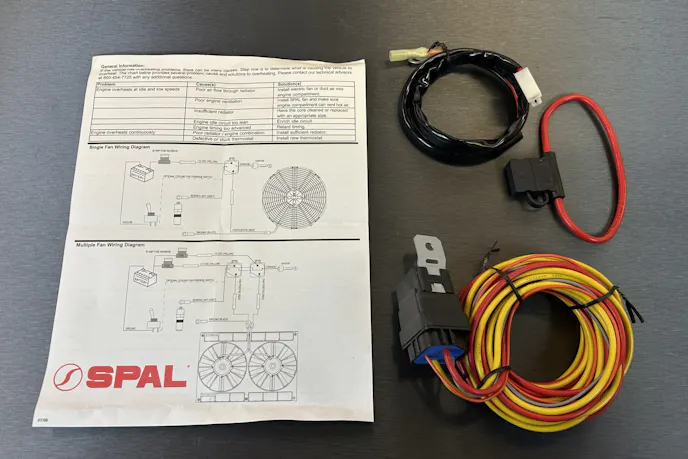
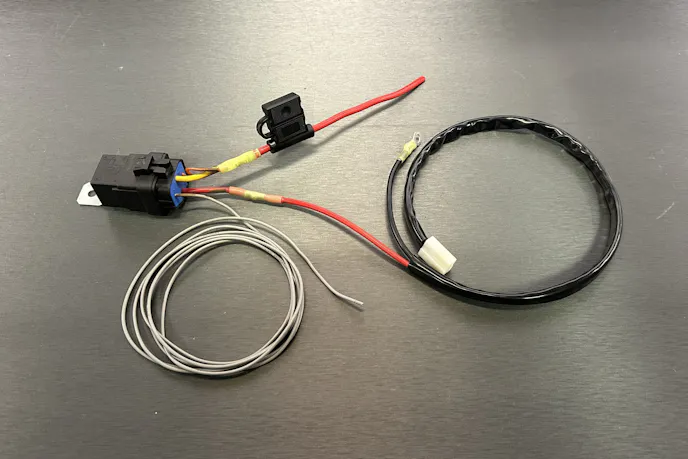
The LS in this RX7 is going to be controlled by a factory PCM, which offers the ability to control a cooling fan that can be programmed to turn on and off with the tune file. The PCM offers a simple on/off switch via a ground. It cannot ground the fan itself, but can trigger the ground side of a relay to turn the fan on and off.
The yellow and orange wires on the relay harness connect directly to a 40-amp fused 12-volt positive battery source. Using the included heat shrink wire crimps, we join these wires together. The large-gauge red wire on the relay harness connects to the red positive wire on the fan harness. All that is left on the relay harness is the small-gauge gray wire, which we will connect to the LS standalone harness to trigger the fan to come on and off at a predetermined engine coolant temperature in the tune file. If we wanted, we could also attach this wire to a switch in the dash to simply ground the wire to trigger the fan whenever we wanted.
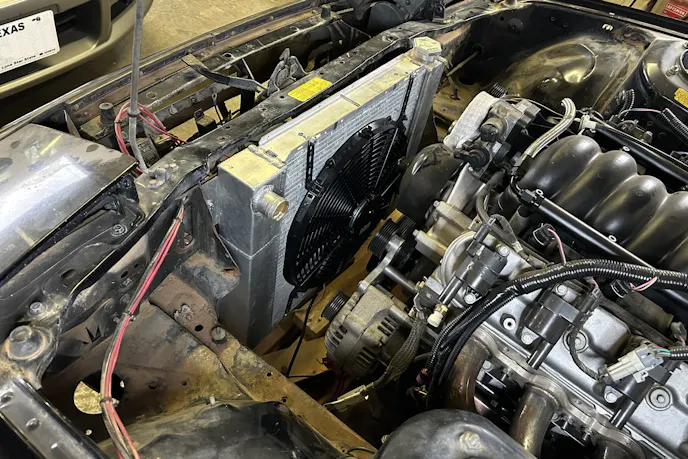
We still have to tackle the rest of the wiring before we can move on with the rest of the LS RX7 project, but now our cooling system is ready to handle whatever our right foot can throw at it. It might be hot lapping it at the drag strip on a hot Saturday afternoon, lap after lap on the road course, or just the biggest burnout before the rear tires blow, but the cooling system will now get all the airflow it needs thanks to our new 16-inch electric cooling fan from SPAL.
You might also like
ATI Releases 139-Tooth SFI Flexplate Kits For LS, LT, And Vortec Performance Applications
ATI's new flexplate kits give LS and LT builders a stronger, more precise connection between engine and transmission.