

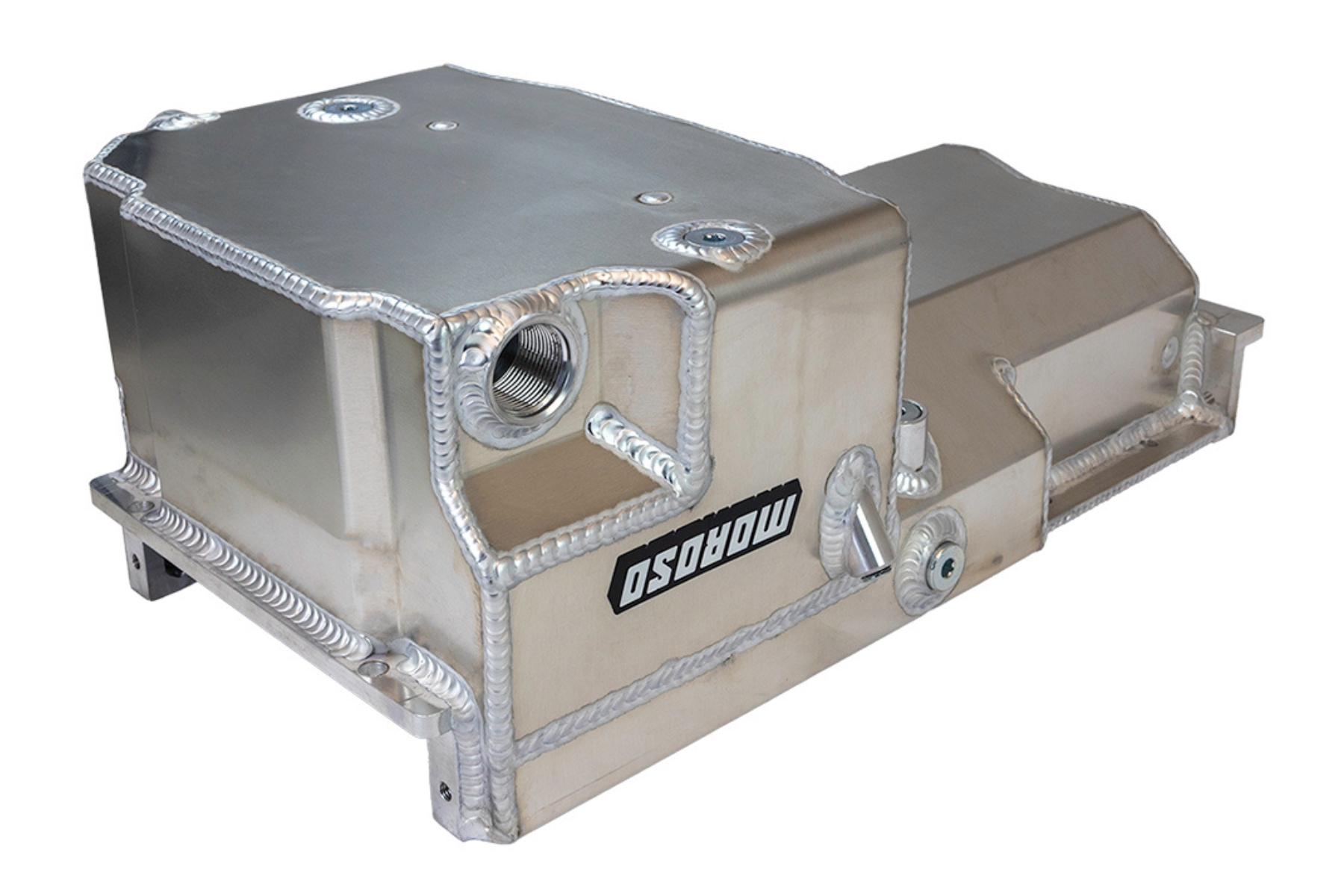
Nobody pops the hood at a car show and points at the oil pan. It sits down in the dark where the dirt is, only to get ignored until something goes wrong. Then it becomes the most interesting part of the engine. Moroso has four new wet-sump LS oil pans in the lineup, and between them they cover sand rails, street and strip cars, road race builds, and drag-only combinations. Two of the four bolt to GM LS Gen III and Gen IV blocks, as well as the Dart LS Next Gen 3, while the other two are built specifically around the non-skirted Dart LS Next and LS Next 2.
Why LS Oil Pans Live Or Die On Oil Control
The reason all four of these LS oil pans are loaded with baffles and trap doors comes down to where the oil goes when the car does something violent. Hard launches shove oil toward the back of the sump, corners throw it sideways, and a sand rail bouncing through a whoop section throws it everywhere at once. If the oil leaves the pickup area even briefly, the pump pulls air instead of oil, pressure drops, and the bearings are the first to find out.
That is the job of a trap door assembly. Oil can move into the pickup area freely, but the doors make it difficult to leave. Anti-climb baffles keep oil from crawling up the pan wall, and a louvered windage tray separates the oil in the sump from the rotating assembly spinning just above it. None of this is new thinking, but the way each of these pans applies it changes depending on what the engine is bolted into.
The 12-Quart Sand Rail Pan
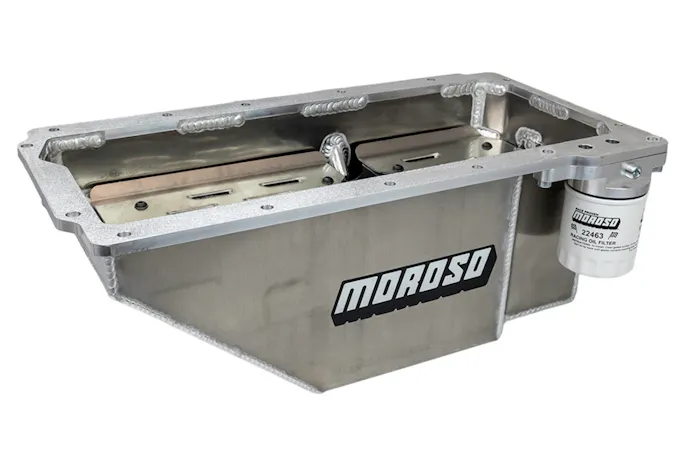
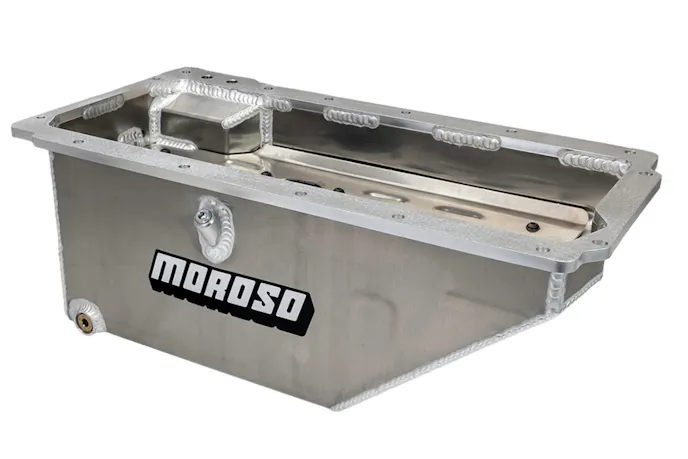
The Moroso 20131 is the deepest of the four LS oil pans in this group. It is a fully fabricated aluminum pan with a billet rail, 8.250 inches deep, and it holds 12 quarts plus the filter. Engine application covers GM LS Gen III and Gen IV blocks, plus the Dart LS Next Gen 3, and it is designed for sand rails with rear-facing, rear-mounted engines. Moroso also lists marine applications, with the usual reminder to check your dimensions before ordering.
Inside is where the money went. The pan features a diamond-shaped four-trap-door assembly, plus two additional rear trap doors, anti-climb baffles, and a removable louvered windage tray. Moroso built that combination specifically for oil control in high-horsepower sand rails, which makes sense when you consider that those cars spend their day at wide-open throttle with the nose pointed at the sky. The pan clears a 4.250-inch stroke with most steel rods, so a big-inch combination is on the table.
A billet aluminum 22 mm spin-on filter adapter mount is included, with a .250-inch NPT port, though the filter itself is sold separately. There is also a .250-inch NPT dipstick provision. Pickup selection depends on your block, with Moroso listing part 24131 for the GM LS and part 24132 for the Dart LS Next, both built specifically for pan No. 20131.
A Six-Inch Steel Pan For Street, Strip And Road Race
If the sand rail pan is the specialist, part No. 20132 is the one that fits the most driveways. It is a fabricated steel pan finished in black powder coat by Moroso Powder Coating, six inches deep, holding 10 quarts plus the filter. The same engine application list applies, covering GM LS Gen III and Gen IV along with the Dart LS Next Gen 3, and Moroso aims it at road race, street/strip, off-road, and marine cars running an open crossmember.
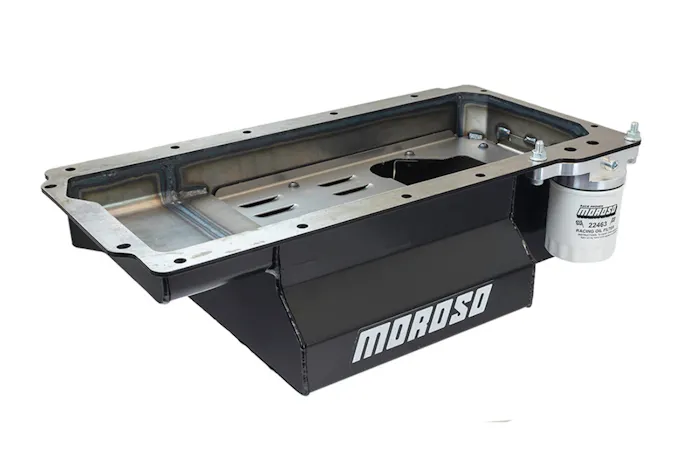
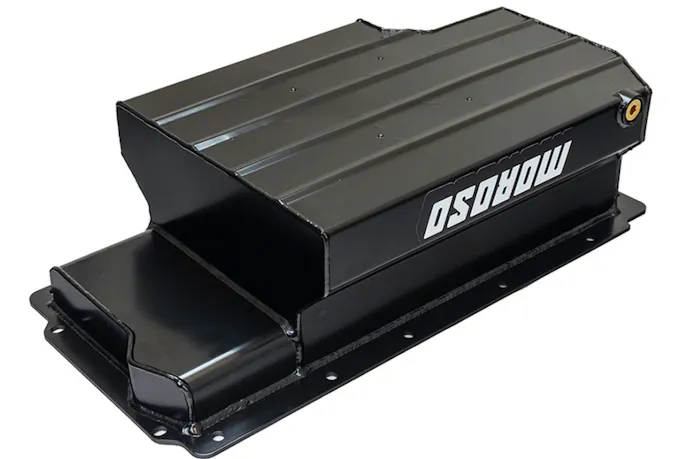
The interesting detail is the sump itself. Rather than going deeper for capacity, Moroso went longer, using a 16-inch sump that adds oil without costing ground clearance. Anyone who has dragged a deep pan across a driveway apron, or worse, a corner curb, will understand why that matters. Oil control comes from four trap doors, front and rear anti-climb baffles, and a removable louvered anti-slosh baffle. Like the 20131, it clears a 4.250-inch stroke with most steel rods and includes the billet aluminum 22 mm spin-on filter adapter mount with a .250-inch NPT port.
Recommended pickups here are part No. 24050 for the GM LS and part 24152 for the Dart LS Next. Moroso also lists a magnetic -8AN drain plug (97006), a stud kit (38542), a one-piece gasket (93152), and two windage trays, part No. 22941 and part No. 22943 for engines running main cap studs.
Two Drag Race LS Oil Pans For Non-Skirted Dart Blocks
The last two go after a narrower audience, specifically anyone running a non-skirted Dart LS Next or LS Next 2. Both part numbers 20134 and 20135 are fabricated aluminum, eight inches deep, holding six quarts, and both are built for drag race use, with a note to check dimensions for chassis fitment.
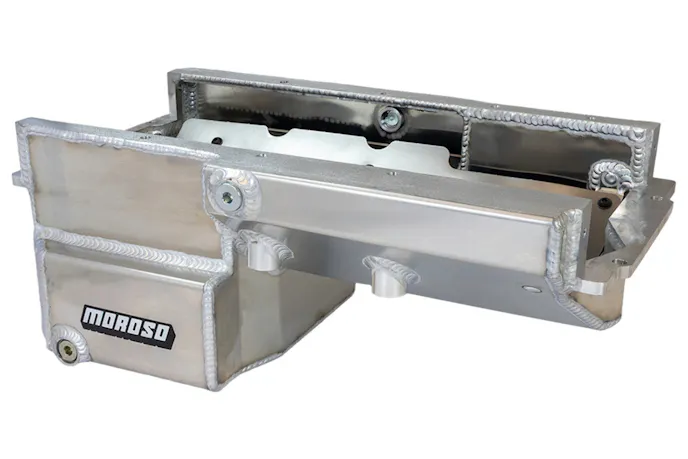
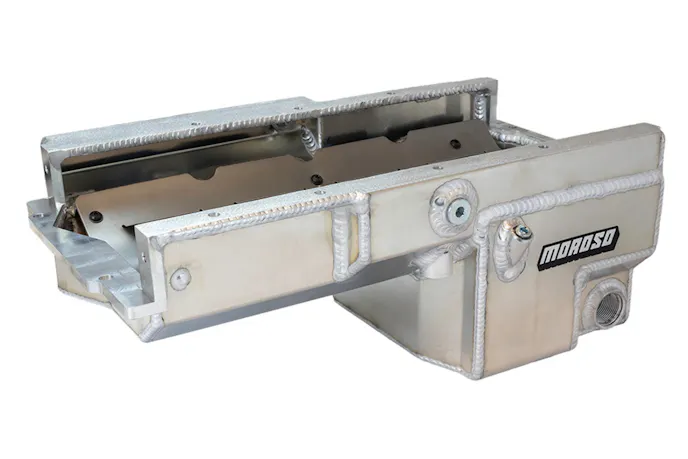
What both pans share is a design detail that saves a step during assembly. Billet end caps eliminate the need for billet adapter rails to install the pan on a non-skirted block, which is one less part to source and one less joint to seal. Inside, each pan uses an integrated trap door baffle, a louvered windage tray, and a full-length power kick-out. Both clear a 4.100-inch stroke with most steel rods and include a .250-inch NPT dipstick provision along with dual -8AN drain-back provisions.
The difference between the two is the pickup. The 20134 is the conventional version and uses an internal pickup, with Moroso recommending part 24144 or part 24152 for the Dart LS Next Gen 3/SHP. The 20135 instead has a driver-side -16AN female pickup built into the left side of the pan, which is the setup you want when the plumbing is already headed in that direction. Moroso lists a -16AN screen fitting, part No. 23692, among its options for that pan.
What These LS Oil Pans Need That Does Not Come In The Box
All four of these LS oil pans rely on a short list of accessories that are easy to forget until the engine is on the stand and the crane is rented. Moroso’s 22463 is the 22 mm GM LS filter that matches the adapter mount included with the 20131 and 20132, and it is sold separately from the pan. Dipsticks are separate too. The twist-lock 25973 appears on the options lists for the 20131, 20134, and 20135, joined on the two drag race pans by the 25970 and the braided stainless 25971. Those two pans also list the 97005 steel plug, the 97006 magnetic drain plug, and, on the 20134, a pick-up flange reinforcement (24890).
The 20131 and 20132 also list remote filter adapters (23688), 90-degree remote adapters (23707), and an external accumulator input adapter (23716), plus the 25030 oil galley diverter. The 20131 options list adds Moroso’s 22121 and 22122 standard-volume, high-pressure GM LS oil pumps, along with the 38541 stud kit.
Which Of These LS Oil Pans Fits Your Build
Your chassis is going to make this decision more than your horsepower goal does. A rear-engine sand rail with a rear-facing LS and room for 12 quarts points straight at the 20131, since nothing else in the group was designed around that layout. If the car lives on the street, sees road course time, or spends its weekends somewhere dusty, the 20132 and its long, shallow sump keep capacity up without hanging anything extra below the crossmember. For a non-skirted Dart LS Next built for the quarter mile, the choice comes down to plumbing, with the 20134 keeping the pickup inside the pan and the 20135 moving it out to a driver-side -16AN feed. Check dimensions against your chassis before ordering any of them. Then order the matching pickup at the same time, and head to Moroso’s site for full specs.
You might also like
Win A 2026 3LZ Coupe Through The Corvette ZR1 NCM Sweepstakes Draw
The National Corvette Museum launched the Corvette ZR1 NCM Sweepstakes. One winner takes home a 1,064-horsepower mid-engine sports car.