

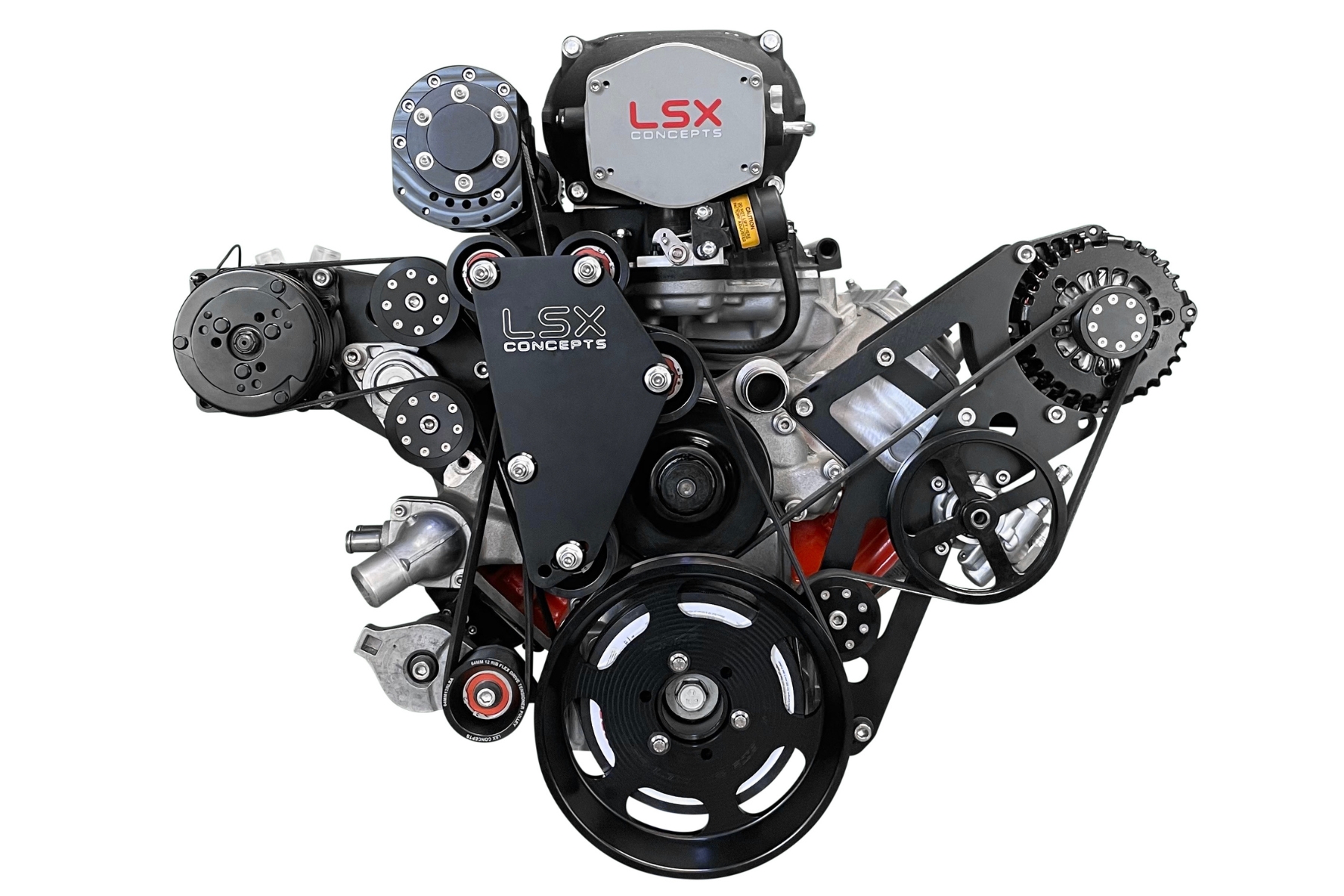
When boost climbs and overdrive ratios get aggressive, small weaknesses in a supercharger drive system can quickly turn into expensive failures. LSX Concepts has been deep in that territory, pushing Magnuson TVS2650 Hot Rod combinations past the comfort zone to see what holds up and what does not. The result is two innovative products aimed squarely at serious LS builders: the Magnuson Hot Rod 2650 Front Bearing Support and the LSA Supercharger Flex Drive 10 or 12 Rib Jackshaft Drive Edition.
Together, these components target one goal. Keep the belt planted, the jackshaft stable, and the boost consistent at power levels that stretch well beyond 1,000 horsepower.
Solving Real-World Issues In The Magnuson 2650
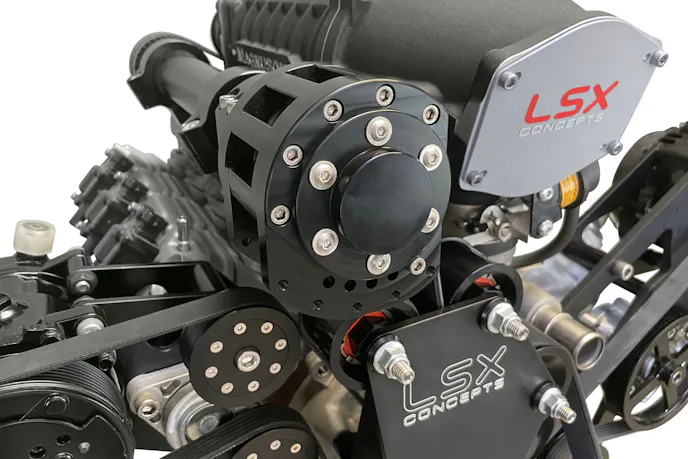
The Magnuson TVS2650 Hot Rod has become a popular choice for high-horsepower LS combinations, especially in pro-touring cars, drag builds, and even drift applications. As more builders pushed these units past 1,200 horsepower and into the 1,400-plus range, patterns started to emerge. Jackshaft failures, belt misalignment, and pulley bending under extreme load were no longer isolated incidents.
The LSX Concepts Magnuson Hot Rod 2650 Front Bearing Support is designed to address those weak points directly. One of the major concerns centered on carbon fiber jackshafts, where the steel ends could detach due to incomplete gluing during assembly, combined with internal pressure buildup and inadequate venting. Under high overdrive ratios, that pressure and load only increase.
By reinforcing the front of the drive system, the bearing support adds stability and improved pressure management. The design helps eliminate excessive pulley deflection, which in turn maintains full rib engagement across the belt. That means more consistent power transfer and zero belt slip when the blower is working hardest.
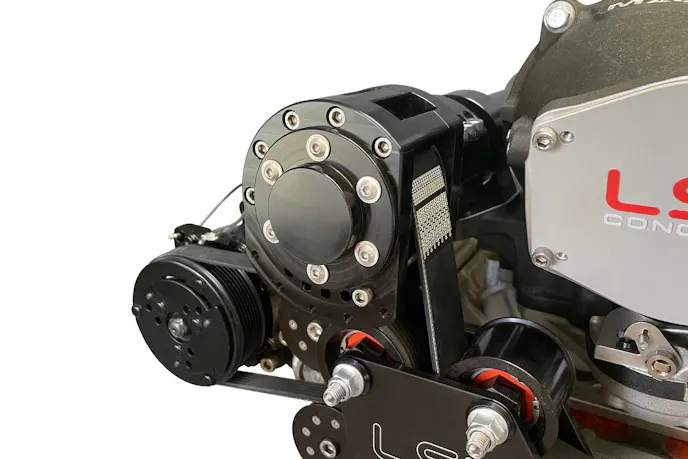
Each unit is finished in black anodizing and includes a custom-machined 3.00-inch Griptec supercharger pulley, available in both 10-rib and 12-rib configurations. The Griptec profile increases belt bite under high boost conditions, further reducing the chance of slip. For builders who are already running an LSX Concepts jackshaft flex drive, the front bearing support integrates directly with both the low- and high-mount tensioner versions, as well as other aftermarket LSA-offset supercharger drives.
It is also compatible with throttle bodies up to 120 mm, though some applications may require relocation of the throttle position sensor.
All aluminum components in the front bearing support are CNC-machined from aerospace-grade 6061-T6 billet at the LSX Concepts facility in Mound House, Nevada. From machining to assembly and quality control, everything is handled in-house using American-sourced materials and HAAS CNC equipment. That level of control over the manufacturing process reflects the intended audience. These parts are not for mild street builds. They are for combinations leaning on 1,400 horsepower or more.
The Slimmest LSA Drive On The Market
To complement the new bearing support, LSX Concepts also sells the LSA Supercharger Flex Drive 10 or 12 Rib Jackshaft Drive Edition. This system is engineered as a compact, heavy-duty solution for jackshaft-driven superchargers such as the Magnuson 2650 Hot Rod and even Whipple WK-1810 setups when paired with the appropriate offset pulley.
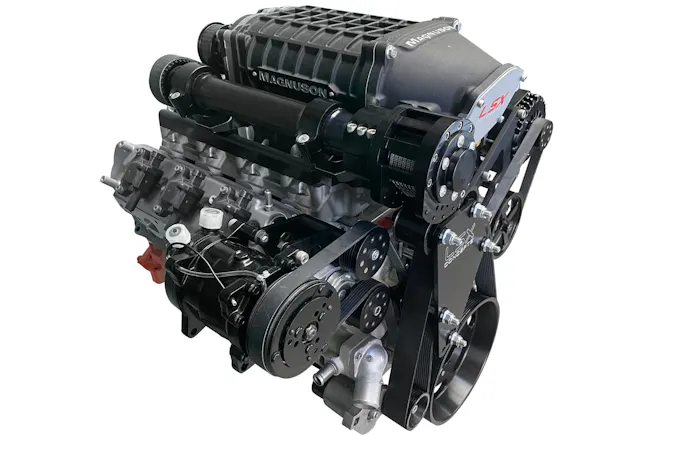
Marketed as the slimmest LSA drive system currently available, the flex drive fits into tight engine bays without requiring frame modifications. That matters for muscle cars, hot rods, and pro-touring builds from the 1960s through the 1980s, where packaging space is limited and cutting up a classic chassis is not always an option.
The system supports both 10-rib and 12-rib configurations. A 10-rib setup is well-suited for 1,000-plus-horsepower street and strip builds, while the 12-rib configuration is aimed at extreme race combinations pushing past 1,400 horsepower.
A factory-style LSA tensioner with a unique cloverleaf adjuster offers eight incremental index positions. Each adjustment changes belt length by 3/16 of an inch, while the tensioner body can be repositioned in .070-inch increments. Combined with an adjustable lower idler pulley that provides 1/2-inch belt length changes per position, the system offers more than three inches of total belt adjustment. That flexibility simplifies installation and fine-tuning.
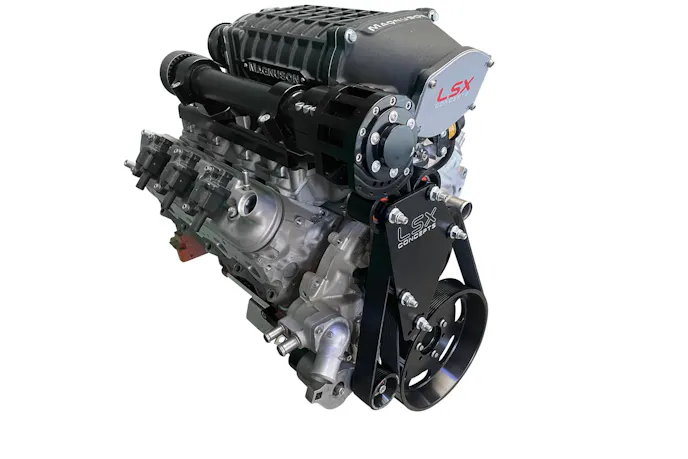
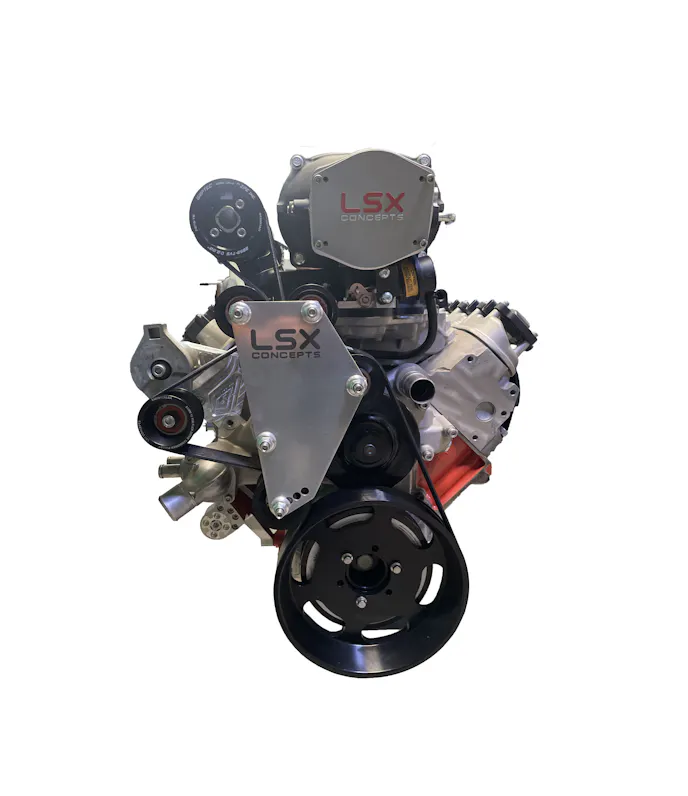
The flex drive includes billet front and rear idler plates, dual 73 mm idler drive pulleys, two 58 mm guided idler pulleys, a 64 mm LSA tensioner pulley, and all necessary installation hardware. Builders can choose between low-mount and high-mount tensioner configurations depending on A/C compressor placement. It remains compatible with factory LSA tensioners as well as Harrop billet and ARS LSA tensioner options.
Proven Under Extreme Conditions
Before release, these components were tested in demanding real-world conditions. Pro Formula Drift driver Alec Robbins’s car served as the development guinea pig, running both the front bearing support and the flex drive in a high-stress environment where sustained boost and aggressive throttle inputs are the norm. That type of testing exposes weaknesses quickly.
For LSX enthusiasts chasing big numbers without sacrificing reliability, LSX Concepts is offering a reinforced path forward. By focusing on jackshaft stability, belt control, and precise adjustment, these new components aim to keep high-boost 2650 combinations consistent, durable, and ready for whatever abuse comes next.
You might also like
2027 Corvette Grand Sport And Grand Sport X Rumors Incoming
Leaks from a GM dealer meeting in Las Vegas point to a 2027 Corvette Grand Sport and a 720-horsepower Grand Sport X replacing the E-Ray.