

There’s an old saying in the performance world that boost is just a measure of restriction. Like most old sayings, there’s a little more to the story. When it comes to positive-displacement superchargers, a higher boost number doesn’t necessarily mean the blower is working better, and a lower number certainly doesn’t mean you’re making less power. What really matters is how much air you can efficiently move through the engine.
In Part 1 of our look at the science of supercharger porting, we dug into what actually happens when companies like Kong Performance start removing material from a factory blower. Volume porting, rotor entry profiles, and outlet modifications can all improve airflow, but knowing where to break out the die grinder is only half the battle. Now it’s time to talk about the science behind those decisions.
Boost Is Not the Goal, Airflow Is
One of the most important concepts to understand when evaluating supercharger porting, and one that Greg Keosayian of Kong Performance emphasizes consistently, is that boost pressure and airflow are not the same thing.
“Supercharger porting is ultimately about improving airflow and increasing the overall efficiency of the supercharger, not simply changing boost pressure. Much of a properly engineered porting program focuses on reducing restrictions at the inlet of the supercharger. By allowing the rotor pack to fill more completely on every revolution, the supercharger is able to move a greater volume of air. Since a positive-displacement supercharger displaces a fixed volume each revolution, improving its ability to fill that volume results in more air being delivered to the engine. In many cases, this actually increases boost pressure because the supercharger is supplying more mass airflow than before.
However, not every modification affects boost the same way. Improvements to the outlet side of the supercharger and the discharge path can reduce pressure losses after the air leaves the rotors, allowing the engine to ingest the airflow more efficiently. Those changes often result in lower measured boost pressure, even though airflow and horsepower have increased.
This is why boost pressure alone is a poor indicator of an effective porting job. A well-designed port program can include modifications that increase boost in some areas while decreasing it in others, all with the common goal of improving the supercharger’s overall efficiency. Many enthusiasts assume that porting should always lower boost, but that isn’t necessarily true. In fact, because many of the largest restrictions exist on the inlet side of the supercharger, removing those restrictions often increases both airflow and boost pressure. The true measure of a successful port is not whether boost goes up or down, it’s whether the supercharger moves more air and produces more power with greater efficiency.”
The System Has to Work Together
One of the most important things experienced porting specialists understand is that the supercharger doesn’t exist in isolation. The inlet port design has to account for the entire air delivery system: the cold air intake, the throttle body, the volume of the plenum, the electronics that govern throttle opening, and even the cooling system’s ability to manage the heat generated by the blower under load.
The rotor entry profile you choose creates an RPM band where the port produces its maximum benefit. That band has to align with the rest of the system’s capabilities. If the cold air intake can’t supply enough volume, or the throttle body is a restriction point, or the heat exchanger can’t keep IAT2 numbers in a reasonable range, the port will underdeliver regardless of how well it was executed.
This is why the best port jobs aren’t just about grinding material. They’re about understanding the complete system and designing an inlet geometry that matches the engine’s needs, the blower’s operating characteristics, and the actual conditions under which the car will be driven.
A properly designed port will produce gains starting from stock blower speeds and continue producing results with up to a 10 to 20 percent increase in blower RPM before a more aggressive profile becomes necessary. Pushing beyond that without accounting for heat management and total system capability leads to predictable problems: high IAT2 temperatures, belt failures, and a power band that’s too narrow to be useful on the street or track.
Kong Performance: Engineering Built From Obsession
Greg Keosayian didn’t come to supercharger porting through a business plan. He came to it through the same path most serious enthusiasts: he wanted to make his own car faster.
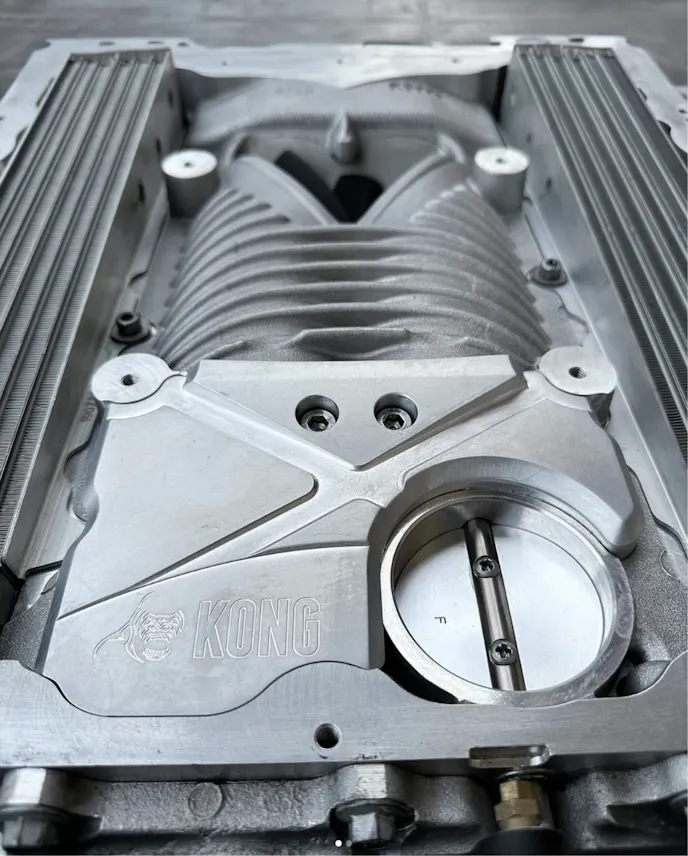
Greg had already built real technical credentials in the performance world before Kong Performance existed. He started his career doing engine calibration and tuning at Lund Racing, developing hands-on expertise with both Ford and LS-based platforms while building a deep understanding of how all the variables in a performance system interact. When he turned his attention to his own C6 ZR1, the tuner’s instinct to understand why things work, not just that they work, drove him to pull the supercharger apart and start experimenting.
“I pulled the supercharger off my own car, spent hours figuring out how to take it apart, and then started grinding material away in areas that I thought might improve airflow,” Greg explains. “The gains weren’t huge initially, but they were enough to make me curious. So I pulled it back off, modified it further, tested again, and repeated that process over and over.”
That iterative, data-driven approach — test, measure, understand, refine — became the foundation of everything Kong Performance does. He was hand-porting superchargers in a two-car garage, wearing a Tyvek suit for six to eight hours at a stretch, shipping units from customers who were seeking him out from across the country, while still working full-time. In 2017, that side business officially became Kong Performance.
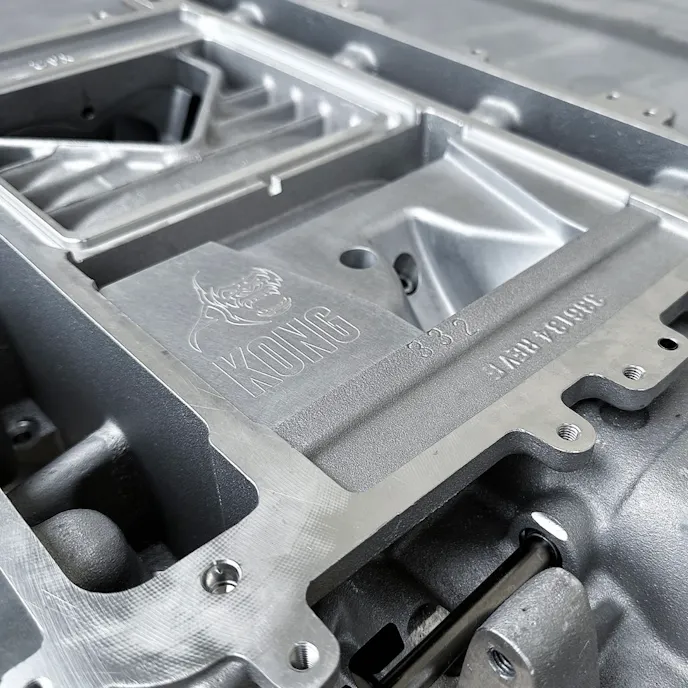
What’s grown since then reflects both the demand for this kind of specialized work and the technical seriousness with which Kong approaches it. The company has expanded into a 20,000-square-foot facility, a move made in 2025, that supports expanded manufacturing, machining, and product development capabilities.
The Supercharger Dyno: Validation Over Guessing
The clearest signal of how seriously Kong Performance approaches the engineering side of this work is the development of their dedicated supercharger dyno, built in partnership with Power Test. There was no off-the-shelf solution that did what Kong needed, so they built their own.
This purpose-built test system allows Kong to evaluate superchargers completely independently of the vehicle, measuring airflow, pressure ratios throughout the system, parasitic power consumption, temperatures, and overall efficiency while making specific design changes. The result is the ability to quantify exactly what a modification is doing, rather than relying on chassis dyno results where chassis friction, weather conditions, driver variation, and dozens of other variables cloud the picture.
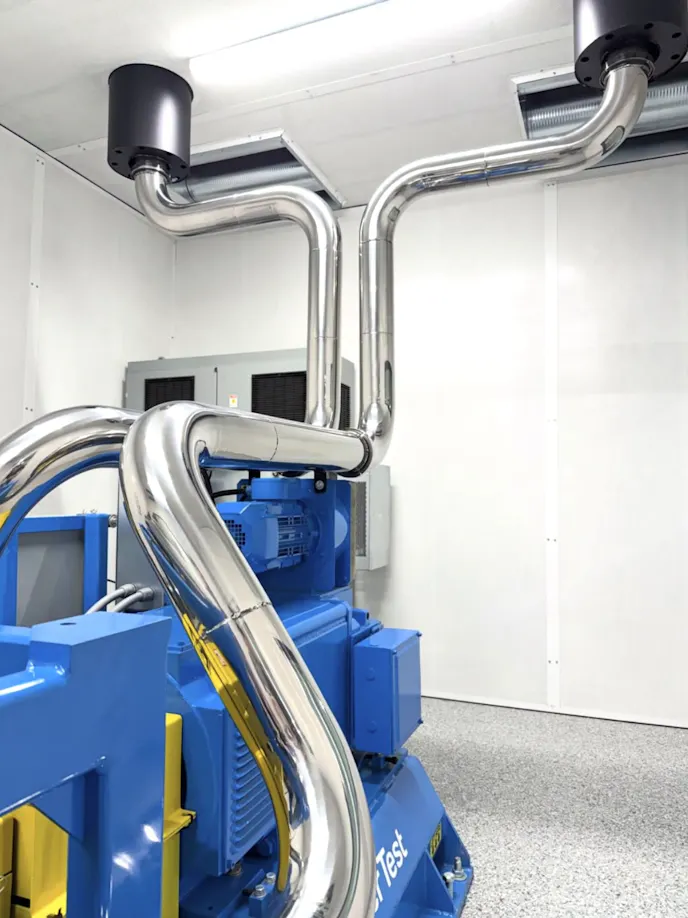
“Instead of guessing, we can quantify exactly what a modification is doing,” Greg notes. “It allows us to validate ideas before they ever reach a customer and helps us understand why something works rather than simply knowing that it works.”
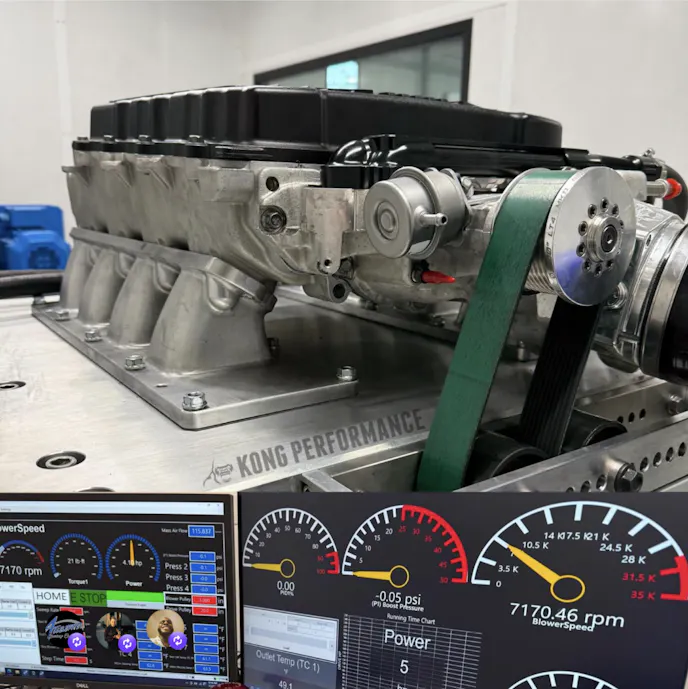
That distinction — understanding why, not just what — runs through everything Kong does. It’s the difference between a shop that has learned by repetition and a shop that has built genuine engineering knowledge around a specific class of hardware. The results validate the approach: Kong-ported superchargers have been behind record-setting performances and race wins across multiple competitive environments, built on a foundation of collaboration with the racers, performance shops, and industry partners who push these systems hardest.
Structural Considerations
There’s one additional dimension to supercharger porting that deserves attention: the structural implications of material removal. Cast aluminum housings are under load during operation. They experience thermal cycling, pressure forces, and vibration across a wide range of operating conditions. The casting’s wall sections weren’t designed with material removal in mind. They were designed to be complete, and they carry tension in ways that aren’t always immediately obvious from visual inspection alone.
When material is removed, that tension distribution changes. Modifications that involve epoxy fill or welding introduce additional variables. These repairs have their own load characteristics and behave differently from the parent casting under the heat and pressure of sustained high-boost operation.
The best porting work maximizes airflow improvement while respecting the structural integrity of the housing. The goal is to extract every bit of performance available within the limits of what the casting can reliably support, and experienced operators know where those limits are. This conservative structural approach has proven itself in applications running deep into the eight-second range, where the consequences of housing failure are severe.
The Bottom Line
Supercharger porting is a precision modification, not a rough-and-ready hack. When done correctly, it addresses fundamental limitations built into the casting process that restrict how efficiently air moves through the supercharger — limitations that the factory never had reason to optimize away because the car was fast enough for the target market.
For owners of GM’s high-performance supercharged platforms who are serious about extracting real performance improvement, understanding the difference between a port that was executed with a deep knowledge of airflow dynamics, blower efficiency maps, system-level interactions, and structural constraints, and one that wasn’t, is the difference between a car that makes more power across the full usable RPM range and one that gained a modest bump at peak while giving something up everywhere else.
Kong Performance has spent years building that knowledge through exactly the kind of systematic, obsessive experimentation and validation that produces genuine expertise. The state of the art facility, the purpose-built supercharger dyno, the record books — they’re all downstream of a guy in a Tyvek suit who wanted to understand what the blower on his ZR1 was actually capable of.
Turns out it was capable of quite a bit more.
You might also like
Flowmaster American Thunder Exhaust Wakes Up Our 5.3L Silverado
We install a Flowmaster American Thunder cat-back on our 5.3L Silverado for classic V8 sound without annoying highway drone.