

In 72 years and five generations of the Chevrolet small-block V8, GM has produced over 100 million engines. The sixth generation — the new LS6 — may be the boldest statement yet.
Production returns to Flint Engine Operations in Flint, Michigan — the city where the first Chevrolet small-block V8 was built on July 9, 1954. The last of that lot left Flint in 1999. Its sixth-generation descendant brings production home, assembled from U.S. and globally sourced parts. It is a symbolic homecoming for an engine family that has powered over 100 million vehicles across seven decades.
Building A New Icon
Unveiled alongside the 2027 Corvette Grand Sport, the 6.7-liter LS6 is not a refresh. It is an all-new architecture developed over five years, guided by GM Assistant Chief Engineer Mike Kociba and LS6 Design System Manager Casey Morrison. Their mission: build a bigger, more powerful V8 that actually improves emissions and maintains fuel economy — something conventional wisdom said couldn’t be done.
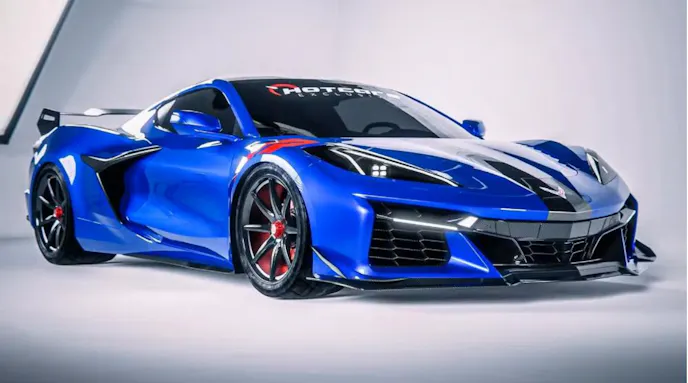
They did it. And in doing so, they created the most torque-rich naturally aspirated production V8 in history. The LS6 will power the 2027 Corvette Stingray, Grand Sport, and Grand Sport X — not a reserved special-edition engine, but the standard bearer for America’s sports car.
The jump from the outgoing 6.2-liter LT2 to 6.7 liters was not predetermined. According to Kociba, the team originally planned a 6.6-liter engine — until digital simulation tools opened a new possibility. By adding just .32” to the piston’s stroke (from 3.62” to 3.94’), they unlocked another 33 cubic inches of displacement with zero penalty elsewhere.
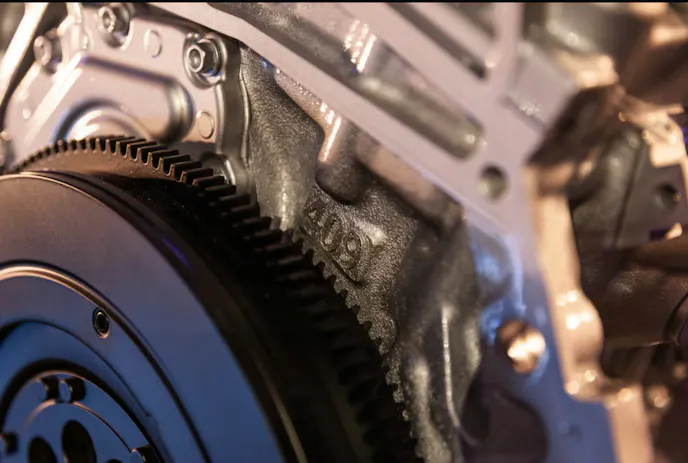
“We were going to make it ‘only’ 6.6 liters, and then we started playing around and realized that by adding .32” to the stroke, we get more performance without compromising anything else,” Kociba said. “In the past, we might not have explored that.”
The bore remains at 4.065” and bore spacing stays at the classic 4.4-inch measurement that has defined every Small Block since 1954. The result: 6.7 liters, or 409 cubic inches — a number with deep resonance in American muscle car history, identical to the displacement Chevrolet celebrated in 1962.
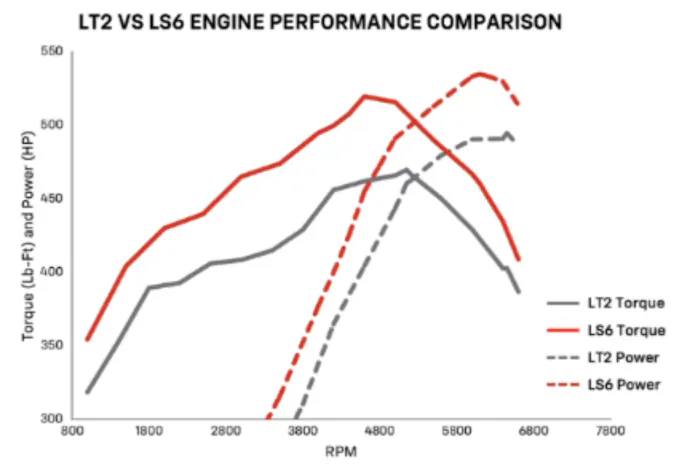
Kociba framed the design goal as a tribute to the muscle car era: “We wanted a wide, high torque band, and high power. It feels like we’re bringing a piece of Americana back.” The LS6 delivers power and torque improvements across the entire rev range up to its 6,600 RPM redline — not just at peak numbers, but everywhere a driver actually uses the engine.
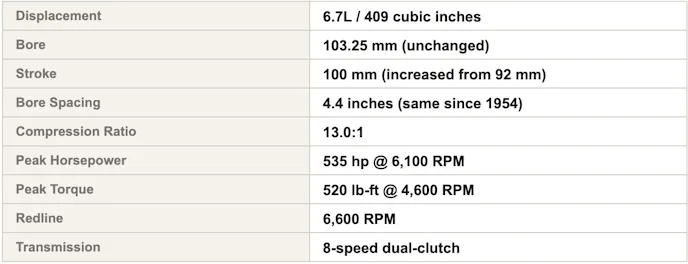
After 30 years of building high-performance vehicles and creating a company, HTR Performance Engineering, that’s focused on excellence in high-output engine development and engine management calibration, I can tell you that the new LS6 has a lot of potential. One of the engine’s most remarkable achievements is its 13.0:1 compression ratio — the highest ever fitted to a production Corvette. For context, the legendary 427-cubic-inch L88 Big Block of 1967–1969, a V8 built specifically for racing, ran 12.5:1 compression. It required leaded fuel to survive. The new LS6 exceeds that on ordinary pump gas.
“That was 12.5:1 on leaded fuel,” Kociba noted. “The only way we could pull off beating that today with unleaded fuel was with our advanced controls.” A new ECU gives engineers unprecedented precision over fueling and ignition timing, preventing the detonation that would have destroyed an earlier engine at this compression level.
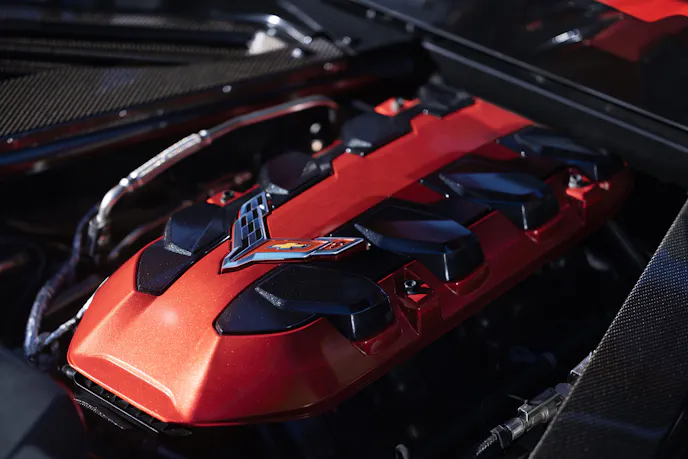
High compression directly improves thermal efficiency — the measure of how much fuel energy is converted into mechanical motion rather than wasted as heat. In practical terms, the LS6 extracts more work from every drop of fuel than its predecessors, which is a core reason the engine achieves better emissions alongside more power.
Kociba compared the cumulative effect of all these upgrades — larger displacement, higher compression, new induction, and new controls — to the impact of bolting a small supercharger onto the LT2, but without the added weight, complexity, or lag that forced induction brings.
All About The Details
Power ultimately comes from moving air, and the LS6’s induction system is purpose-built to flow as much as possible. At the front end sits a larger 95 mm throttle body — an increase over the LT2 — paired with a tunnel ram intake featuring high-velocity ports. The design accelerates air into the combustion chamber, improving volumetric efficiency and amplifying the torque that the large displacement already generates. The short runners lend themselves to higher-end power, while the longer stroke offsets the low-speed torque.
Fueling is handled by a dual-system combining both port injection and direct injection, allowing the engine management system to optimize delivery strategy for every driving condition. At light loads and low RPM, port injection keeps intake valves clean and combustion smooth. Under hard acceleration, direct injection delivers precise fuel placement for maximum power extraction. The port injectors are strategically aimed at the intake valve using a single stream shot to not interrupt the intake ports ability to just move airflow. Which is a benefit of Direct Injection engines.
Cylinder heads for the LS6 have also been revised from the prior Gen 5 LT cylinder head. Significant improvements to cooling through the use of an additional coolant passage, which is independent from the coolant that normally flows through the block. These passages are also targeting traditional hot spots, such as the exhaust valves and spark plugs. Keeping these areas better thermally managed allows higher compression ratios and more aggressive spark advance for improved power output.
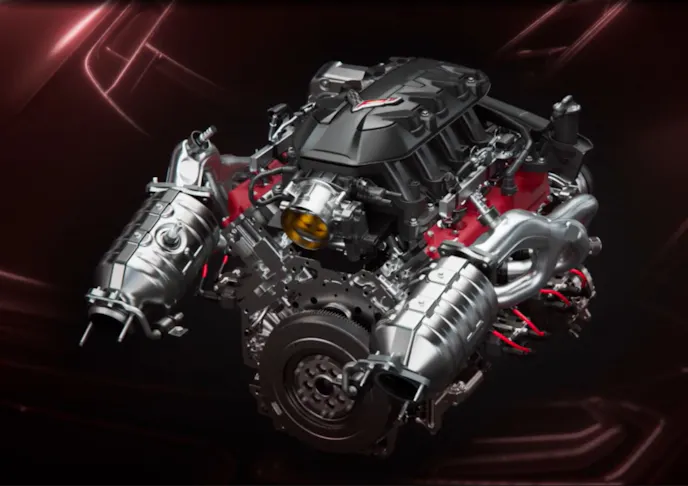
Additionally, both the intake and exhaust valves have been shifted 1 mm towards the intake side to improve port angle and unshroud the valves for better flow. Tied into the cylinder heads’ design, a more thoughtful camshaft profile was derived to feed the LS6. Lift is the same as the LT2, but with the higher flowing “tuned” runner intake manifold, a wider exhaust duration, and a later closing of the intake valve was ground for the LS6’s bump stick. Interestingly enough, the engineer’s approach to the intake ports was actually to make them smaller than the prior Gen 5 motor to stimulate a faster high-flow port. This, combined with the short runner and larger plenum intake, is where efficient airflow was extracted.
The LS6’s lubrication system also received improvements to ensure consistent oil pressure under the sustained lateral and longitudinal loads of circuit driving. An additional feed to the main bearings was added for two points of flow. This added supply significantly improves oil temperature control under high loads. A new continuously variable oil pump is controlled by the ECU to increase and decrease oil pressure as needed for optimal use and demands. As part of the overall oiling and scavenging system, the engineers added a three-stage scavenge pump to help offset the increase in displacement and better control engine crankcase pressures, especially at higher RPM.
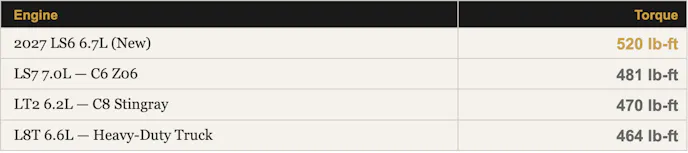
Inside the block, GM opted for a set of forged pistons and connecting rods, replacing cast units and saving weight while dramatically increasing strength for sustained high-load and track operation. Surely a welcome starting point for future modifications. But with 520 lb./ft. of torque, the LS6 already surpasses every naturally aspirated V8 GM has ever produced, including engines with greater displacement.
Power And Efficiency
The engineering challenge that consumed much of the LS6’s development was not making power — it was making power without the usual environmental penalty. The team discovered early in the design process that the combination of larger displacement, higher compression, and advanced controls could actually improve emissions relative to the 6.2-liter LT2 it replaces. The LS6 achieves a reported 28% reduction in emissions over its predecessor, alongside an improvement in fuel economy that GM has not yet fully disclosed.
This outcome runs counter to automotive conventional wisdom. Larger engines almost always mean higher emissions. But the LS6’s thermal efficiency advantage means less unburned fuel and fewer byproducts exit the combustion chamber. The dual-injection system ensures optimal air-fuel ratios across all operating conditions, and the advanced ECU manages combustion with a precision simply unavailable to earlier engine generations.

The practical implication extends beyond the current model year. An engine that makes more power, generates less pollution, and burns fuel more completely is an engine with regulatory longevity — one built to survive tightening emissions standards for years to come.
GM has committed over $1.5 billion across four U.S. manufacturing facilities to support the Gen 6 small-block program, including $579 million for Flint Engine Operations and $888 million for Tonawanda. The LS6 is not just a Corvette engine — it is the foundation of GM’s next generation of V8s, with architecture upgrades that will soon extend to other V8-powered Chevrolets. The Corvette gets it first. Everything else follows.
You might also like
GM Reveals Gen 6 LS V8 Power Numbers For 2027 Silverado And Sierra
GM reveals Gen 6 V8 power for the 2027 Silverado and Sierra, including a 481hp 6.6L L78 and 402hp 5.7L L76.