

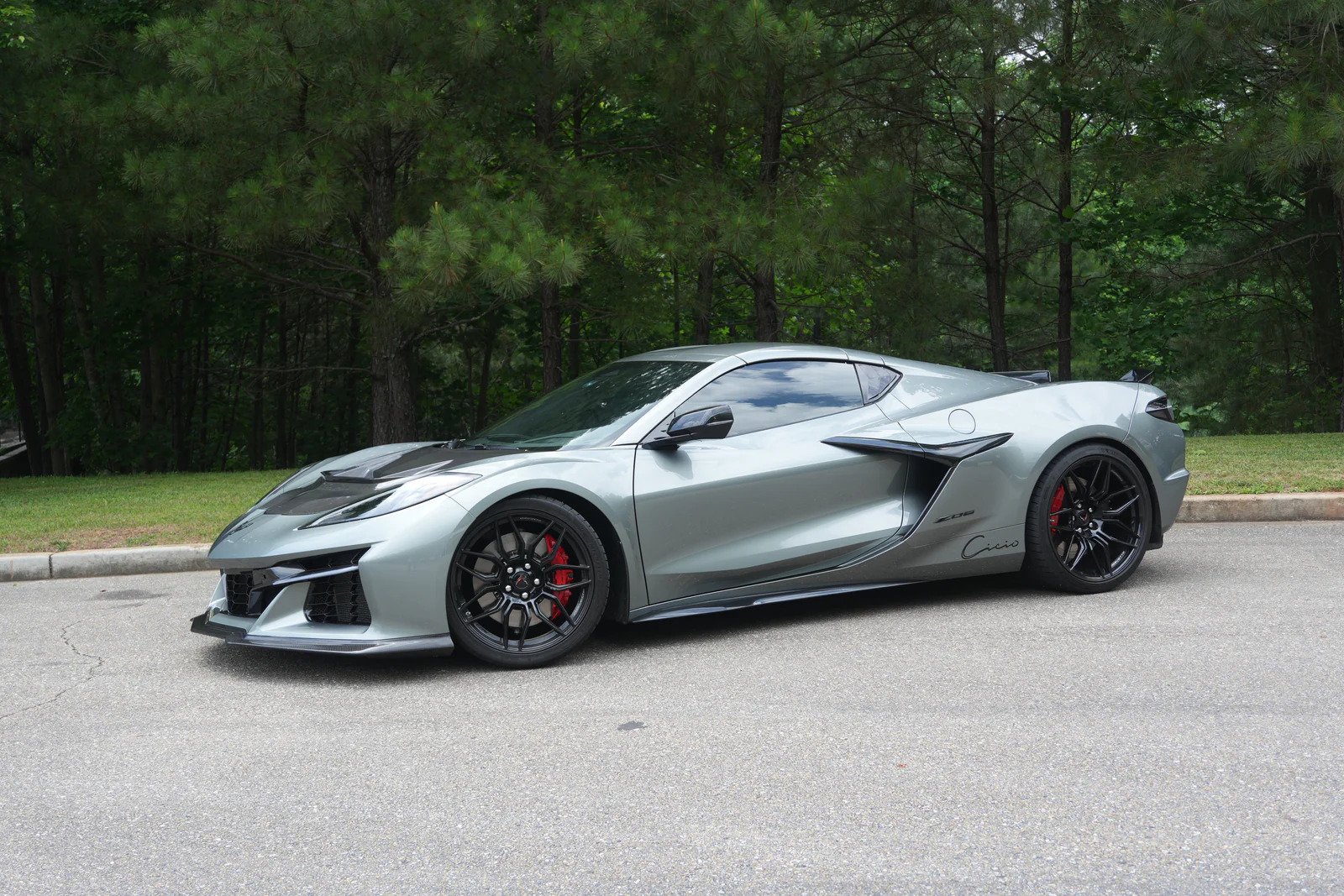
There is a particular kind of frustration known only to Z06 owners. You have a 5.5-liter, flat-plane crank masterpiece under the hood — an engine that howls to 8,600 rpm and produces 670 horsepower straight from the factory — yet when you step on it from a roll, the torque curve tells a different story. The LT6 is a rev-happy, high-revving screamer built around the top end of the tachometer. Down low and in the mid-range, it leaves something on the table.
Cicio Performance, with operations in Alpharetta, GA, and Tampa, FL, has spent years wringing records out of twin-turbocharged exotics. And when they saw that gap in the C8 Z06’s performance, they built a kit to fill it.
The C8 Z06 had always been on our radar, but we were waiting for native calibration support. This finally came available, so we wasted no time relighting the program.” — Andrew Pasik, Sales Representative, Cicio Performance
Georgia’s Premier Forced Induction House
Founded by Nathan Cicio, Cicio Performance has built its reputation on one simple premise: big power, done right. The shop made its name on twin-turbocharged Nissan GT-Rs, Audi R8s, Lamborghinis, and Porsches — platforms where the margin for error is slim and the expectations are sky-high. That culture of precision and reliability carried over the moment the mid-engine C8 Corvette arrived in 2020.
“Georgia’s leading C8 performance shop” is a title they wear with confidence. When the base C8 Stingray landed with its LT2 V8, Cicio immediately attacked it with a twin-turbo system that set the tone for the entire C8 forced-induction market. As the platform evolved, so did their program. But the Z06 required patience.
The 5.5-liter LT6 is a hand-built, flat-plane crank engine unlike anything Chevy has put in a production car before. Its exotic architecture demands careful calibration support before an aftermarket turbo kit can be bolted on responsibly. That support took time to develop — but once it arrived, the Cicio team moved fast.
The Factory Bar: LT6 And The C8 ZR1
To understand what Cicio has accomplished, it helps to understand the engine they started with — and where Chevrolet itself eventually went with forced induction on the C8 platform.
The LT6 in the Z06 is a remarkable piece of engineering. Its flat-plane crankshaft, derived from racing applications, allows for faster-revving combustion pulses and a more aggressive exhaust note. The 8,600 rpm redline is intoxicating. At peak output, the engine is a genuine rival to purpose-built exotic powerplants from Europe. But by design, peak power comes high in the rev range. The torque curve is comparatively flat through the mid-range — polite numbers for an engine of its ambition.
Chevrolet acknowledged that reality when it unveiled the C8 ZR1. The flagship Corvette departs from the naturally aspirated formula entirely, arriving from the factory with a pair of turbochargers bolted to its 5.5-liter flat-plane engine, producing 1,064 horsepower. The ZR1 represents Chevrolet’s own answer to the question of what the LT6 architecture can do with forced induction — and the answer, it turns out, is extraordinary.
Cicio Performance arrived at the same conclusion through the aftermarket. Their C800 package is, in spirit, what Z06 owners have been waiting for: the torque and mid-range grunt that the naturally aspirated engine leaves behind, delivered in a package that maintains the car’s day-to-day character.
The C800 Package: Built Around The Stock Car
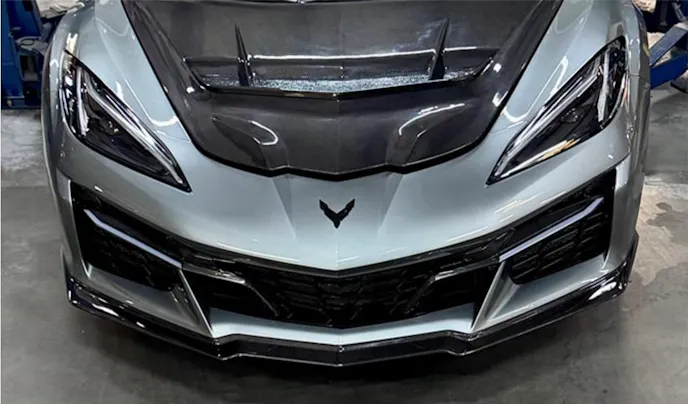
The C800 package is Cicio’s purpose-built twin-turbo kit for the C8 Z06, priced at $39,995 installed and tuned. The first five clients to sign up were offered a discounted rate of $37,500 — a nod to the brand’s history of rewarding early adopters.
What makes the C800 stand apart from a typical turbo kit is its philosophy: design everything around the stock platform. The engine is not rebuilt. The transmission is not reinforced. The fuel system is not upgraded. Cicio engineered the entire package to work within the factory limitations of the LT6, delivering over 800 horsepower on pump fuel without requiring the customer to spend another dollar on internal components.
“The C800 package was engineered to unlock the untapped potential of the C8 Z06 while maintaining the drivability, reliability, and refinement expected from a factory-level experience,” the shop stated. “Designed around the limitations of the stock fuel system, the C800 package safely and consistently delivers 800+ horsepower using the factory engine and transmission.”
Turnaround time is in the 10–15 business day range, meaning owners aren’t without their car for months while components are sourced and fabricated. The kit ships, gets installed, gets tuned, and the car goes back to its owner transformed.
Hardware: The ETS Connection
The turbo hardware at the heart of the C800 was developed in collaboration with Extreme Turbo Systems (ETS), a name well-known in the high-horsepower import community and increasingly prominent in the domestic forced-induction market. The result of that partnership is a system purpose-built for the LT6.
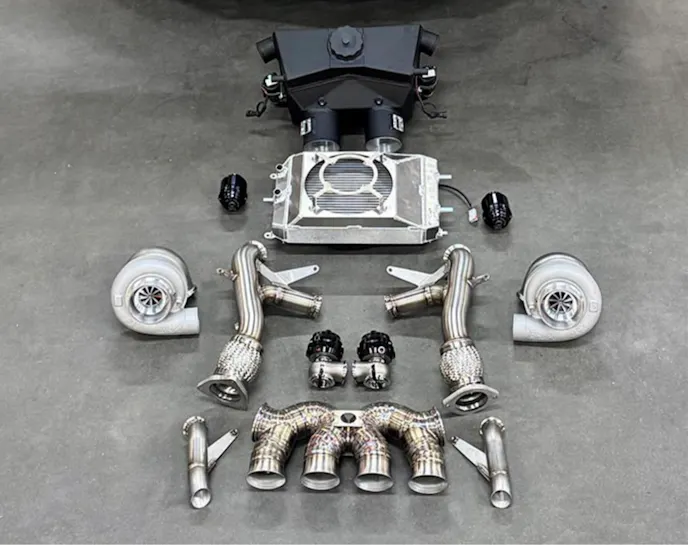
At the center of the kit are a pair of custom-spec 58 mm Xona Rotor turbochargers. Xona Rotor builds billet compressor wheel turbos known for their efficiency and quick spool characteristics — a particularly important attribute on a high-revving engine like the LT6, where boost onset timing matters as much as peak output. The turbos are paired with Tial wastegates, which are the industry benchmark for boost pressure control, and an air-to-air intercooler handles charge temperature management.
The result on 7 pounds of boost is a system that builds pressure quickly, cools the charge air efficiently, and controls boost pressure with precision — all through a piece of hardware designed to bolt onto the LT6 without modification to the block, heads, or rotating assembly.
The Science Of The Tune: Taylor Leier At The Wheel
Hardware is only half the story. On a platform as complex as the LT6 — with its individual throttle bodies, variable cam timing, sophisticated torque management, and flat-plane firing order — the calibration work is where the real magic happens. That responsibility falls to Taylor Leier, Cicio Performance’s lead calibrator.
Leier has earned his reputation working on some of the most demanding turbocharged platforms in the market — GT-Rs, Lamborghinis, C8 Stingrays — and the Z06 presented a unique set of challenges that tested every tool in his arsenal.
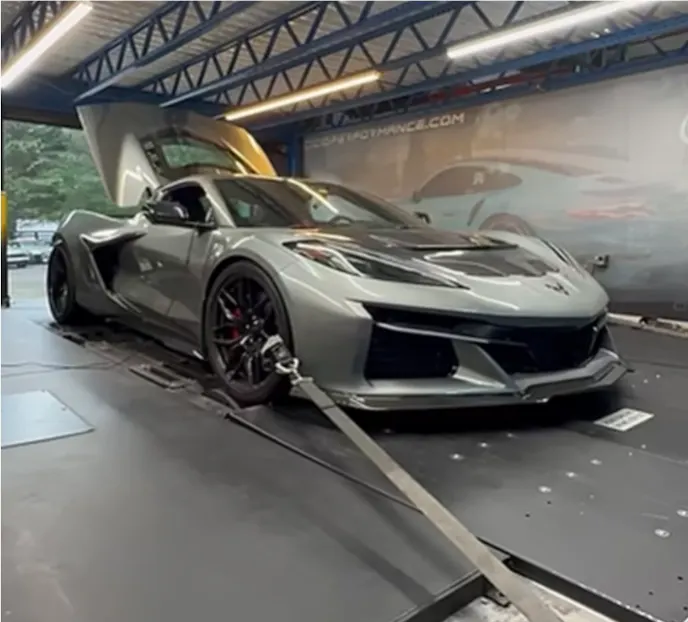
One of the first issues was the intake manifold butterfly (IMTB) valves. From the factory, these valves do not transition smoothly through their operating range, which creates lumpy, inconsistent torque delivery in the mid-range. Leier spent considerable time manipulating the IMTB valve behavior in the calibration to smooth out that curve and maximize torque production through the portion of the rev range where the naturally aspirated engine falls short.
Cam timing optimization was another layer of complexity. With boost added to an engine that already relies heavily on variable intake and exhaust cam timing for its power character, Leier worked to find the overlap and advance curves that made the most of both worlds — the factory cam strategy and the added energy of the turbocharger.
The individual throttle bodies, which are central to the LT6’s naturally aspirated feel, presented their own hurdle under boost. Under forced induction, the stock throttle body control logic tends to restrict airflow as the engine’s torque model sees more cylinder pressure than it was calibrated to handle. Leier worked through the factory torque model to allow the throttle bodies to remain open under boost conditions — a detail that separates a professional tune from a rough-edged calibration.
And then there is the transmission. Without direct torque table access for the automatic’s shift logic, the calibration still needed to produce clean, confident shifts through all gears at elevated power levels. Leier reports the transmission is shifting precisely, with no signs of slip even in the upper gears under full load — a testament to how well the stock ZF unit responds to a well-executed tune.
Manipulating the IMTB valves to smooth out the curve and optimizing cam timing with boost—that’s where you really find the mid-range the factory left on the table.” — Taylor Leier, Lead Calibrator, Cicio Performance
The Numbers: Dyno Results
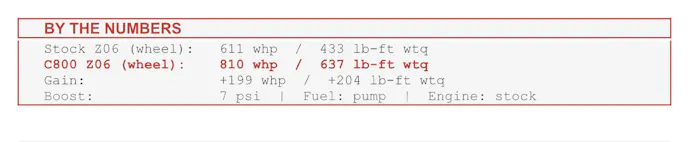
The first C8 Z06 through the C800 program told the story in numbers. The car baseline tested at 611 wheel horsepower and 433 lb./ft. of wheel torque — a real-world figure that reflects the LT6’s drivetrain losses from its rated 670 crank horsepower.
After the C800 installation and tune, the same car produced 810.4 wheel horsepower and 637.46 lb./ft. of wheel torque. That is a gain of 199.4 wheel horsepower and 204.46 lb./ft. of torque — on just 7 pounds of boost, with the stock engine, stock transmission, and stock fuel system intact.
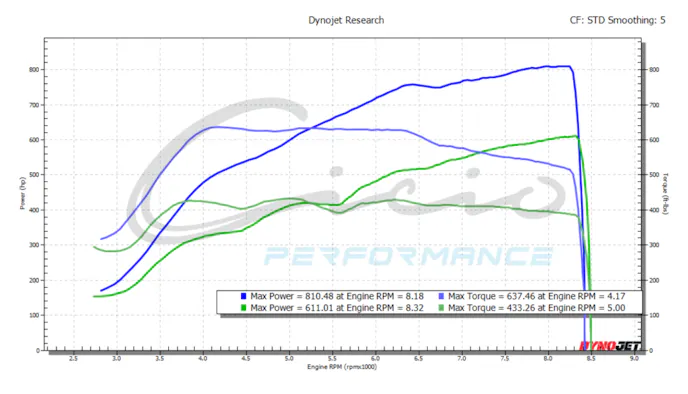
The torque number is particularly telling. At 637 lb./ft. to the wheels, this is no longer a car that rewards only those willing to chase the redline. The torque curve that was once the Z06’s quiet limitation has been reshaped into a proper mid-range weapon — the kind of force that pins you to the seat in the gears that matter most in real-world driving.
The Full C8 Menu
The C800 for the Z06 is Cicio’s newest chapter, but it sits within a broader C8 Corvette program that has been developing since the platform launched. For Stingray owners looking to transform their LT2-powered cars, the shop offers the C700 and C700X packages, targeting approximately 650 wheel horsepower on low boost with a driving character that remains smooth and manageable. The C700X adds an X-pipe exhaust for a more aggressive sound profile.
At the top of the Stingray hierarchy sits the C900 and C900X, pushing roughly 900 horsepower and 700 lb./ft. of torque on approximately 11–13 pounds of boost and E85 fuel. These builds run the stock internal engine components but add a piggyback MoTeC ECU system that integrates seamlessly with the factory electronics. Every package across the lineup shares the same DNA: maximum performance, minimum drama, and a factory-comparable ownership experience.
The Bottom Line
The C8 Z06 in stock form is a remarkable achievement. But for the enthusiast who has lived with the naturally aspirated LT6 and felt that slight itch of wanting more — more mid-range, more torque, more presence in the gears between the redline pulls — the Cicio C800 package addresses every one of those feelings directly.
At $39,995 installed and tuned, it is not an inexpensive proposition. But consider what is included: a full twin-turbo system with Xona Rotor turbochargers, Tial wastegates, and an air-to-air intercooler; a complete exhaust system; HP Tuners-based software integration; and a professional calibration from one of the more respected tuners in the high-performance Corvette community. No engine teardown. No rebuilt transmission. No upgraded injectors. One bill, one visit, one transformed car.
The factory LT6 screams. The Cicio C800 gives it something to back that scream up with. Contact Andrew Pasik and the Cicio Performance team to learn more.
You might also like
Cadillac Celebrates 125 Years With A $239,000 Escalade-V Collector Series
Cadillac unveils the 2027 Escalade-V 125th Anniversary Collector Series, a $239,000 supercharged V8 SUV limited to just 252 examples.