

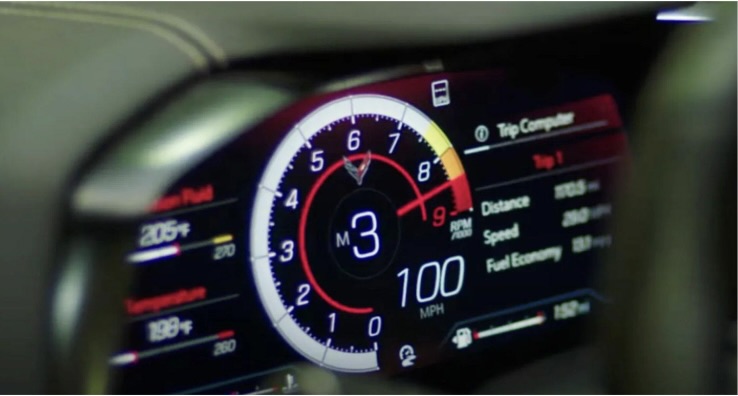
The crankshaft is the backbone of any internal combustion engine — the rotating centerpiece that converts the linear motion of pistons into the rotational force that ultimately drives the wheels. In a V8, the geometry of how those crank pins are arranged fundamentally defines how the engine behaves: how it breathes, how it balances, how it sounds, and how high it will rev.
For nearly a century, the American V8 has been synonymous with the cross-plane crankshaft — a design with pins arranged 90 degrees apart, forming an “X” shape when viewed from the front. It produces the iconic, burbling exhaust note that defines muscle cars and pickup trucks. But starting with the 2023 Corvette C8 Z06 and its all-new LT6 engine, General Motors made a deliberate and historic departure: a flat-plane crankshaft in a production American performance V8.
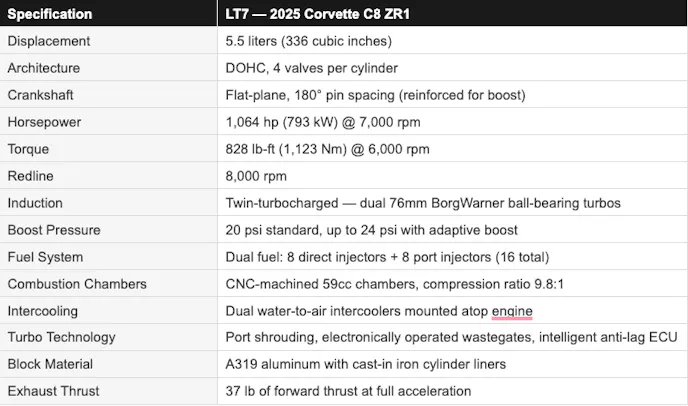
The decision didn’t stop there. The 2025 Corvette C8 ZR1 carried the philosophy even further with the twin-turbocharged LT7 — an engine that uses the same flat-plane architecture to produce 1,064 horsepower and 828 lb./ft. of torque, making it the most powerful production V8 ever built by an American manufacturer. Together, the LT6 and LT7 represent GM’s “Gemini” architecture — two siblings engineered in tandem from the very beginning.
And yet, in a fascinating parallel story, Cadillac Racing’s championship-winning V-Series.R prototype racer tells the other side: a 5.5-liter V8 that deliberately uses a cross-plane crankshaft for 24-hour endurance racing, where smooth power delivery and reliability trump the exotic character of the flat-plane. Same displacement, entirely different engineering philosophy — and entirely different missions.
Crankshaft Geometry: The Cross-Plane Crankshaft
To visualize the cross-plane design, imagine looking at the front of the crankshaft with a compass. In a cross-plane V8, one crank throw points north, the next points east, the third points south, and the fourth points west — each offset by 90 degrees. This arrangement, with throws forming a literal cross shape, has been standard American V8 practice since Cadillac’s engineers developed it in the early 1920s.
The problem it solved: Early flat-plane V8s suffered from severe second-order vibration — shaking at twice crankshaft speed. Roland Hutchinson, a GM mathematician working in Dayton, Ohio in 1921, solved this by designing the “quartered” crankshaft. By spacing the throws 90 degrees apart, the unbalanced piston forces cancel each other out, producing a V8 that runs with remarkable smoothness across its entire RPM range. Cross-plane V8s use crankshaft counterweights to achieve near-perfect primary balance. The cost is weight and rotational inertia.
Crankshaft Geometry: The Flat-Plane Crankshaft
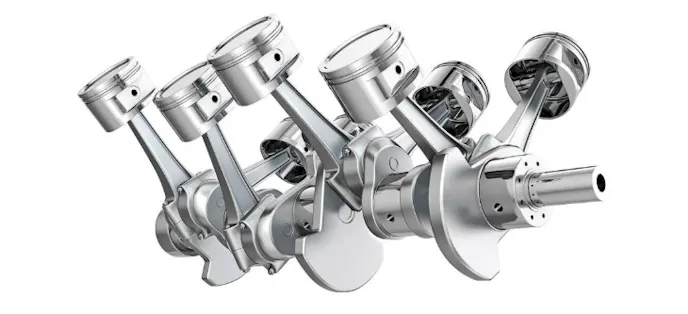
In a flat-plane design, the four crank pins sit in a single plane — two pointing up and two pointing down, separated by 180 degrees. This mirrors the crankshaft geometry of a four-cylinder engine; the flat-plane V8 is essentially two inline-four engines joined at the hip.
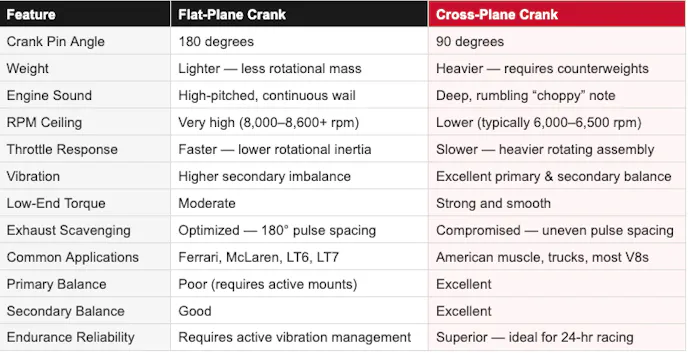
The absence of heavy counterweights makes the flat-plane crank significantly lighter and reduces rotational inertia. This means the engine responds to throttle inputs almost instantaneously and can spin to very high RPMs that would be unsafe in a heavier cross-plane rotating assembly. The trade-off is that second-order vibration returns. Modern engineering addresses this through stiff engine mounts, harmonic dampers, and active engine mount systems.
Why Firing Order Matters
Beyond balance, the most practically significant consequence of crankshaft geometry is firing order — the sequence in which cylinders fire relative to each other and the exhaust system. In a cross-plane V8, the uneven 90-degree pin spacing means both cylinder banks experience moments where two cylinders fire in rapid succession. In the 6.2L LT2 V8 found in the standard C8 Stingray, the firing order results in the third cylinder in the left bank firing immediately after the first cylinder in the same bank — with only 90 degrees of crankshaft rotation between them.
This matters enormously for exhaust scavenging. When one cylinder finishes its exhaust stroke and expels gases down the pipe, it creates a low-pressure wave that — if timed correctly — helps pull exhaust out of the next cylinder. This is called scavenging, and it dramatically affects volumetric efficiency and peak power. With only 90 degrees of separation, exhaust pulses from a cross-plane V8 can stack up in the collector, increasing back-pressure and reducing this beneficial scavenging effect.
Flat-Plane’s Exhaust Advantage
In a flat-plane V8, combustion events always alternate between the left and right cylinder banks. Each bank sees a new exhaust pulse every 180 degrees of crankshaft rotation — just like an inline-four engine. This even spacing gives exhaust gases ample time to clear the manifold before the next pulse arrives, maximizing scavenging efficiency and allowing engineers to design exhaust systems that are both more effective and more straightforward.
This is one of the core reasons why flat-plane V8s can produce more power per liter than cross-plane designs, and why they allow higher RPM limits — better exhaust flow means the engine can breathe more freely at elevated engine speeds.
The Sound Difference
The auditory signature of each design is perhaps the most immediately recognizable difference for enthusiasts. The cross-plane V8 fires unevenly across its banks, creating the rhythmic burble and deep, lopey rumble that defines American muscle. The flat-plane V8 sounds entirely different — a high-pitched, continuous wail that rises relentlessly toward the redline. Because it effectively operates as two independent four-cylinder engines joined together, it fires evenly and consistently. The result is an exhaust note reminiscent of a Ferrari or McLaren: exotic, screaming, and spine-tingling at high revs. The C8 Z06’s LT6 produces exactly this kind of sound — un-American in the best possible way, and entirely intentional.
LT6: GM’s Naturally Aspirated Masterpiece
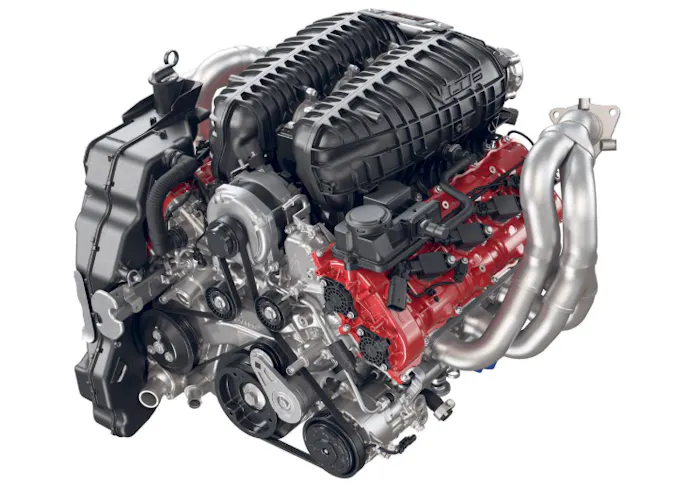
The LT6 program, internally codenamed “Small Block Gemini,” represented a clean-sheet DOHC V8 design built around the flat-plane crankshaft from the outset. GM drew on two seasons of racing experience with the Corvette C8R — powered by a 5.5L DOHC flat-plane V8 in IMSA WeatherTech SportsCar Championship competition — to accelerate development. The racecar served as a rolling laboratory, allowing engineers to validate thermal management, lubrication, and valve timing strategies under the most punishing conditions imaginable before the engine reached production.
The engine’s 5.5L displacement was achieved by shortening the stroke of the LT2’s 6.2L architecture. A shorter stroke means pistons travel less distance per cycle, allowing the engine to spin faster safely. Combined with a large bore, this creates an “oversquare” design — perfect for a high-RPM screamer.
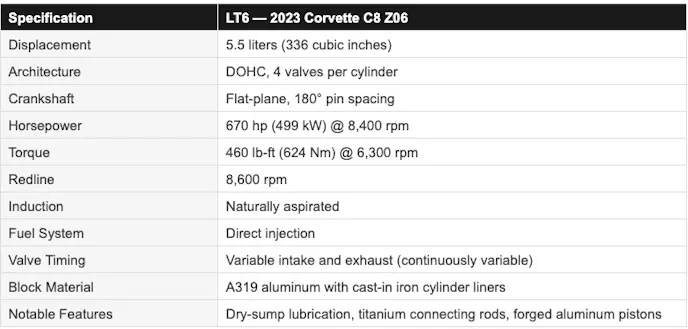
The LT6 redlines at 8,600 rpm — a figure that would have been unthinkable in an American production V8 a decade ago. This is made possible by the flat-plane crank’s lower rotational inertia and the engine’s short-stroke, large-bore architecture. By comparison, the LT4 supercharged V8 in the C7 Z06 redlined at just 6,500 rpm — a difference of 2,100 rpm that fundamentally transforms the driving experience.
LT7: A Twin-Turbo Flat-Plane Record Breaker
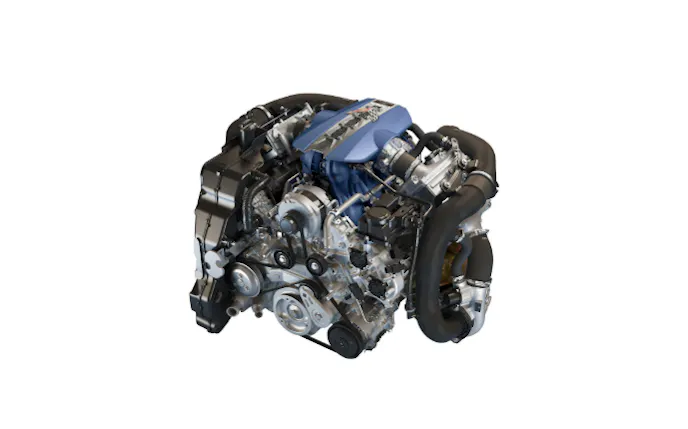
When GM engineers designed the LT6, they were simultaneously developing its turbocharged sibling. The “Small Block Gemini” program was always conceived as a family of two engines — one naturally aspirated, one force-fed — both sharing the same flat-plane crankshaft foundation. This dual-path development meant that by the time the LT7 was unveiled alongside the 2025 Corvette C8 ZR1, it was not an afterthought. It was the plan all along.
Crucially, GM did not simply bolt turbos onto an LT6. As Chevrolet stated: “Engineers did not create an LT6 with turbochargers, but instead changed and optimized virtually every system for a boosted application.” The block, heads, pistons, connecting rods, crankshaft, fuel system, lubrication system, and cooling system were all modified or redesigned to survive and exploit forced induction. While sharing the same architecture and dimensions, the LT7’s crankshaft is uniquely reinforced to handle the massive stress of its twin turbochargers.
Flat-Plane Crank: Why Keep It Under Boost?
Many observers expected GM to abandon the flat-plane crankshaft for the turbocharged ZR1. After all, forced induction typically favors lower-RPM torque production — a domain where the heavier, counterweighted cross-plane crank excels. But GM kept the flat-plane, and the reasoning is multifaceted.
First, the even exhaust pulse spacing of a flat-plane crank is particularly valuable with turbochargers. Each turbo receives evenly spaced exhaust pulses from its four-cylinder bank, allowing it to spool more consistently and efficiently. Uneven pulse spacing, as seen in cross-plane applications, can cause turbines to experience alternating high and low energy inputs, reducing efficiency and increasing turbo lag. The flat-plane’s inherent regularity is an asset, not a liability, in a forced-induction application.
Second, the lighter rotating assembly enables faster throttle response — critical in a 1,064 horsepower supercar where the difference between power-on and power-off must be instantaneous and controllable. The LT7’s peak power arrives at 7,000 rpm, and its 8,000 rpm redline means the driver has a broad, usable power band that extends well into territory a cross-plane engine simply cannot safely reach.
The Other Path: Cadillac V-Series.R And The Cross-Plane Racing V8
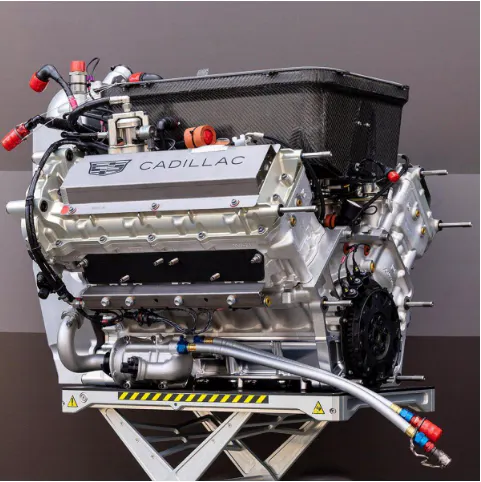
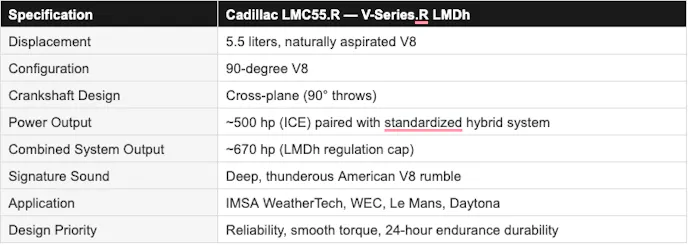
While Chevrolet’s production Corvettes embraced the flat-plane revolution, Cadillac Racing made a striking counterintuitive choice for its championship-winning LMDh prototype: a naturally aspirated 5.5-liter V8 with a cross-plane crankshaft. The Cadillac LMC55.R engine — the heart of the Cadillac V-Series.R — stands out in the modern Hypercar/LMDh class, where most competitors use turbocharged or flat-plane configurations.
The result is unmistakable on track: while rival prototypes whine and shriek, the Cadillac V-Series.R thunders through corners with a deep, American V8 rumble that is immediately recognizable to any motorsport fan. It is a deliberate sonic and engineering statement.
Why Cross-Plane for Endurance Racing?
The engineering rationale is clear once you consider the mission. Unlike sprint racing, endurance competition — the Rolex 24 at Daytona, the 12 Hours of Sebring, the 24 Hours of Le Mans — demands that an engine operate at racing speeds for an entire day or night, often under the most punishing thermal and mechanical conditions imaginable. In this environment, the virtues of the cross-plane crankshaft become decisive:
Superior mechanical balance: The cross-plane crank’s counterweighted design cancels out primary and secondary vibration forces that would fatigue engine components over a 24-hour run. Every vibration cycle is a stress cycle, and endurance engines must withstand millions of them.
Smooth power delivery: The even firing intervals of a cross-plane V8 provide consistent torque throughout the RPM range, reducing stress on the drivetrain and giving drivers more predictable throttle response when managing tire wear over long stints.
Proven reliability: The cross-plane geometry has been refined over a century of V8 development. Its inherent balance characteristics mean less reliance on complex active damping systems that could introduce additional failure points in a racing context.
Same Displacement, Different Worlds
The juxtaposition is remarkable: the production LT6 in the C8 Z06 and the racing LMC55.R in the V-Series.R both displace exactly 5.5 liters and both draw from GM’s deep well of V8 engineering expertise. Yet they arrive at opposite conclusions on crankshaft geometry, reflecting entirely different performance mandates.
The LT6 is optimized for a road car driver who wants maximum excitement per mile: a screaming rev ceiling, exotic exhaust note, and instantaneous throttle response. The LMC55.R is optimized for a professional racing driver who needs to trust their engine for 24 consecutive hours: smooth power, minimal vibration fatigue, and mechanical predictability under extreme conditions.
Neither choice is wrong. They are simply right for their respective missions — a testament to how deeply crankshaft geometry shapes an engine’s fundamental character.

What The Gemini Engines Mean For Automotive History
The LT6 and LT7 are not simply powerful engines. They represent a philosophical statement: that the flat-plane crankshaft, long considered the domain of European exotic cars, is now a defining characteristic of America’s most iconic sports car.
General Motors made this choice deliberately. Engineers could have built a cross-plane DOHC V8 with turbochargers and produced enormous torque in a more conventional package. Instead, they chose a path that prioritizes the full high-RPM experience — the sound, the throttle response, the character — that only a flat-plane engine delivers.
The Gemini architecture also demonstrates the power of simultaneous engineering. By developing the LT6 and LT7 in parallel from day one, GM ensured that the turbocharged ZR1 engine would share architecture with the naturally aspirated Z06 engine without compromising either design. This is a level of powertrain planning that few manufacturers execute successfully.
And by choosing a cross-plane configuration for the Cadillac V-Series.R, GM demonstrates something equally important: that it understands each tool in its engineering arsenal, and knows when to deploy which one. The flat-plane delivers the spectacle. The cross-plane delivers the endurance. Together, they define what GM’s V8 program has become in the modern era.
For Corvette enthusiasts and automotive engineers alike, the LT6, LT7, and LMC55.R stand as proof that the century-long story of the American V8 is still being written — and the next chapter is more exciting than ever.
You might also like
ATI 6R80E Transmission Kit Brings Six-Speed Power To LS Swaps
The ATI 6R80E transmission kit adapts Ford's six-speed automatic to bolt behind LS and LT Chevy engines rated up to 1,000 horsepower.