



Chevrolet’s Gen-V small-block has been around for a decade already, and while it hasn’t eclipsed the fabled Gen-III and IV LS as the engine of choice among enthusiasts, companies like Late Model Engines (LME) have shown it has the potential to make even more horsepower than its predecessor. At the recent PRI Show, it unveiled its new standard and raised deck billet LT1/LT4 engine blocks.
Late Model Engines was founded in Houston, Texas, in 2003 and has been one of the innovators in LS and LT engine tech ever since. The introduction of its new billet aluminum LT1/LT4-style blocks at PRI 2025 had the show buzzing and crowds packing its booth. The blocks not only come in two deck heights, but they can be solid for pure race applications or water-jacketed for street applications.
The fabrication process for the water-jacketed version is remarkable in and of itself.
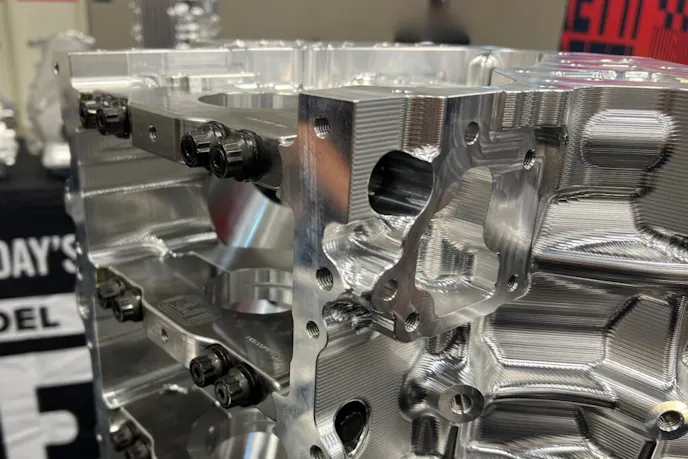
“The block is cut and and then we have a full insert that is machined billet and we press into here (the block),” explained LME Co-Founder Pecos Laughlin. “There are grooves going around the outside (of the bore), and we inject epoxy to seal and hold, and then we put the sleeves in it afterwards.”
The end result is a block that can support 3,000 or more streetable horsepower with water. It is made from 6061 T6 aluminum with billet main caps.
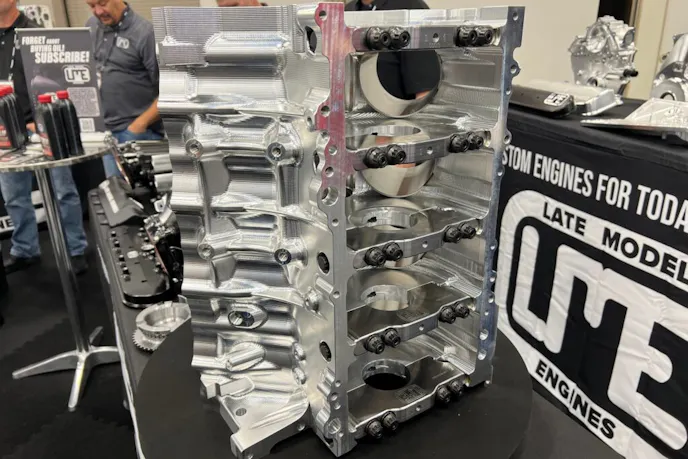
The process is the same for LME’s LS blocks, too, which have been on the market for a while now.
The six-bolt main LT blocks and billet caps are all made in house. Another interesting part is how LME captures the cap with the skirts of the block. It is also doweled with the OD-ground main stud where it locates into the bore. It runs 1/2-inch main studs and 1/2-inch side bolts as well.
The raised block has a raised cam. It is offered in a 55mm, but LME can do 60mm also, but the latter gets rid of direct injection. The deck height is 9.750-inches versus 9.240 in the standard block.
“Both LS and LT are offered with and without water in a 9.240- or 9.750 deck height,” said Bryan Neelen, co-founder of LME.
For the uninitiated, the LME solid blocks would not need filler like an old-school OE design. This makes them perfect for drag racing. The traditional-style blocks have near the factory capacity for coolant with the strength of a billet block.
The lifter bore options are standard .842-inch, .903-inch, and .937-inch keyed for tie-bar or keyway lifters.
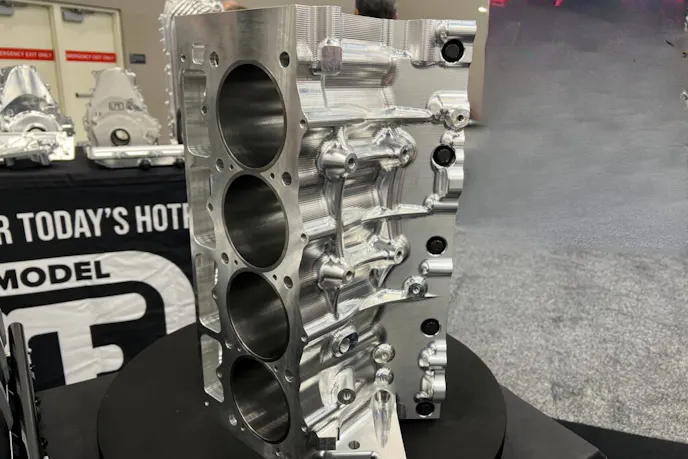
Late Model Engines is ramping up production as this is written, and will be able to tailor them precisely to the customer’s needs, so if you need a specific lifter bushing setup or cam diameter, LME can accommodate that.
“One thing that’s cool about this is there’s nothing else on the market that’s available in a tall-deck LT, so we’re looking forward to building some nice, naturally-aspirated 502s, 468s, you know, step up the game in the naturally-aspirated world with the LT,” said Neelen. “In the LS world, we’ve been running 441 cubic-inch tall-deck turbocharged engines for a long time, and that works out really well, so 4.125 bore with 4.125 stroke, tall-deck — you can’t beat it for power and durability.”
You might also like
Project Swedish Meatball: Introducing Our Wild LS-Swapped Volvo Wagon
We're stuffing a turbocharged 5.3L LS and six-speed transmission into this 1994 Volvo wagon.