

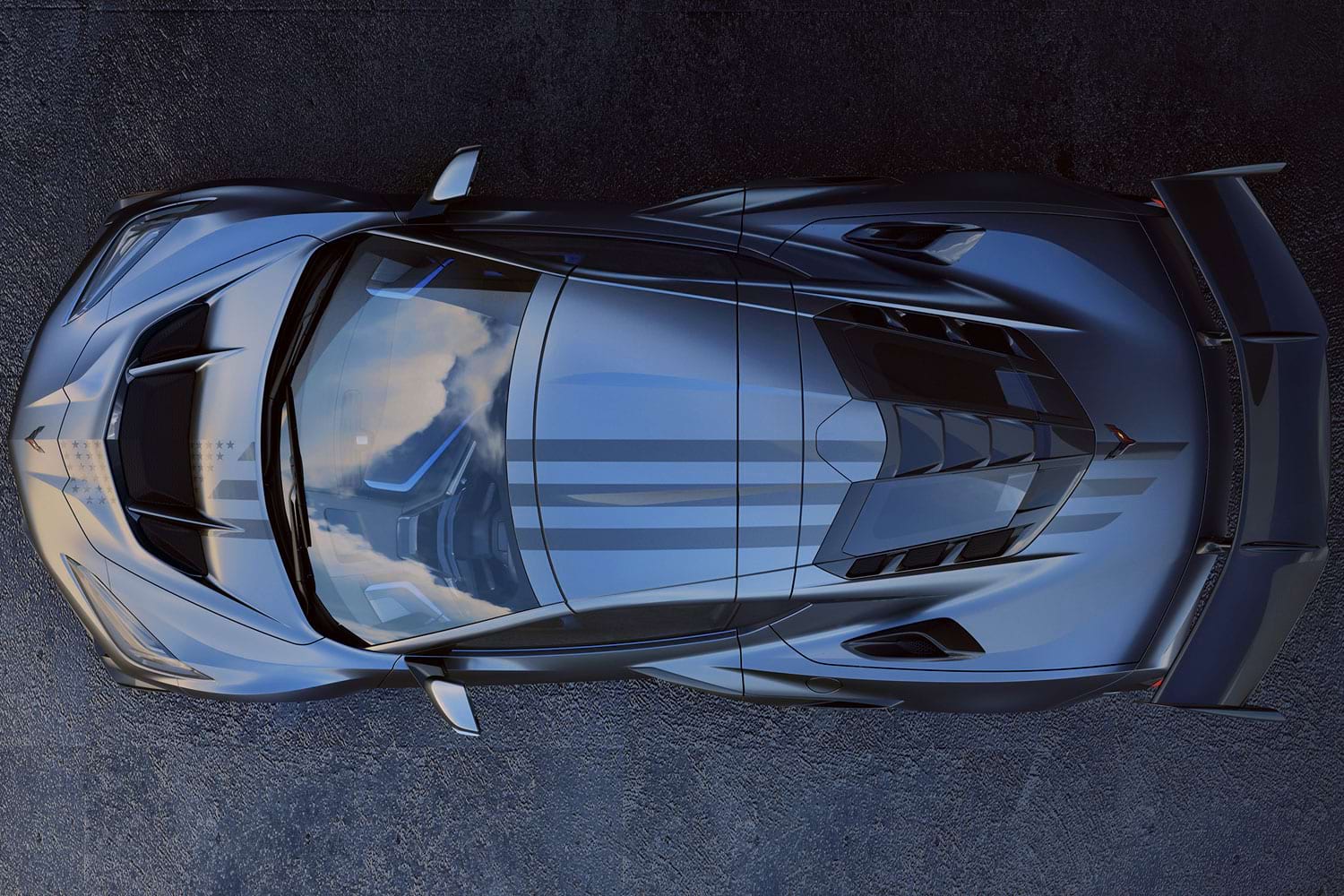
General Motors’ Magnetic Ride Control (MRC), also known as MagneRide, stands as one of the most revolutionary suspension technologies ever developed for production automobiles. By replacing conventional mechanical valving with magnetized fluid, it delivers a system capable of adapting shock absorber damping in real time — adjusting to road conditions faster than the human eye can blink. What began as a niche innovation on a luxury Cadillac sedan has evolved across four generations into a defining feature of GM’s performance and luxury lineup, culminating in its sophisticated implementation on the mid-engine C8 Corvette.
The Recipe For MagneRide
Magnetic Ride Control was initially developed under the name MagneRide by Delphi Automotive Corporation, an automotive supplier with deep roots in General Motors. In 1994, GM established an internal parts and components division called the Automotive Components Group (ACG). By 1995, this organization had been renamed Delphi Automotive Systems, and in 1999 it was spun off as a fully independent, publicly held corporation. It was within this environment of engineering innovation that the foundational research on magnetorheological (MR) fluid-based damping took shape.
The engineers at Delphi recognized that the traditional approach to adaptive suspension, relying on computer-controlled mechanical valves within the shock absorbers, introduced unnecessary mechanical complexity and slower response times. Valves have moving parts, and moving parts introduce lag, wear, and failure modes. The team’s insight was to eliminate the valve entirely and instead use the hydraulic fluid itself as the control mechanism. By infusing the fluid with microscopic magnetized iron particles, they discovered they could alter the fluid’s resistance to flow simply by applying an electromagnetic field: no moving parts required.
The result was a suspension system of extraordinary speed and precision, and General Motors introduced it to the world as a mid-year update to the 2002 Cadillac Seville STS, marking the debut of production magnetorheological suspension on an American vehicle. Following Delphi’s financial troubles and Chapter 11 bankruptcy filing in 2005, the MagneRide business unit was ultimately acquired by Beijing West Industries (BWI), which continues to manufacture and develop the technology to this day.
The Secret’s In The Sauce
The core of Magnetic Ride Control is magnetorheological (MR) fluid: a specialized medium unlike any conventional shock absorber oil. MR fluid is a synthetic hydrocarbon oil in which microscopic magnetic particles, typically ranging from 3 to 10 microns in diameter, are suspended in a colloidal solution. In their resting state, these particles are randomly distributed throughout the fluid and have no significant effect on the fluid’s viscosity. The fluid flows freely and behaves much like conventional hydraulic oil.
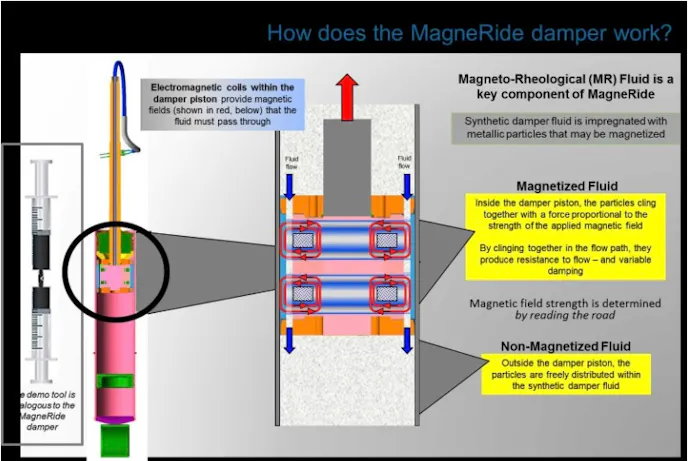
The transformative property of MR fluid emerges when it is exposed to a magnetic field. When an electromagnetic coil within the shock absorber piston is energized, the magnetic field causes the iron particles to align themselves in chains perpendicular to the direction of fluid flow; specifically across the narrow fluid passages in the piston. These chains of aligned particles create a fibrous, lattice-like structure that dramatically restricts the flow of fluid through the piston. The result is an increase in the effective viscosity of the fluid, which stiffens the damper.
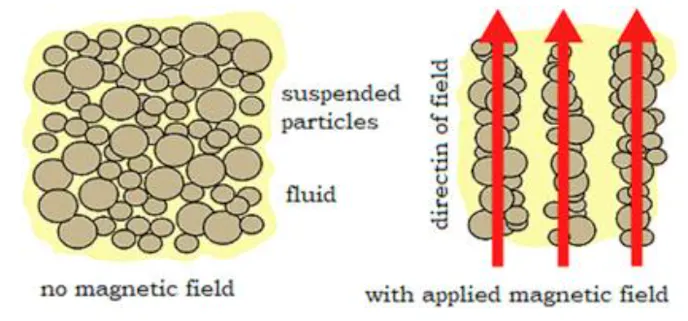
One of the most remarkable capabilities of MR fluid is the sheer range of viscosity states it can achieve. By adjusting the electrical current delivered to the electromagnetic coils, the system can move the fluid along a continuous spectrum from its free-flowing baseline state all the way to a near-solid consistency, effectively locking the damper at maximum stiffness. Crucially, this is not a binary on/off switch; it is an infinitely variable continuum.
This means engineers can program the Electronic Control Unit (ECU) to “draw” virtually any force-velocity curve for the damper, meaning any desired relationship between how fast the suspension moves and how much resistance it provides. This level of control was previously impossible with traditional mechanical valving, which offered only a limited number of discrete settings.
Perhaps the most astonishing characteristic of MR fluid-based suspension is how fast it can change states. The original first-generation MagneRide system was capable of altering damping resistance in less than one millisecond. To put that in perspective, a human eye blink takes approximately 150 to 400 milliseconds. That means the suspension can complete a full transition from soft to firm and back again roughly 150 to 400 times in the duration of a single blink.
The system reads road conditions and adjusts the shocks every five milliseconds, 200 times per second, making it among the fastest-reacting adaptive suspension systems ever engineered for a production vehicle. This near-instantaneous response is what allows Magnetic Ride Control to smooth out individual potholes, react to sudden body roll during hard cornering, and adapt to surface changes mid-corner without any perceptible delay to the driver.
The speed advantage comes directly from the physics of MR fluid: there are no mechanical valves to open or close, no hydraulic actuators to move, and no servomotors to spin. The change in viscosity occurs at the molecular level, driven purely by electromagnetic force, which travels at nearly the speed of light.
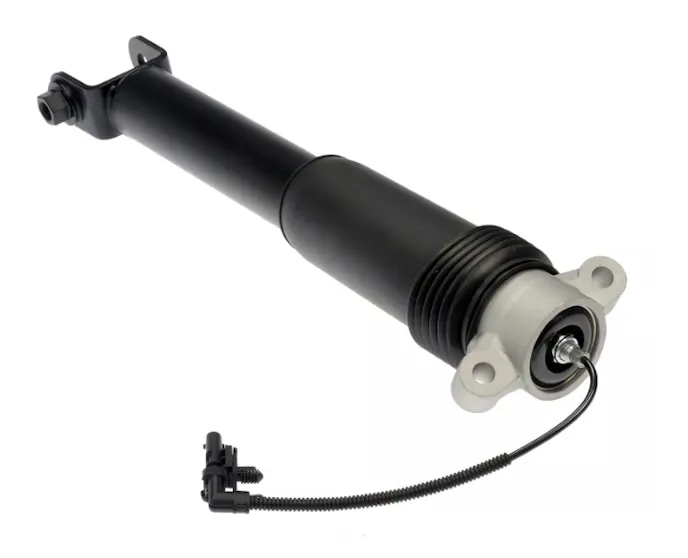
Each Magnetic Ride Control shock absorber is a monotube damper, or a single-chamber design that offers better heat dissipation and more consistent performance than traditional twin-tube shocks. Inside this monotube housing sits a piston that travels up and down as the wheel moves over road imperfections.
In the third-generation MagneRide design, the piston contains two electromagnetic coils wound in opposite directions, along with two small fluid passages. When the coils are de-energized, the MR fluid flows freely through these passages as the piston moves, resulting in a soft, compliant damping force. When the ECU commands an increase in stiffness, it sends a precisely controlled electrical current to the coils, generating a variable magnetic field across the fluid passages. The iron particles in the fluid instantly align with the field, restricting flow and increasing resistance proportionally to the current strength.
Aging Like A Fine Wine
The use of two opposing coils in Generation Three was a deliberate engineering solution to a specific problem discovered in earlier generations. With a single coil, a phenomenon known as eddy current caused a delay of approximately 20 milliseconds from the moment the ECU cut electrical current to the moment the damper actually lost its magnetic field and softened. While 20 milliseconds sounds trivially short, at speed it can represent meaningful distance traveled and can affect the smoothness of suspension transitions. The dual-coil, opposing-winding design effectively cancels out this residual eddy current, allowing the damper to respond to commanded softening just as instantly as it responds to commanded stiffening.
Magnetic Ride Control is not simply a set of smart shock absorbers. It is an integrated sensing and computing system. While the MR dampers themselves are passive components, it is the array of sensors feeding data to the ECU that gives the system its intelligence. Over successive generations, the sensor suite has grown significantly in sophistication.
At the heart of the sensing system are accelerometers, devices that measure acceleration forces in one or more axes. The system uses both body-mounted and, in later generations, wheel hub-mounted accelerometers. Body accelerometers measure the motion of the vehicle’s sprung mass (the body, chassis, and occupants), detecting heave (vertical bounce), pitch (nose-up/nose-down rocking), and roll (side-to-side lean). Wheel hub accelerometers in the fourth-generation system directly measure the motion of each individual wheel, or the unsprung mass, providing a faster and more direct read of road surface inputs before those inputs have a chance to propagate into the body.
Wheel speed sensors provide the ECU with precise data on how fast each individual wheel is rotating. This information is critical for several reasons. It allows the system to detect wheel lockup or spin (important for coordinating with ABS and traction control). It allows calculation of vehicle speed, and it provides a proxy for understanding load transfer under acceleration and braking.
A steering angle sensor mounted in the steering column tells the ECU exactly how much the driver has turned the wheel and in which direction. This is predictive information, as it tells the system a lateral load event (a corner) is imminent before the body has even begun to roll. With this advance notice, the ECU can pre-load the appropriate dampers to resist body roll from the very first moment the vehicle begins to change direction, rather than waiting to react after the roll has begun.
Dedicated lateral (side-to-side) and longitudinal (front-to-back) accelerometers measure the g-forces the vehicle is experiencing in real time. Lateral g-forces indicate cornering intensity and help the system tailor anti-roll damping. Longitudinal g-forces indicate braking and acceleration events, allowing the system to stiffen the front shocks under hard braking (to resist dive) and stiffen the rear shocks under hard acceleration (to resist squat).
Overall vehicle speed, derived from wheel speed sensors and communicated via the vehicle’s CAN bus, allows the ECU to apply speed-appropriate damping maps. At low speeds over rough surfaces, softer settings maximize comfort. At highway speeds, the system progressively firms up to improve stability and reduce the effects of aerodynamic forces.
Different Flavors For Different Tastes
On most vehicles equipped with Magnetic Ride Control, the driver can select from multiple suspension modes — typically labeled Tour, Sport, and Track (or Race). These driver inputs communicate directly to the ECU and shift the entire operating envelope of the system: the baseline damping levels, the aggressiveness of the response algorithms, and the thresholds at which the system intervenes. In Tour mode, the system prioritizes compliance and comfort. In Sport, it biases toward firmer body control. In Track mode, it maintains near-maximum stiffness at all times while still reacting to individual wheel events.
The first-generation MagneRide system debuted on the 2002 Cadillac Seville STS. It featured a single electromagnetic coil within each monotube damper piston and a relatively simple ECU by modern standards. Despite this, it was a technological leap. The system read road conditions roughly 1,000 times per second and adjusted damping in under one millisecond. It demonstrated that MR fluid was a viable production technology and set the benchmark for adaptive suspension responsiveness.
The second generation brought refinements to the fluid formulation, the ECU algorithms, and the sensor integration. The single-coil architecture was retained, but improvements in the ECU’s processing capability allowed for more nuanced damping maps and better integration with the vehicle’s other dynamic control systems. This generation saw MagneRide spread to additional Cadillac models and begin its integration into the Corvette lineup.
The third generation represented the most significant architectural change since the system’s inception. The most impactful hardware change was the transition from a single-coil to a dual-coil piston design, with the two coils wound in opposing directions. As described above, this eliminated the eddy current delay, making the system’s response to commanded softening as fast as its response to commanded stiffening.
The third-gen ECU was entirely redesigned, boasting three times the computing capacity and ten times the memory of its predecessor. This was partly driven by a regulatory requirement for lead-free electronics, which necessitated a clean-sheet ECU design. The engineers used this opportunity to substantially improve tuning precision and expand the system’s operating algorithms. Enhanced seals and bearings were also incorporated to extend the system’s durability envelope and enable its use on heavier vehicles, including pickup trucks and SUVs.
The fourth generation of MagneRide, as implemented on the C8 Corvette and other current GM performance vehicles, represents the current pinnacle of the technology. Its defining hardware innovation is the addition of accelerometers mounted directly in every wheel hub. These sensors measure the motion of the unsprung mass (the wheel, tire, and hub assembly) directly and independently of the body’s motion.
The practical significance of this is profound. Previous generations inferred what the road surface was doing primarily from body motion sensors, meaning the system was always reacting to inputs that had already begun to travel up through the suspension. With wheel hub accelerometers, the system can detect a road surface disturbance at the wheel level and begin adjusting the damper before that disturbance has fully propagated into the body. This makes for even smoother, more imperceptible transitions and allows for finer control over body motion separation.
The eighth-generation Corvette (C8), which debuted for the 2020 model year as GM’s first mid-engine production Corvette, represented a complete ground-up redesign of the platform. The decision to mount the engine behind the driver, a layout long favored by exotic European sports cars for its superior weight distribution, created both opportunities and challenges for the suspension system.
With the engine’s mass now located between the axles rather than overhanging the front, the C8 achieves a near-ideal 40/60 front-to-rear weight distribution. This layout places enormous demands on the rear suspension during hard acceleration and cornering, making precise, rapid damping control more important than ever. Magnetic Ride Control was the natural choice.
Sustenance For LT And LS Enthusiasts
The C8’s fourth-generation MRC system works in concert with the Corvette’s Performance Traction Management (PTM) system, its electronic limited-slip differential, and its available electronic power steering to create a fully integrated chassis dynamics platform. The wheel hub accelerometers give the system an unprecedented window into what each tire is actually experiencing at the contact patch: information used not just to control the dampers but also to inform the broader suite of chassis systems.
The C8 Corvette offers a range of driver-selectable modes — Weather, Tour, Sport, Track, and the optional Z-mode on higher-trim variants — each of which reconfigures the Magnetic Ride Control system alongside the powertrain, steering, and stability control parameters. In Tour mode, the system delivers a remarkably supple, long-travel ride for what is fundamentally a track-capable sports car. Switch to Track mode, and the algorithms shift to maximize body control and tire contact patch consistency, using the near-instantaneous response of MR fluid to keep the Corvette flat, communicative, and exploitable at high speed.
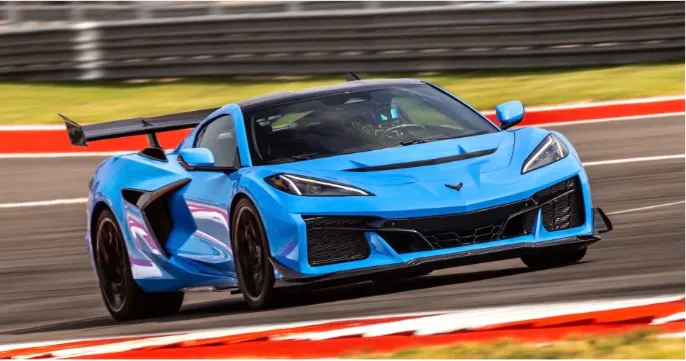
The C8 Z06 and C8 ZR1 add even greater performance requirements, and their MRC calibration reflects the higher g-loads, more aggressive aerodynamic downforce levels, and wider performance envelope of each variant. The Magnetic Ride Control system on the Z06 is tuned to work in harmony with the available carbon fiber wheels and stickier performance tires to maximize lateral grip and body control on the circuit.
On the C8, Magnetic Ride Control delivers its signature dual promise: ride quality that belies the car’s performance capabilities in casual driving, and body control that rivals purpose-built race cars when pushed to the limit. Independent testing has confirmed that the C8 Corvette produces lateral acceleration figures that match or exceed cars costing several times as much, with MRC cited as a key enabler of that performance. The system’s ability to manage the transition between the C8’s relatively large suspension travel (necessary for ride comfort on public roads) and the rigid body control needed at high cornering speeds remains one of the benchmark achievements in adaptive suspension engineering.
From its debut on the 2002 Cadillac Seville STS to its fourth-generation implementation in the C8 Corvette, General Motors’ Magnetic Ride Control has traced a remarkable evolutionary arc. What began as an elegant solution to the limitations of mechanical valving has grown into one of the most sophisticated suspension technologies available on any production vehicle in the world.
The technology’s secret weapon, magnetorheological fluid, remains as elegant in its principles today as it was when Delphi’s engineers first conceived it: microscopic iron particles, suspended in synthetic oil, that snap into alignment at the command of an electromagnetic field and relax again the instant the current ceases. The speed of that response, the absence of mechanical complexity, and the infinite variability of the damping curve make MR fluid a uniquely powerful tool for chassis engineers.
As the C8 Corvette demonstrates, when that technology is paired with a sophisticated array of sensors like body accelerometers, wheel hub accelerometers, steering angle sensors, wheel speed sensors, and lateral/longitudinal g sensors, and governed by an ECU with the processing capacity to synthesize all of that data in real time, the result is a suspension system that truly seems to anticipate the road rather than merely react to it. That combination of prediction, precision, and speed is the enduring legacy of GM’s excellent Magnetic Ride Control system.
You might also like
Project Swedish Meatball Gets A Fresh AutoMeter Gauge Cluster
AutoMeter’s InVision Digital Dash and CAN Bridge give LS-swapped vehicles a modern, plug-and-play gauge cluster solution.