

Six years into the mid-engine Corvette, the aftermarket has found the C8’s weak link, and it isn’t the engine. Twin-turbo and supercharged LT2 builds now put down well over 1,000 wheel horsepower, and the most extreme cars run past 1,300. All of it goes through the same part: the TREMEC TR-9080, the eight-speed dual-clutch transaxle that is the C8’s only transmission.
The TR-9080 was engineered around a 495 HP Stingray. At two and three times that output, it is starting to fail in a predictable order. First, the clutch slips. Then builders hit a controller that won’t clamp it any harder. Solve both, and the shafts and gears inside the case start to break.
In part one of Breaking The C8 Corvette Transmission: What Fails And How To Fix It, we’ll dive into common failures and explain why they’re happening.
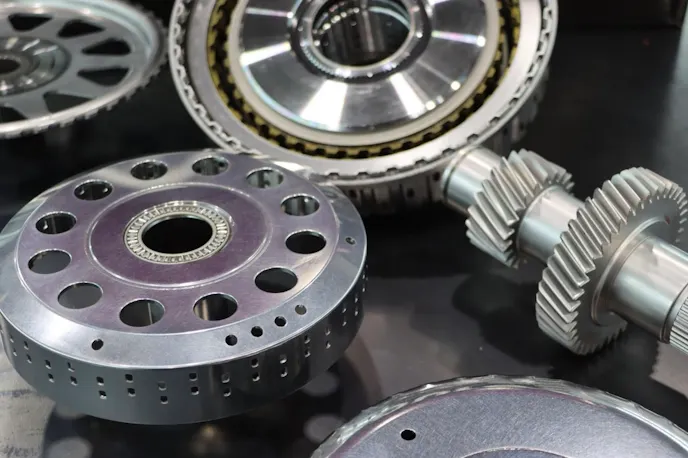
How The TR-9080 Carries Power
The TR-9080 packs more shafts, gears and hydraulic servos into one case than almost any other modern car transmission. Five aluminum castings hold two clutches, six shafts, five synchronizers, about two dozen gears and five shift rods, providing eight forward speeds, reverse and a park lock. TREMEC rated the first versions for 590 lb./ft. (800 Nm) of input torque at up to 7,500 RPM. Every part is a link in the path to the rear wheels, and a place where an overpowered build can find a limit.
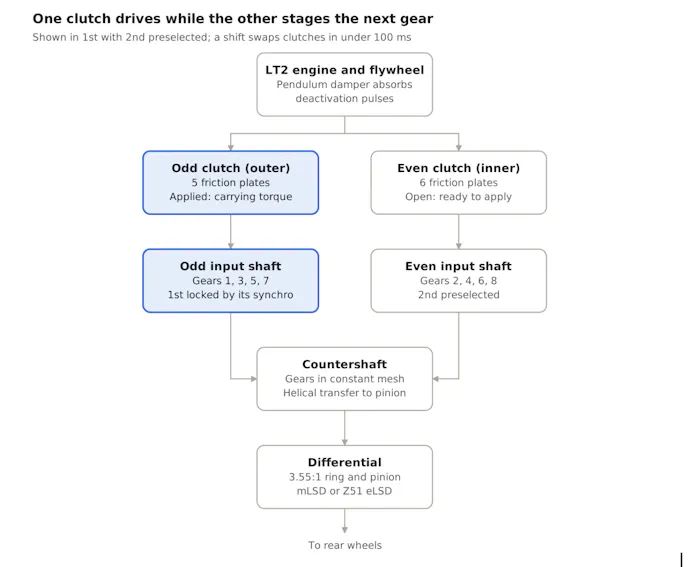
The core idea is simple: the TR-9080 is two manual gearboxes sharing one case. One clutch and main shaft carry the odd gears; the other carries the even gears. While the car pulls in one gear, the transmission control module (TCM) has already engaged the next one on the idle shaft, so a shift is a clutch handoff rather than a gear change. The incoming clutch starts engaging before the outgoing one releases, an overlap of about 100 milliseconds with no break in torque. Short hydraulic circuits and fast-acting solenoids make that possible.
From Crankshaft To Clutch
Power enters through a flywheel carrying the starter ring gear and a centrifugal pendulum damper, which quells the torsional pulses the LT2 makes when it switches between four- and eight-cylinder modes. TREMEC buys the assembly from a Tier 2 supplier, and Chevrolet shrank its diameter so the engine could sit an inch lower than in the C7.
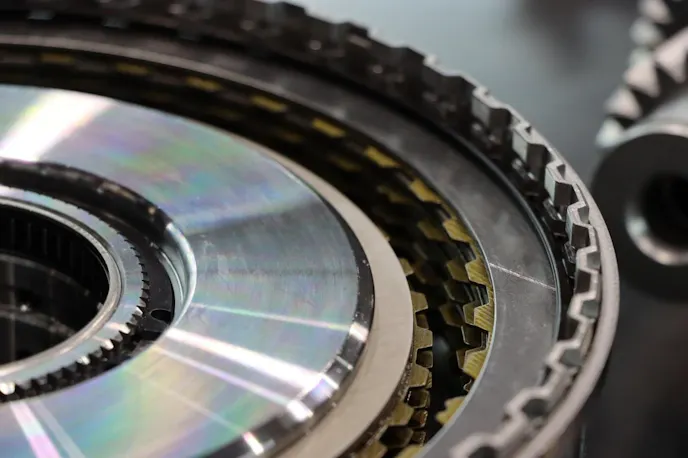
Behind it sit two normally open wet clutches, nested one inside the other to save length. Hydraulic pistons that rotate with the clutches squeeze them closed on the TCM’s command. The outer clutch has five driven plates and turns the main shaft carrying the odd gears at the rear of the transaxle. The inner clutch has six, one more to make up for its smaller diameter, and turns the main shaft carrying the even gears at the front. The main shafts are concentric too: the inner clutch drives the outer shaft, and the outer clutch drives the inner one.
Either clutch can serve as a launch clutch. For performance launches the TCM can briefly command over-torque engagement, pushing clamp force past the clutch’s steady-state capacity.
Gears, Synchronizers, And The Final Drive
As in a manual gearbox, every main-shaft gear is permanently meshed with a mate on the countershaft. No torque flows until the actuators slide two of the five triple-cone synchronizers into place, locking the selected gear to the main (input) shaft and its partner to the countershaft (output). Three friction surfaces instead of one speed up engagement when the next gear is pre-selected in the background.
Torque leaves the countershaft through helical gears to a pinion shaft that drives a spiral-bevel ring gear. To drop the engine an inch lower than in the C7, TREMEC put the input shafts at the very bottom of the case, below the countershaft and final drive. Final drive is 4.89:1 with the base car’s mechanical limited-slip differential and 5.17:1 with the Z51’s electronic unit, and the 8.8:1 overall spread gives a short first gear and a tall, quiet eighth.
The shaft layout also governs shifting. In normal driving the TR-9080 never skips a gear. Under a full-throttle kickdown it will jump ratios, such as 7th to 4th, 6th to 3rd or 5th to 2nd, as long as the shift crosses from an odd gear to an even one.
Hydraulics, Fluid, And Control
Clutch apply, synchronizer movement and differential control are all electro-hydraulic. Three electro-hydraulic control bodies, packed with solenoids and pressure and position sensors, do the work under a single master controller. That controller, the TCM, reads shaft speeds, throttle, brake pressure, steering angle, lateral and longitudinal g and drive mode, then decides how hard to clamp each clutch.
One fluid does everything. It lubricates the gears and bearings, cools and conditions the clutch frictions and serves as hydraulic fluid for the servos. TREMEC engineers called developing that single fluid one of the program’s biggest challenges. The answer was Pentosin FFL-4, a synthetic from Fuchs. About 11 liters sit in a bottom pan, pressurized by a gear-driven pump and cooled by a stacked-plate heat exchanger on top of the transaxle that circulates engine coolant. The specified service interval is a fluid change every 22,500 miles and a filter change every 7,500.
That shared oil is why a slipping clutch does so much damage. And because clamp force comes entirely from this hydraulic system, the TCM decides how much power ever reaches the gears behind the clutch.
Failure One: The Clutch Slips
The clutch pack is the first grip point. Every gear, shaft and ring gear behind it only sees the torque the clutch can hold. When clamp force falls short of engine torque, the pack slips, usually first on the 2-3, 3-4 and 4-5 shifts under boost.
TREMEC’s 590 lb./ft. rating sits comfortably above the stock LT2’s 470 lb./ft., but leaves little room for a power adder. Extreme Turbo Systems, the first shop to pass 1,000 HP in a C8, found the stock clutches weren’t up to the job and replaced them before its record runs.
Wet clutches tolerate slip far better than dry ones because fluid carries the heat away. But sustained slip under boost still glazes the frictions and cooks the fluid, and because that fluid is shared with the gears, hydraulics and differential, a slipping clutch overheats and contaminates the whole transaxle.
Failure Two: A Controller That Wouldn’t Clamp
A stronger clutch only helps if something commands enough pressure to close it. That job belongs to the TCM, a TREMEC-developed 32-bit unit that sets clamp pressure from its own model of engine torque. Add 500 HP and the TCM doesn’t know it. It keeps commanding pressure for a stock engine, and the clutch slips. For most of the C8’s life, nobody outside TREMEC and GM could change that.
In the early years, even the engine controller was encrypted, and builders such as FuelTech ran a second, standalone ECU alongside the factory unit just to make power. HP Tuners cracked the Stingray’s E99 ECM in 2023, but the TCM stayed closed. Even though ECM tuning handled most of the problem, there was always an underlying limit with the TCM not being accessible.
What followed was calibration voodoo. Tuners had the ECM report more torque than the engine made, tricking the TCM into commanding more clamp, which worked for modest gains but ran out of range on big builds. Piggyback pressure boxes raised clutch pressure by a fixed 5, 10, or 15 percent, or overrode it at set throttle and RPM points. Harder, higher-plate-count clutch packs bought capacity at whatever pressure the TCM allowed, at the cost of harsh low-speed shifts. Each fix worked around the controller rather than changing it, and each traded drivability for clamp.
The deeper problem is that holding torque and controlling it are different things. A pack can be built to hold far more than stock power, but without control over clamping pressure, engagement rate, slip targets, and torque intervention, even a good one runs hot, wears quickly, and fails early. Some clutch developers shelved their programs rather than sell hardware the factory controller couldn’t support.
Failure Three: The Hard Parts Break
Get the clutch to hold and the TCM to clamp it, and the problem moves downstream. The full output of a 1,000-plus wheel horsepower engine now reaches the TR-9080’s shafts and gears instead of being lost to slip, and the power-hungry end of the industry is breaking them.
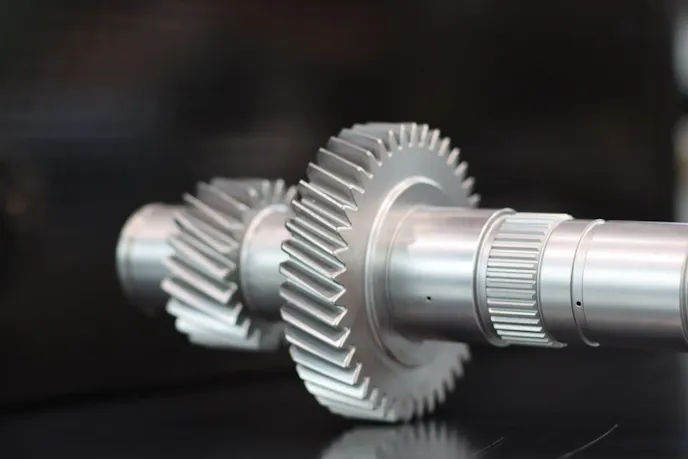
The input shafts go first. Low-mileage transmissions behind true 1,300-plus wheel horsepower combinations have snapped them. On its own, that is an expensive inconvenience: a broken input shaft rarely damages anything else.
Teardowns of those units turned up something more dangerous: cracks starting in fifth gear. They are very hard to see by eye but show clearly under magnetic-particle (Magnaflux) inspection, so a gearbox can look healthy on the bench while a gear is failing. A fifth gear that lets go would send fragments through the entire gearbox, valve bodies included, and turn it into scrap.
The even gears have held up so far, though nobody knows how they will fare as power climbs. Behind them, the transfer gears and ring and pinion carry every pound-foot that gets through.
The architecture makes all of this hard to fix one part at a time. First and third gears are machined as one piece with the odd input shaft, and fifth and seventh are a single piece on the countershaft side. And because gears run in matched pairs, replacing one side of a ratio means replacing its mate on the other shaft too.
In Part Two of Breaking The C8 Corvette Transmission: What Fails And How To Fix It, we’ll take a closer look at what it takes to build a C8 transmission capable of handling the horsepower enthusiasts are determined to make, and Pure Drivetrain Solutions’ innovative fixes. After all, there’s no sense in making 1,300 horsepower if your transmission can’t survive long enough to enjoy it. Because at this level, horsepower is only as good as the drivetrain that can put it to work.
You might also like
LS Turbo Chevy Laguna Delivers A Sneaky 730 HP Punch
Dustin’s turbo Chevy Laguna looks factory stock until the BorgWarner S475 turbo spins up and the fender-exit exhaust rips.