

For Corvette enthusiasts, the C8’s dual-clutch transmission has always been something of a mystery. We all know it shifts with incredible speed, helping the mid-engine Corvette rip off sub-three-second 0-60 times and embarrass supercars costing three or four times as much. But very few enthusiasts understand how the TREMEC TR-9080 actually works, or why it’s arguably one of the most sophisticated transmissions ever installed in an American production car.
That mystery just became a lot more relevant. With HP Tuners recently unlocking calibration access to the C8’s T46 transmission control module, enthusiasts can finally tune the transmission alongside the engine for the first time. Suddenly, understanding what happens inside the TR-9080 isn’t just interesting engineering trivia; it’s valuable knowledge for anyone planning to modify or tune a C8 Corvette. From its lightning-fast clutch swaps and predictive shift logic to its integrated differential and race-inspired thermal management, here’s part two of our look at the remarkable transmission that’s redefining what a Corvette can be.
Understanding a single gear change illustrates how elegant the C8 Corvette’s TREMEC TR-9080 8-speed truly is. When the car is accelerating in 1st gear, the odd clutch is engaged, and power flows through the 1st gear pair on the odd shaft. Simultaneously, the transmission’s control module, having predicted that an upshift to 2nd gear is imminent, commands the even shaft’s synchronizer to pre-select 2nd gear. The even clutch, still disengaged, is already connected to a spinning 2nd gear and is fully ready.
When the upshift command is issued (either by the algorithm or the driver via paddle), the TCM executes a torque handoff: the odd clutch releases while the even clutch engages in a precisely overlapping sequence. For a fraction of a second, both clutches are partially engaged in what is called a torque blend, preventing any gap in power delivery. The entire process, from the moment the shift is commanded to the moment the new gear is fully engaged, takes less than 100 milliseconds.
On a forced downshift, such as when the driver aggressively accelerates from 7th gear, the system can skip multiple ratios simultaneously. The computer can command a shift from 7th all the way to 4th gear, bypassing 5th and 6th entirely, by selecting the appropriate synchronizer position on the target shaft before completing the clutch swap.
The Shaft And Gear Architecture
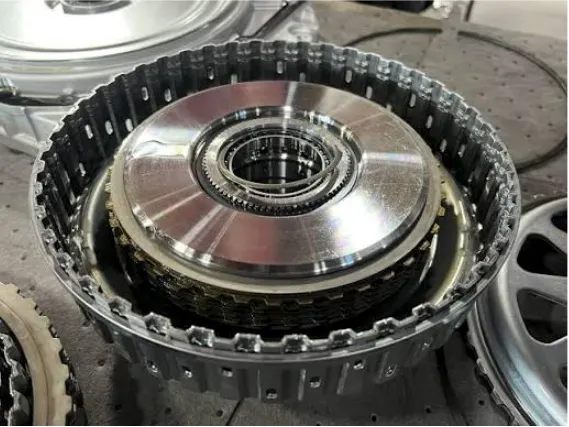
Inside the TR-9080’s five aluminum housings, the mechanical architecture follows the dual-shaft principle with precision-engineered helical gears. The two main input shafts, one carrying odd gears, one carrying even, are concentric (one runs inside the other), with the inner clutch connected to the outer shaft and vice versa. All main shaft gears remain in permanent mesh with mating gears on the counter shaft; no torque is transmitted through any given gear until a synchronizer sleeve is moved to lock that gear to its shaft.
Five triple-cone synchronizer assemblies handle this task, moved by computer-controlled electro-hydraulic actuator solenoids in the Synchro Activation Valve (SAV) body. Triple-cone synchronizers, which use three friction surfaces rather than one, provide faster, smoother engagement than single-cone designs and are particularly important in a DCT where pre-selection speed matters. From the counter shaft, torque exits through helical gears that drive the adjoining pinion shaft, which meshes with a spiral-bevel ring gear to deliver power to the differential.
The Brain: Transmission Control Module And Algorithms
The TR-9080 is governed by a standalone 32-bit Transmission Control Module (TCM) physically mounted in the C8’s rear passenger-side wheel well area — a location chosen to protect it from the heat generated by the drivetrain. Every aspect of the TCM’s hardware and software was developed entirely in-house by TREMEC, a point of considerable pride for the company and a direct legacy of the Hoerbiger acquisition.
The TCM continuously processes a stream of sensor data to determine optimal shift behavior. Inputs include vehicle speed (from three hall-effect speed sensors — two input sensors monitoring specific gear teeth, plus one output sensor), lateral g-force, longitudinal g-force, brake pressure, throttle position, steering angle, and the selected driving mode. The shift algorithms use model-based control strategies, building detailed real-time models of the transmission’s subsystems, clutch slip, synchronizer position, fluid temperature, and torque capacity, to calculate optimal torque targets for every shift event.
Adaptive And Predictive Shift Logic
Some of the TREMEC TR-9080’s most impressive capabilities come from its predictive behavior. The TCM is calibrated to anticipate driving scenarios and respond before the driver even makes a conscious input. During aggressive braking approaching a corner, for example, the system will begin downshifting earlier than a conventional automatic would, ensuring the engine is at the right RPM to provide both engine braking and immediate power when the driver begins to accelerate out of the bend. If the car is exiting a corner under high lateral g-force, the system will delay an upshift by holding the current gear to keep the engine in its torque peak for maximum traction off the apex.
The system also employs adaptive learning. The TR-9080 features a Fast Learn process, analogous to the adaptive clutch relearn procedures familiar to transmission technicians on GM’s conventional automatics, that characterizes the specific clutch pack behavior of each individual unit. This calibration must be performed after a transmission replacement, a clutch repair, or a TCM replacement, and requires reaching a specific fluid temperature range (140–212°F / 60–100°C) before the process can execute correctly.
Valve Bodies: The Hydraulic Control System
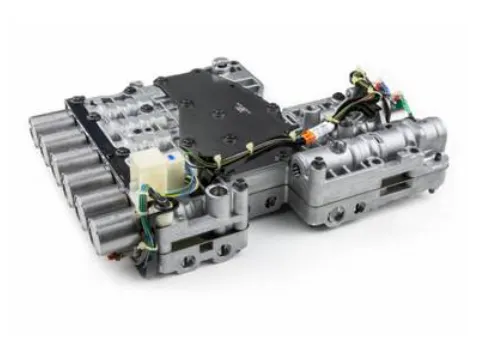
The TR-9080’s electro-hydraulic actuation system consists of two primary valve bodies working in concert. The Main Valve Body (MAV) contains eight solenoids and manages clutch engagement, cooling flow, and differential control. It houses three clutch pressure sensors (one for the odd clutch, one for the even clutch, and one for the eLSD), a temperature sensor, and a cascade of control valves handling clutch proportioning, pressure regulation, cooler bypass, and safety functions.
The Synchro Activation Valve Body (SAV) contains six electro-mechanical actuator solenoids responsible for moving the shift rails that engage the synchronizers. A pressure sensor on this body monitors overall line pressure. Mounted below the SAV are the odd and even sensor modules, each containing shift fork position sensors that provide the TCM with real-time feedback on synchronizer position — essential data for confirming a gear has been fully engaged before the corresponding clutch is applied. As with GM’s 8-, 9-, and 10-speed automatics, replacing either valve body requires programming the TCM with the new part’s unique flow rate values using its 22-digit Part Unique Number (PUN).
Launch Control And Burnout Mode
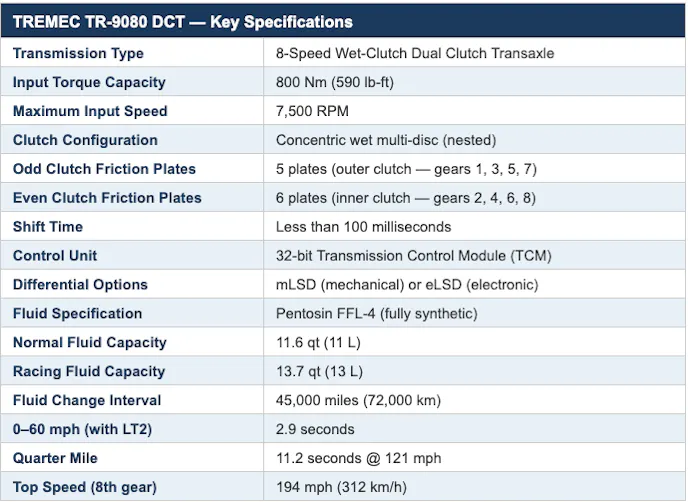
To achieve the C8’s claimed 2.9-second 0-to-60 mph time, the TR-9080 incorporates a sophisticated launch control system. During a launch control sequence, the engine is held at a fixed 3,500 RPM before the 1st gear clutch is engaged in a carefully managed slip event, optimizing wheel torque while minimizing wheelspin. Over-torque shifting, sometimes called torque boost, is employed during aggressive launches to temporarily command clutch engagement torque above the steady-state clutch capacity for brief periods, maximizing acceleration force.
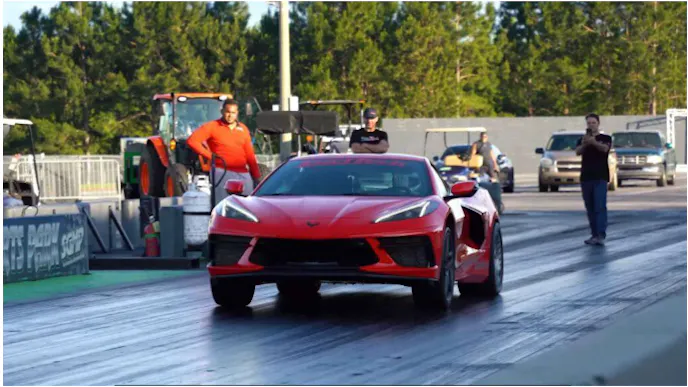
Perhaps the most viscerally satisfying feature is what Corvette engineers call “declutch mode” — and what many owners simply call burnout mode. When the driver pulls and holds both paddle shifters simultaneously, the TCM commands both clutches to release entirely, allowing the engine to build RPM freely while the car remains stationary (with the brakes applied). Releasing the paddles causes the clutch to engage, sending all available torque to the rear tires simultaneously. This feature, along with the standard burnout capability to warm the rear tires before a performance launch, reflects how seriously TREMEC and GM took the TR-9080’s role as a track-capable performance instrument.
The Integrated Differential
One of the TR-9080’s most elegant design achievements is its fully integrated differential, housed within the same aluminum casing and sharing the same fluid, pump, cooler, and filtration system as the rest of the transmission. This common-sump architecture eliminates the mass, cost, and complexity of a separate rear differential and dedicated lubrication system, yielding a more compact, lighter transaxle package.
Two differential variants are offered. The mechanical limited-slip differential (mLSD) is a clutch-type unit with predetermined bias profiles: a proven, robust design that distributes torque between the rear wheels based on fixed mechanical characteristics. The electronically controlled limited-slip differential (eLSD) is a more sophisticated epicyclic planetary differential with a normally open wet clutch. The eLSD can vary its locking ratio continuously and in real time based on driving mode, vehicle speed, steering angle, and lateral g-force. Both differentials use spiral-bevel gear designs, and both feature active, forced lubrication to ensure long-term reliability during sustained high-performance driving.
Thermal Management And Track Readiness
A transmission designed for a sports car that will be driven on track faces thermal challenges that street-only units never encounter. Sustained high-speed running, aggressive braking, and repeated launch sequences generate enormous quantities of heat in the clutch packs, synchronizers, and gear meshes. TREMEC’s engineering team drew directly from motorsport experience in developing the TR-9080’s thermal management strategy.
The oil management system was specifically designed to maintain flow to the clutches without generating constant parasitic drag. An active thermal management system, inspired by race car gearbox designs, modulates fluid flow rates to the clutch packs depending on their thermal state, prioritizing cooling when temperatures rise while minimizing pumping losses during normal driving. The oil management system was also optimized to withstand the extreme lateral and longitudinal gravitational forces that high-performance drivers encounter, ensuring adequate lubrication to all critical components even during sustained cornering or aggressive acceleration.
The recommended fluid is Pentosin FFL-4, a fully synthetic transmission fluid produced by Fuchs and available through AC Delco. Under normal driving conditions, the system holds 11.6 quarts (11 liters), but Corvette owners preparing their car for track use are advised to increase capacity to 13.7 quarts (13 liters) to provide additional thermal buffer during extended high-performance sessions. It’s worth noting that for 2024 and newer models, GM introduced a redesigned transmission case with updated baffling, meaning this additional “track fill” is no longer required.
The Driver Interface
Aware that removing the manual gearbox entirely risked alienating core Corvette enthusiasts, GM and TREMEC designed the TR-9080’s driver interface to deliver as much direct engagement as possible within an automated architecture. The C8’s shift selector is a modern button-style unit offering P, R, N, D, and M (Manual) positions.
In Drive mode, the TCM manages all shift decisions autonomously. In Manual mode, the driver takes control via carbon-fiber paddle shifters mounted to the steering column. In manual mode, the system will still automatically downshift as the car decelerates to a stop, preventing stalls — a concession to usability that preserves the driver-engagement experience without requiring constant intervention. Pulling and holding a single paddle while in manual mode commands the transmission to downshift to the lowest gear ratio appropriate for the current vehicle speed, effectively providing instant kick-down performance on demand.
The response is, by every account, exceptional. Early press reviews declared the system a success in terms of engagement, with the paddle-shift feel described as sharp, immediate, and communicative. Corvette chief engineer Ed Piatek noted that DCTs can change gears faster than any human can shift a manual transmission — and the TR-9080, with its sub-100-millisecond shifts, makes that statement in a way that is viscerally apparent from the driver’s seat.
Aftermarket Clutch And Drivetrain Upgrades
For owners chasing power well beyond the LT2’s factory output, the TR-9080’s clutch packs are the first component to reach their limit. Turbocharged and supercharged C8 builds pushing past roughly 700 to 1,200 wheel-horsepower will overwhelm the factory clutch stacks, and a small but capable aftermarket has emerged to address it. Dodson Motorsport’s Superstock upgrade adds extra friction plates to both the odd and even clutch stacks, raising torque capacity enough to safely support over 700 wheel-horsepower for street or track use, while the company’s more aggressive Sportsman’s and Promax kits, built around billet clutch baskets and upgraded friction materials, target heavily built engines producing anywhere from 900 to well over 1,200 wheel-horsepower.
Because the TR-9080’s integrated differential and clutch packs share a single fluid supply, builders pushing these upper limits typically pair a clutch upgrade with supporting hardware, most commonly a larger-capacity transmission sump pan for improved cooling and fluid volume, along with reusable metal-mesh filter canisters that improve filtration and flow under sustained high-load conditions.
Tuning and Calibration Access
For most of the C8’s production run, the TR-9080’s transmission control module remained effectively closed to independent tuners, a gap that stood in contrast to the extensive ECM tuning support long available for the LT2 engine itself. That changed in 2026, six years after the C8 DCT’s introduction, when HP Tuners announced calibration support for the Tremec T46 transmission controller across 2020-2026 Corvette C8 Stingray, Z06, E-Ray, and ZR1 applications. The release, delivered through HP Tuners’ MPVI4 and RTD4 interfaces, its VCM Suite software, and its remote-tuning TDN network, requires a new GM T46 TCM Upgrade Service performed on the vehicle’s original controller before transmission calibration access is unlocked. Once licensed, tuners gain read, edit, and write access to transmission calibrations through VCM Editor and transmission-specific data logging through VCM Scanner, allowing clutch engagement pressure, shift behavior, and other TCM parameters to be adjusted natively rather than through the external pressure-control boxes that had previously served as a workaround.
For the aftermarket clutch upgrades described above, this native calibration access effectively closes the loop, giving builders a direct, software-based path to properly tune the TR-9080 around their hardware changes rather than relying on piggyback controllers.
The TREMEC TR-9080 is more than a transmission — it is the product of a deliberate, multi-year convergence of mechanical engineering excellence and advanced mechatronics, built to satisfy the competing demands of a performance car, a daily driver, a fuel-economy achiever, and a track weapon simultaneously.
GM’s decision to build the C8 Corvette around this technology was initially controversial, and predictably so. The manual gearbox is deeply embedded in Corvette lore, and its absence felt, to some, like a betrayal. But the data told a different story, and the engineering team responded not by compromising but by raising the bar. In the TR-9080, they created a gearbox that shifts faster than the fastest human, thinks ahead of the driver, manages heat with the discipline of a race car, and delivers an overall driving experience that represents the apex of what a production sports car transmission can be.
Whether measured in shift times, torque capacity, thermal endurance, or the grin it puts on the face of anyone who mashes the throttle at highway speed, the TR-9080 DCT is, by any objective measure, an extraordinary engineering achievement — and the reason the C8 Corvette is not merely a good American sports car, but a genuine world-class supercar.
You might also like
Flowmaster American Thunder Exhaust Wakes Up Our 5.3L Silverado
We install a Flowmaster American Thunder cat-back on our 5.3L Silverado for classic V8 sound without annoying highway drone.