

Selecting the correct fuel injector size is one of the most critical — and most misunderstood — steps in building a high-performance engine. An injector that is too small will starve the engine of fuel at peak power, causing dangerous lean conditions. An injector that is too large will operate at very low duty cycles at idle and part throttle, making it nearly impossible to tune for good idle quality, throttle response, and emissions compliance.
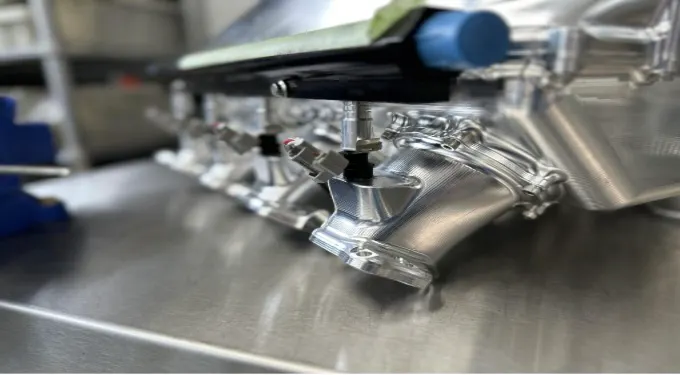
This article walks through the methodology used by professional engine builders and fuel system designers to calculate the correct injector sizing for port fuel injection (PFI) applications. The process considers:
- Target brake horsepower at the flywheel
- Fuel chemistry and its effect on Brake Specific Fuel Consumption (BSFC)
- Total system fuel flow requirements in pounds per hour (lb/hr)
- Parasitic power losses — particularly from forced-induction systems such as centrifugal superchargers
- Injector duty cycle limits to preserve injector longevity and tuning headroom
Step 1: Establishing Your Target Brake Horsepower
The starting point for any injector sizing calculation is the target brake horsepower (BHP). Brake horsepower is the power measured at the crankshaft, or flywheel, before any drivetrain losses are accounted for. Why Flywheel horsepower? Wheel horsepower (WHP) is lower than BHP because of friction losses in the transmission, driveshaft, differential, and axles. If you design your fuel system around WHP, you will undersize the injectors. Always use flywheel BHP as your baseline.
Step 2: Accounting for Parasitic Power Losses
An often-overlooked factor is the parasitic power consumption of forced-induction accessories. The engine’s pistons, combustion chambers, and fuel injectors do not “know” that some of the work they are doing goes toward spinning a supercharger rather than reaching the flywheel. From the fuel system’s perspective, the engine must burn enough fuel to produce the gross indicated power, which includes both the net flywheel power you want and the supercharger’s parasitic consumption. Designing injectors based only on the net target power will result in undersized injectors that cannot support peak power demand. The fuel system must be sized for gross power output, not just the net flywheel number.
Example: ProCharger F1-X Supercharger
Consider an engine targeting 1,200 BHP at the flywheel using a ProCharger F1-X centrifugal supercharger. The F1-X has a documented parasitic consumption of approximately 160–200 horsepower at full boost and high RPM. This means the injectors must be sized to support 1,360–1,400 BHP of gross fuel demand, even though only 1,200 BHP appears at the flywheel.
When in doubt, always use the higher parasitic loss estimate (200 horsepower for the F1-X in this example). Undersized injectors in a forced-induction application can cause catastrophic lean-out events. Slightly oversized injectors are far easier to tune around.


Step 3: Understanding Brake Specific Fuel Consumption (BSFC)
Brake Specific Fuel Consumption (BSFC) is the mass of fuel consumed per unit of power produced per unit of time, expressed in pounds of fuel per horsepower per hour (lb/hp·hr). It is a measure of an engine’s thermodynamic efficiency at converting the chemical energy stored in fuel into mechanical work at the crankshaft. BSFC is not a fixed constant; it varies with engine speed, load, combustion chamber design, ignition timing, air/fuel ratio, and critically, the type of fuel being burned. Using the wrong BSFC value will result in injectors that are either too small or wastefully large.

93-Octane Pump Gasoline
Gasoline is a blend of hydrocarbons with a stoichiometric air/fuel ratio (AFR) of approximately 14.7:1. At wide-open throttle (WOT) on a naturally aspirated engine, a rich power AFR of around 12.5:1–13.0:1 is typical. For turbocharged or supercharged applications, target AFR is often pushed richer to 11.5:1–12.5:1. Because gasoline is a relatively energy-dense fuel, engines require a comparatively modest mass of fuel per unit of power.
E85 (85% Ethanol Blend)
E85 is a blend of approximately 85% denatured ethanol and 15% gasoline. The stoichiometric AFR of pure ethanol is 9.0:1, and the blended stoichiometric AFR of E85 is approximately 9.7:1–9.8:1. Because E85 is burned at a much richer mixture relative to its stoichiometric ratio, and because ethanol has a significantly lower energy density than gasoline by mass, an engine running E85 must consume considerably more fuel mass to produce the same power.
M1 Methanol (Racing Methanol)
M1 methanol is pure methyl alcohol (CH₃OH) and is the fuel of choice in many forms of open-wheel racing, sprint car racing, and top-level drag racing. Methanol has a stoichiometric AFR of approximately 6.47:1, meaning the engine must ingest nearly twice as much fuel mass per unit of air compared to gasoline.
Methanol’s extremely high heat of vaporization (∼4.7× that of gasoline) provides enormous charge-cooling benefits, allowing very high compression ratios and boost pressures that would be impossible on pump gas. However, the consequences for injector sizing are dramatic — methanol demands fuel flow rates roughly double those of gasoline for equivalent horsepower output.

Step 4: Calculating Total Fuel Flow
With target power and BSFC established, the total fuel flow required by the engine is calculated using a straightforward formula. This gives the total mass of fuel the engine must consume per hour to produce the desired power.
FORMULA: Total Fuel Flow (lb/hr) = Gross Design Power × BSFC
Step 5: Applying the 80% Injector Duty Cycle Limit
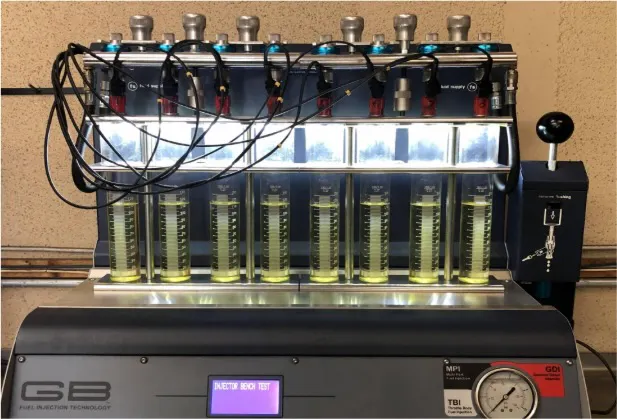
A port fuel injector is a solenoid-actuated device that opens and closes at a rate commanded by the engine control unit (ECU). Duty cycle (DC) is the percentage of time the injector is held open during each engine cycle. At 100% duty cycle, the injector transitions from a precisely-controlled pulsed device to a simple open orifice. The ECU loses the ability to make fine fuel adjustments, idle quality degrades dramatically, and the injector solenoid overheats from continuous current draw, leading to accelerated wear and premature failure. The industry-standard maximum operating duty cycle for port fuel injectors in a continuous high-performance application is 80%. This limit serves several critical functions:
- Controllability: The ECU retains the ability to increase or decrease fueling precisely, essential for closed-loop control, transient response, and safe operation.
- Thermal protection: Injector solenoids generate heat during operation. Keeping duty cycle at or below 80% provides necessary off-time for heat dissipation.
- Tuning headroom: Real-world conditions — altitude, fuel quality variation, temperature changes, and future power modifications — all require the ability to add more fuel.
- Fuel atomization: Proper injector opening and closing events ensure a well-atomized fuel spray. Near-static operation degrades the spray pattern and hurts combustion efficiency.
The 80% duty cycle limit directly increases the required injector flow rate. If the injector can only be commanded open 80% of the time, it must be physically capable of flowing enough fuel in that 80% window to meet the full fuel demand.
FORMULA: Min. Injector Flow (lb/hr) = [Total Fuel Flow ÷ No. Cylinders] ÷ 0.80
Worked Examples: 1,200 BHP Supercharged Engine
Using our example engine targeting 1,200 BHP at the flywheel with a ProCharger F1-X (200 HP parasitic loss) on an 8-cylinder engine, here is how the calculation works for each fuel type.


As noted, fuel consumption is significantly increased over pump gas. E85’s lower energy density by mass means the engine must consume roughly 45% more fuel to produce the same power output.

The methanol calculation illustrates the dramatic fuel system demands of this chemistry. Injectors rated at over 263 lb./hr. per cylinder are required — more than 2.7× the flow rate needed for the same power on pump gasoline.

When selecting an injector, always round up to the next commercially available size. A slightly larger injector operating at a slightly lower duty cycle is always preferable to one operating at its absolute limit.
Fuel Pressure Correction
Injectors are rated at a specific differential fuel pressure, most commonly 43.5 psi (3 bar) and 58 psi (4 bar) for most OEM and aftermarket performance injectors. When operating at a different fuel pressure, the effective flow rate changes. Flow rate scales with the square root of the pressure differential:

Always confirm that the injector flow rate you select matches the fuel pressure your system is designed to operate at, and account for any boost-referenced fuel pressure regulator that increases base fuel pressure proportionally with boost.
A Note on Idle Quality and Minimum Injector Pulse Width
While this article focuses on sizing injectors for maximum power, it is equally important to consider the minimum controllable fuel flow of the injector. At idle, the ECU commands very short injector pulses — as short as 0.8–1.5 milliseconds on some platforms. A very large injector (e.g., 250+ lb/hr) may deliver an excessive fuel mass even in this short a pulse, making idle tuning difficult or impossible on a street-driven vehicle. For dedicated race vehicles that do not require street idle quality, maximum power sizing is the primary concern. For street or street-strip builds, consider whether the minimum injector size required for your power target is still compatible with acceptable idle behavior, or whether a staged injection strategy might provide the best of both worlds.
The complete injector sizing formula, incorporating all factors discussed in this article:

The Four Pillars of Correct Injector Sizing
Sizing port fuel injectors for a high-performance application requires understanding the full picture of where power comes from, how much fuel each chemistry demands per unit of power, and what real-world mechanical demands are placed on the fuel system beyond just the engine itself.
- Flywheel BHP: Always design to flywheel power, never wheel power.
- BSFC and fuel chemistry: Gasoline, E85, and methanol require dramatically different fuel mass flows for the same power output. Use the correct BSFC for your fuel.
- Parasitic loss: Forced-induction accessories consume real horsepower. Size for the gross engine output required, not just the net flywheel number.
- 80% duty cycle limit: Never design to 100% duty cycle. The 80% cap protects injector reliability, preserves ECU control authority, and provides essential headroom for real-world variation.
Follow these four principles and the three-step calculation method outlined in this article, and you will arrive at a minimum injector sizing that is safe, tunable, and appropriately matched to your engine program, regardless of whether you are building a weekend warrior street machine or a purpose-built racing engine.
You might also like
Inside GM's Magnetic Ride Control: From Cadillac To The C8 Corvette
Magnetic Ride Control evolved from Cadillac innovation into the Corvette's high-tech suspension, delivering comfort and track-ready handling.