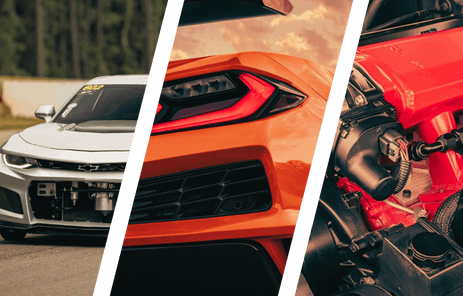

Making four-digit horsepower with a C8 Corvette is no longer the monumental undertaking it once was. Thanks to the aftermarket, boosted LT2 combinations are pushing well beyond 1,000 horsepower, with some of the wildest builds eclipsing 1,300 at the wheels. Unfortunately, as we explored in Part 1, making that kind of power is only half the battle. Getting it through the factory Tremec TR-9080 eight-speed dual-clutch transmission without breaking something is where things get interesting.
The good news is that the aftermarket isn’t sitting around waiting for GM or TREMEC to come up with a solution. The pros at Pure Drivetrain Solutions are developing stronger clutch assemblies, upgraded internal components, and improved control strategies to help the TR-9080 survive well beyond its original design parameters. In Part Two, we’re taking a closer look at those upgrades, the company behind them, and what it takes to make the C8 Corvette’s transmission as capable as the engines enthusiasts are building.
The Aftermarket Answers
Each failure now has an aftermarket answer, arriving in the same order as the problems.
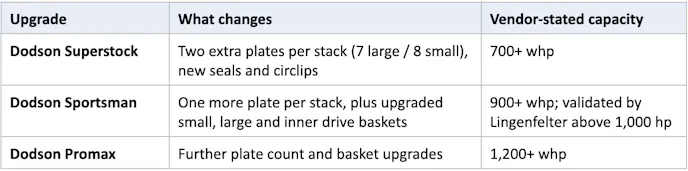
Clutches came first. Dodson Motorsport’s kits, sold through tuners such as Lingenfelter and built on the customer’s core assembly, add friction area and strengthen the baskets. GPZ friction material helped Extreme Turbo Systems become the first to pass 1,000 hp in a C8.
Calibration followed. On July 7, 2026, HP Tuners announced support for the T46 TCM across 2020–2026 Stingray, Z06, E-Ray, and ZR1, with the Grand Sport and Grand Sport X pending. After a GM upgrade service on the original module, tuners can directly edit clutch and shift pressures, the torque-limit tables that gate higher-pressure regions, launch and roll-on slip, launch RPM and engagement rate, and shift scheduling. On one Paragon Performance test car, stock calibration showed visible slip on the 2-3 and 3-4 shifts; a custom map raised clutch pressure and cleaned up every shift, including the stubborn 4-5. The voodoo era is over, though the balance remains: too little pressure slips, too much makes shifts harsh.
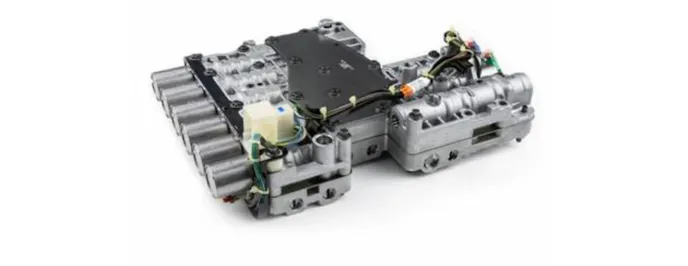
Clutches that hold and a controller that will clamp them are exactly what expose the hard parts. Until recently, nobody was building those.
Pure Drivetrain Solutions: Building What TREMEC Didn’t
One person who has found that limit happens to own one of the industry’s leading transmission builders. Chris Miller owns Pure Drivetrain Solutions (PDS), known for some of the most robust 8- and 10-speed transmissions on the planet, and is now focused on the TR-9080. PDS says it is the first company to design and develop internal hard parts for the TREMEC.
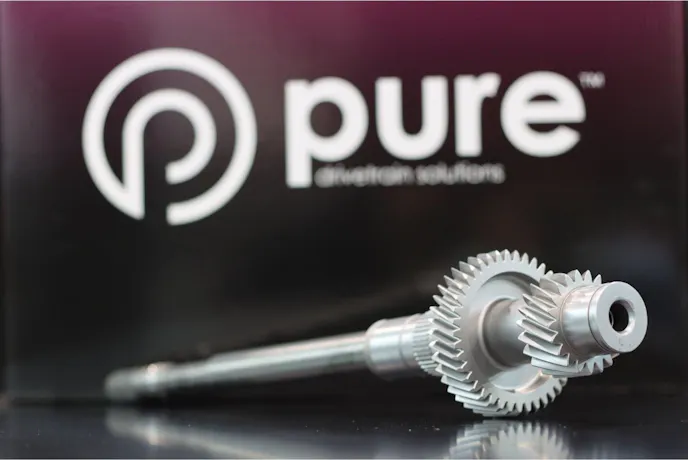
The program grew out of Miller’s own garage. His 2025 Stingray Z51 is built to be capable of 1,600 horsepower, and running a true 1,300-plus wheel horsepower has broken the input shafts in three of his own low-mileage TR-9080s. The failures described earlier are his: tearing those transmissions down revealed the cracked fifth gears in two of them.
A Clutch Program, Shelved And Restarted
PDS’s history with the TR-9080 actually starts with the clutch. Several years ago, it invested heavily in upgraded clutch assemblies, then stepped away. Miller was constantly fighting the factory calibration over clutch pressure, torque management, engagement, and adaptive strategies, and he wasn’t comfortable selling hardware the factory controller couldn’t reliably support.
TCM access changed that. With proper calibration, Miller says, the factory clutch now supports roughly 800 wheel horsepower, impressive given what it was designed for. From there, PDS developed its Stage 2 clutch assembly, now being tested in his development Stingray at about 1,350 wheel horsepower. He expects it to support about 1,400 wheel horsepower, but he would rather find its real limit on the car than assign an arbitrary rating.
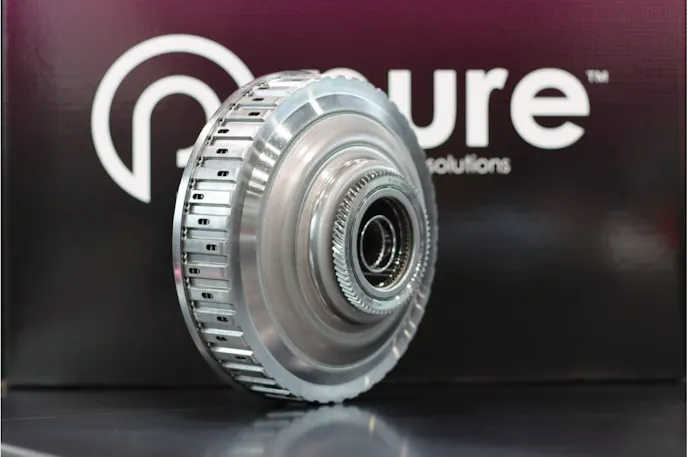
That reluctance comes from how clutches actually work. Capacity is a function of apply pressure, effective friction area, coefficient of friction, mean friction radius, and the number of active friction faces. Horsepower alone doesn’t set it; engine torque, slip, heat load, and calibration all play a part. Miller sees Stage 2 as the package that will serve most PDS customers, with a large jump in torque capacity and durability at a reasonable price.
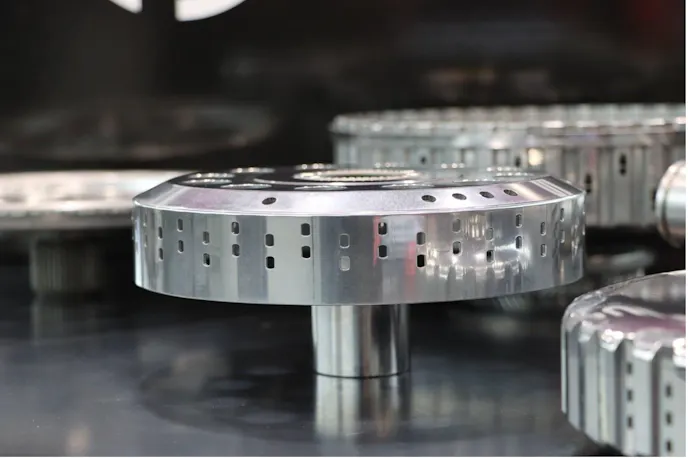
A Stage 3 clutch is already built. It adds an all-new billet clutch basket and piston assembly to address limits beyond the friction material: structural rigidity, clutch pack geometry, piston stability, and consistent apply under much higher loads. PDS won’t install it until Stage 2 has genuinely run out of capacity.
What The Friction Material Leaves Behind
Miller has spent as much time on what a clutch sheds as on what it holds. Having studied the TR-9080’s valve bodies, hydraulic circuits, and solenoids himself, he worries that some aftermarket clutch makers still use friction formulations proven in older automatics. Those had large passages and forgiving controls. The TR-9080 and modern 10-speeds use tiny metering orifices, precision valve bores and tight-clearance pressure-regulating solenoids. Miller likens them to modern high-pressure fuel injection, where minor contamination causes real trouble.
Depending on its composition, bonding system, and response to repeated heat cycles and engagements, a friction material can shed microscopic particles into the fluid. Some are fine enough to pass through the filter or bypass it under certain conditions. In circulation, they can foul solenoids, build deposits in valve bores, stick valves, and upset pressure regulation, which ultimately compromises clutch control.
The trap is timing. A transmission can shift perfectly for several thousand miles before intermittent hydraulic problems appear and progressively worsen. When it is finally torn down, the contaminated solenoids and sticking valves are obvious, but the clutch material that seeded them may no longer look like the culprit.
That is why PDS has evaluated clutch construction, wear behavior, particle generation, and material chemistry, including independent third-party analysis of friction materials. Static coefficient of friction is only part of the target. Dynamic friction, thermal stability, compressibility, wear rate, debris generation, and long-term compatibility with the hydraulics matter just as much. A clutch that holds huge power for a few dyno pulls means little to Miller if it eventually helps kill the transmission.
Engineering The Shaft And Gears
The input shaft looked straightforward until its two integral gears entered the picture. A standalone shaft could be optimized purely for tensile and yield strength, torsional fatigue resistance, and fracture toughness. A shaft that is also two gears has to do two very different jobs. The shaft needs core strength and toughness to survive torsional, shock, and cyclic fatigue loads. The gear teeth need high surface hardness and resistance to contact fatigue, pitting, scuffing, and tooth-root bending fatigue. Those requirements don’t always favor the same material or heat treatment.
PDS usually starts extreme-strength shafts in 300M steel, and Miller weighed maraging steels and other specialty alloys. For this part, he chose 9310 instead. The alloy has a long history in heavily loaded aerospace and motorsports gears because it combines a hard, wear-resistant carburized surface with a comparatively tough, ductile core. Carefully controlled carburizing, quenching, and tempering give the teeth a case that resists contact fatigue while keeping the core tough enough for torsional shock and cyclic loading.
Miller stresses that the alloy name alone doesn’t decide how the finished part performs. Case depth, carbon gradient, retained austenite, residual stress, and the transition from case to core all matter. Too much hardness or case depth in the wrong place invites brittleness and cracking, and too little costs tooth durability. Send five pieces from the same batch of steel to five heat treaters, he says, and you can get five different parts, because austenitizing temperature, soak time, quench severity, tempering, and finishing all shape the final microstructure. The difference between a part that survives extreme power and one that fails early often comes down to those details.
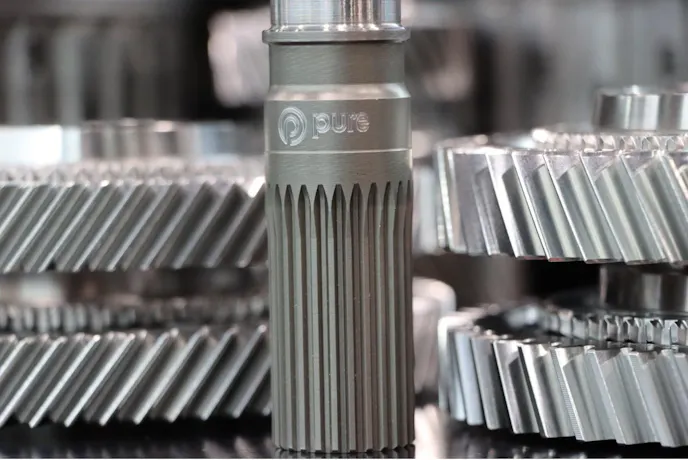
PDS has spent years refining its own thermal processing, and it is also working on tooth geometry, root stress concentration, surface finish, and residual compressive stress. The aim is better torsional, bending, and contact fatigue resistance without giving up the toughness that real high-horsepower use demands. In Miller’s view, the material with the highest advertised tensile strength doesn’t automatically make the strongest part; material, geometry, heat treatment, and microstructure have to work together.
The Rest Of The Program
The first hard-parts package came together as a chain reaction. The broken input shaft was the starting point, but first and third gears are machined into that shaft, so a new shaft meant new first and third gears, and new countershaft gears to mesh with them. On the countershaft side, fifth gear was the one cracking, and it is a single piece with seventh. Replacing that piece forced PDS to make new input-side fifth and seventh gears to match. What began as a shaft replacement became the complete odd input shaft with both sides of the first, third, fifth, and seventh gear sets. Miller says the package also addresses several other issues the team found during teardown. Having gone that deep, PDS drew prints and built 3D models of the entire TR-9080, and plans to make 2/4/6/8, the transfer gears, and the ring and pinion as power climbs.
Around the transmission, PDS is developing upgraded axle stubs, axles, transmission pans, filtration, and differential covers, plus projects Miller isn’t ready to discuss. Each starts by identifying the real mechanical or operational limit, then engineering around rigidity, material, heat, lubrication, hydraulic efficiency, fatigue life, and serviceability rather than building something that merely looks stronger than stock. Miller believes the platform has a tremendous amount of untapped potential, and PDS has invested heavily in the parts to support where the market is headed.
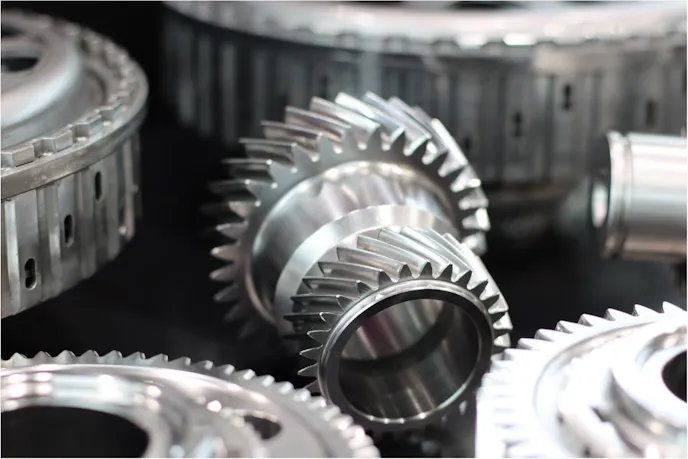
Testing happens on PDS’s own hardware. Beyond his Stingray and its broken transmissions, Miller bought two used Z06 gearboxes and a new ZR1X gearbox from GM, ordered the moment his own ZR1X got a VIN. A Grand Sport X is also on order. PDS proves its parts on its own cars, Miller says, rather than doing what other companies do and using customers’ cars for research and development. He has never cared about rushing to be first. Anyone can make a part stronger on paper; the real work is a part that performs consistently, survives the abuse, and doesn’t create new problems elsewhere.
The Bottom Line
The TR-9080 is a well-engineered transaxle built for a 495 HP car, and the aftermarket has more than doubled that. Its failures arrive in order: the clutch slips, the controller won’t clamp it, and then the shafts and gears give way.
The first two problems now have mature answers in bigger clutch packs and native TCM calibration. The third is new ground, and Pure Drivetrain Solutions is among the first to break it, with clutches, hard parts, and supporting components engineered as a system and proven on its owner’s own cars. For C8 enthusiasts chasing four-digit power, the transmission has become a system to be built rather than a box to be ignored.
You might also like
Stripped LS Block Threads? ARP's Block Saver Kits Can Save The Day
Stripped threads don't have to mean a junk LS block. ARP's Block Saver Kits offer a stronger solution for damaged head and main cap threads.